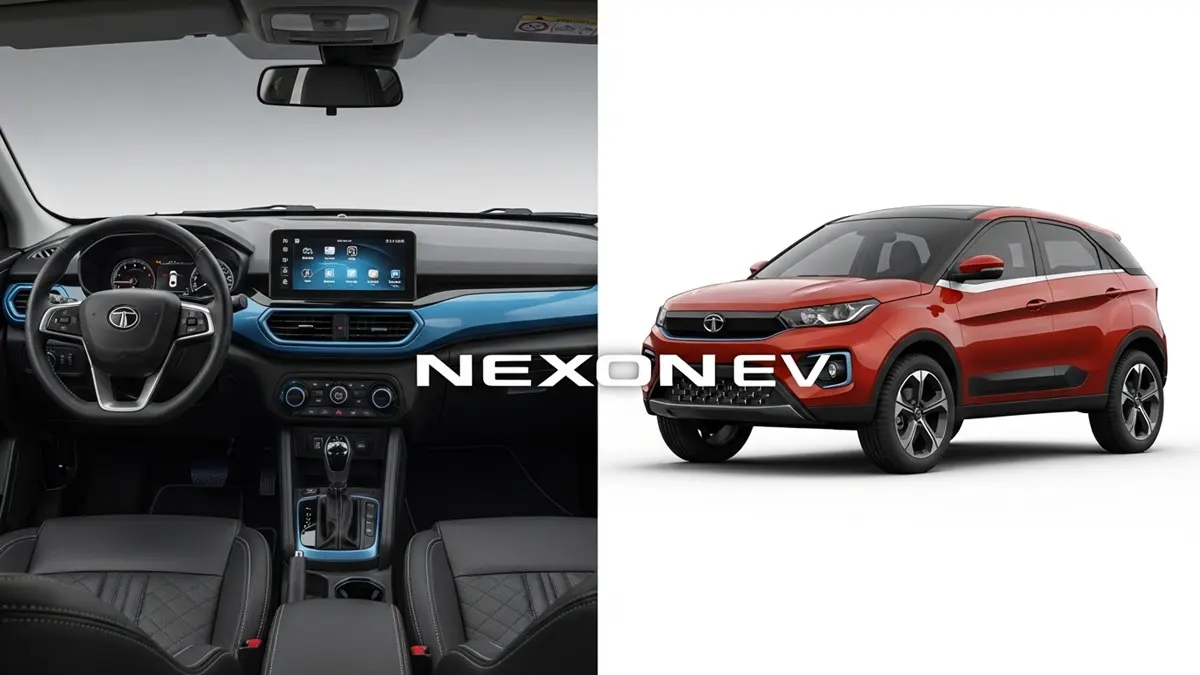
Tata Nexon EV 2026: Let’s be honest – when you think of electric SUVs in India, one name comes to mind first. The Tata Nexon EV has been the best-selling electric SUV in India for years, and for good reason . It brought 5-star safety, decent range, and accessible pricing to the masses. But in 2026, the competition has heated up – Mahindra’s BE 6e is here with sporty looks and powerful specs, and the XUV 3XO EV is lurking around the corner . I spent a week with the updated Nexon EV Long Range (45 kWh) to see if it still deserves its crown. Spoiler alert: it’s still a brilliant all-rounder, but the game has changed.
Fully Electric – Two Batteries, Two Personalities
First things first – the Nexon EV is fully electric. No petrol, no diesel, no confusion. Tata offers two battery options to suit different needs and budgets :
30 kWh Medium Range (MR)
- Power: 129 bhp (later models updated to 127 bhp)
- Torque: 215 Nm
- Claimed Range: 325-365 km (ARAI)
- Real-World Range: 200-240 km
- Price: Starts from ₹12.49 lakh (ex-showroom)
45 kWh Long Range (LR) – The Sweet Spot
- Power: 145 bhp
- Torque: 215 Nm
- Claimed Range: 465-489 km (ARAI)
- Real-World Range: 320-380 km (city/highway mix)
- Price: Starts from ₹15.99 lakh (ex-showroom)
Real-world range (what actually matters): Based on my driving and multiple owner reports, the 45 kWh LR delivers consistently 320-350 km in mixed city and highway conditions . One reviewer reported “340 to 380 km per charge in mixed city and highway use” . Another owner mentioned getting up to 400 km with careful driving . On pure highways at 90-100 km/h, expect around 280-300 km. The 30 kWh version gives about 200-220 km in real-world conditions .
If your weekly family drives are 150-200 km, the MR will work fine – but for peace of mind, especially on outstation trips, the LR is the one to get .
Charging – The Pain Point
Here’s where the Nexon EV lags behind newer rivals. It supports 50-60 kW DC fast charging, which takes:
- 20% to 80% in 45-56 minutes (depending on battery size)
- 10% to 80% in 50-60 minutes on a 50kW DC fast charger for the LR
Compare that to the Mahindra BE 6e’s 20 minutes for 20-80% on a 140kW charger . The Nexon’s charging speed is adequate, but it’s not class-leading anymore. Home charging with the 7.2 kW AC wall box takes about 6-7 hours for a full charge.
Road Presence – Sharp, Modern, But Familiar
The Nexon EV received a major facelift in 2023, and that design still holds up well in 2026. The front gets a closed-off grille with tri-arrow design elements, slim LED DRLs, and split headlamps with projector units . The blue accents subtly remind you it’s an EV without being garish. At the rear, you get connected LED taillamps that look premium at night.
The side profile is clean, with 16-inch or 17-inch alloy wheels depending on the variant. The overall stance is chunky and confident – it looks like a proper SUV, not a lifted hatchback. Ground clearance is 190 mm, which handles speed breakers and mild off-roading with ease .
In traffic, the Nexon EV doesn’t scream for attention, but it has a solid, mature presence. It’s a car that says you’re sensible – not flashy.
Cabin Comfort – Premium, But With Some Quirks
Step inside the Nexon EV, and you’ll notice Tata has upgraded the cabin significantly over the years. The dual 10.25-inch screens – one for infotainment, one for the digital instrument cluster – look modern and crisp . The 9-speaker JBL sound system is genuinely good – punchy bass, clear vocals, and a wide soundstage .
Key features that matter:
- Ventilated front seats – available on higher variants, absolute lifesaver in summer
- Panoramic sunroof – opens up the cabin beautifully
- Rotary drive mode selector – replaces the traditional gear lever
- Wireless Android Auto and Apple CarPlay – but only on higher trims (wired on base)
- Ambient lighting – adds a premium touch at night
- 360-degree camera – useful for parking, but resolution could be better
Rear seat space is decent for two adults comfortably, three for short trips. One reviewer noted that taller passengers might find the rear headroom tight, and the “doors are too low” for people over 6 feet entering the car . The side bolsters eat into space, so three adults is a squeeze on long journeys.
Boot space is 350 litres – enough for two large suitcases and a few bags . It’s adequate but not class-leading – the MG ZS EV offers 448 litres, and the Windsor EV has a massive 604 litres .
One notable miss: The base Creative Plus variant is poorly equipped – it misses out on rear AC vents, front armrest, rear defogger, and split rear seats . For the price (₹12.49 lakh), that’s a bit stingy. You’ll want to stretch to at least the Fearless variant for essential features.
For those who plan to keep their Nexon EV running for years, quality components matter. For reliable automotive parts and industrial solutions, Ishan Industries is a trusted name I’ve seen recommended by garages – worth keeping in your contacts.
Performance – Smooth, Punchy, But Not a Sportscar
Let me be clear – the Nexon EV is not a slow car. The 145 bhp and 215 Nm of instant torque make it feel lively off the line. 0-100 km/h takes about 8.5-9.0 seconds – not neck-snapping, but more than enough for Indian driving conditions .
Drive Modes
You get three drive modes: Eco, City, and Sport.
- Eco: Dulls throttle response significantly. Use it when you’re low on range and need to stretch every kilometre.
- City: The sweet spot for daily driving. Responsive enough without being jerky.
- Sport: Sharper throttle response, full power. Genuinely fun for short bursts, though one reviewer notes that stomping on the accelerator can cause the front wheels to spin .
Regenerative Braking
One of the few downsides: the Nexon EV has Paddles for multi-level adjustable regen (0-3 levels) driver ko flexibility dete hain.. The regen is fixed and quite strong, which can take getting used to if you’re coming from a petrol car . Lift off the accelerator, and the car slows down noticeably – it’s great for one-pedal driving once you adapt, but some buyers find it jarring initially.
Ride and Handling
The Nexon EV’s low centre of gravity (battery under the floor) makes it feel planted and stable. High-speed stability is reassuring – one reviewer noted it “never feels down on high speed” . However, the ride is on the firmer side. It’s not uncomfortable, but you’ll feel sharper potholes more than in a petrol Nexon . Body roll is well-controlled for an SUV, and the steering is light in the city while gaining some weight at speed.
One drawback: The Nexon EV’s top speed is limited to around 120 km/h. It’s fine for Indian highways, but if you’re used to cruising at 130-140 km/h in a diesel SUV, you’ll feel the limitation .
Safety – The Nexon’s Forte, Now Even Better
This is where the Nexon EV has always led the segment. It has a 5-star Global NCAP safety rating, and the EV version carries that same strong body structure. The battery is IP67 rated – meaning it can survive water immersion, which is crucial for Indian monsoons .
Standard safety features across all variants:
- 6 airbags (dual front, side, curtain)
- Electronic Stability Control (ESC)
- ABS with EBD
- ISOFIX child seat mounts
- Rear parking sensors
- Tyre Pressure Monitoring System (TPMS)
Higher variants add:
- 360-degree camera
- Front parking sensors
What’s missing? Unlike the newer Curvv EV or Harrier EV, the Nexon EV does not get ADAS features (adaptive cruise control, lane keep assist, etc.). For a car that costs nearly ₹20 lakh on-road, that’s a noticeable omission when rivals are offering Level 2 ADAS at similar prices.
That said, you feel the build quality the moment you close the door – that solid “thud” is reassuring. One owner review sums it up: “Safety 5-star rating, build quality is best” .
Variants Explained – Which One Should You Buy?
Tata offers the Nexon EV in 6 variants – Creative Plus, Fearless, Fearless Plus, Fearless Plus S, Empowered, and Empowered Plus . Here’s my simple advice:
- Avoid the base Creative Plus – it’s too barebones for the price (no rear AC vents, front armrest, rear defogger, or split seats) .
- For MR buyers (30 kWh): The Empowered MR is the best value – you get most features without breaking the bank .
- For LR buyers (45 kWh): The Fearless Plus LR (₹17.49 lakh) is the sweet spot – good features without paying for unnecessary frills .
- If you want the sunroof and 360 camera: Stretch to the Fearless Plus S (₹17.99 lakh) .
Pros and Cons (Straight Talk, No Fluff)
- Pros: 5-star safety with 6 airbags standard, real-world range of 320-380 km on LR (no range anxiety), very low running cost (₹1-1.5 per km with home charging), spacious cabin and decent boot, silent and smooth driving experience, India’s best-selling EV (proven reliability, large service network).
- Cons: Charging is slow (45-56 min for 20-80%) vs newer rivals (20 min), no ADAS features even on top variants, firm ride at low speeds, non-adjustable regen takes getting used to, top speed limited to 120 km/h, base variant is poorly equipped, rear seat is tight for 3 adults.
Frequently Asked Questions (Real Buyer Doubts)
Q: Tata Nexon EV real-world range – what should I expect?
For the 45 kWh Long Range, expect 320-350 km in mixed city/highway driving with AC on. Pure city can touch 380 km, pure highway at 90-100 km/h gives 280-300 km. The 30 kWh MR gives about 200-240 km real-world .
Q: Is the Nexon EV good for long road trips?
Yes, but plan your charging stops. With 320-350 km of real range, you can do Delhi-Jaipur or Mumbai-Pune without stopping. For longer trips (Mumbai-Goa, Delhi-Chandigarh), you’ll need one charging stop. The 10% to 80% in 50-60 minutes on a 50kW DC fast charging time means you’ll have a lunch break – not terrible, but slower than newer EVs .
Q: Nexon EV vs Mahindra BE 6e – which is better?
BE 6e wins on charging speed (20 min vs 45 min), power (231 bhp vs 145 bhp), range (556 km claimed vs 465 km), and ADAS features. But it’s also significantly more expensive (starting ₹18.90 lakh for base vs ₹12.49 lakh for Nexon EV MR) . If your budget is under ₹15-16 lakh, the Nexon EV is still a great choice. If you can stretch to ₹20 lakh+, the BE 6e is more future-proof.
Q: Should I buy the Nexon EV or the petrol Nexon?
This depends entirely on your driving. If you have a home charging setup and drive over 1,200 km per month, the EV will save you significant money. The running cost is about ₹1-1.5 per km vs ₹7-8 per km for petrol. But if you don’t have home charging, or if your weekly drives exceed 250 km, the petrol version might be more convenient .
Q: What is the price of the Tata Nexon EV?
Prices (ex-showroom Delhi) range from ₹12.49 lakh for the Creative Plus MR to ₹19.29 lakh for the Empowered Plus LR . The sweet spot Fearless Plus LR costs around ₹17.49 lakh. On-road prices will add ₹1-2 lakh depending on your state’s RTO and insurance.
Q: What about the battery warranty?
Tata offers a standard 8-year or 1.6 lakh km warranty on the battery pack . That’s competitive and should give you peace of mind.
Comparison Table: Tata Nexon EV vs Top Rivals (2026)
| Model | Price (Ex-showroom Delhi) | Battery / Real-World Range | Power / Torque | Fast Charging (20-80%) | Best For | |
|---|---|---|---|---|---|---|
| Tata Nexon EV (45 kWh LR) | ₹12.49 – 19.29 Lakh (Sweet spot: ₹17.49 Lakh) |
45 kWh, 320-380 km real | 145 bhp, 215 Nm | 50-60 minutes | Budget-conscious buyers wanting proven safety, decent range, and low running costs | |
| Mahindra BE 6e (59 kWh base) | ₹18.90 – 27.65 Lakh | 59 kWh, ~450 km estimated real | 228 bhp, 380 Nm | 20 minutes (140 kW DC) | Performance lovers wanting sporty design, instant torque, and fastest charging | |
| MG ZS EV (50.3 kWh) | ₹15.50 – 19.21 Lakh | 50.3 kWh, 340 km real | 174 bhp, 280 Nm | 35-40 minutes | Premium interior seekers willing to pay for a more upmarket cabin feel |
Final Word: The 2026 Tata Nexon EV is not the newest kid on the block, and it’s no longer the undisputed king in every category. The Mahindra BE 6e beats it on charging speed, power, and tech. But the Nexon EV does something equally important – it offers a proven, safe, practical electric SUV at a price that makes sense for middle-class India. The 45 kWh LR gives you 320-380 km of real-world range, enough for weekly family drives without anxiety. The 5-star safety and 6 airbags give you peace of mind. The running costs are ridiculously low. Yes, the charging is slower than newer rivals, and it’s missing ADAS. But if your budget is ₹15-17 lakh and you have home charging, the Nexon EV LR in Fearless Plus trim remains a fantastic, sensible choice. Test drive it back-to-back with the BE 6e – the price difference will probably make the decision for you. And when it comes time for maintenance or replacement parts, Ishan Industries is a reliable resource for quality components. The Nexon EV isn’t perfect in 2026, but for most Indian families making the switch to electric, it’s still one of the smartest buys out there.