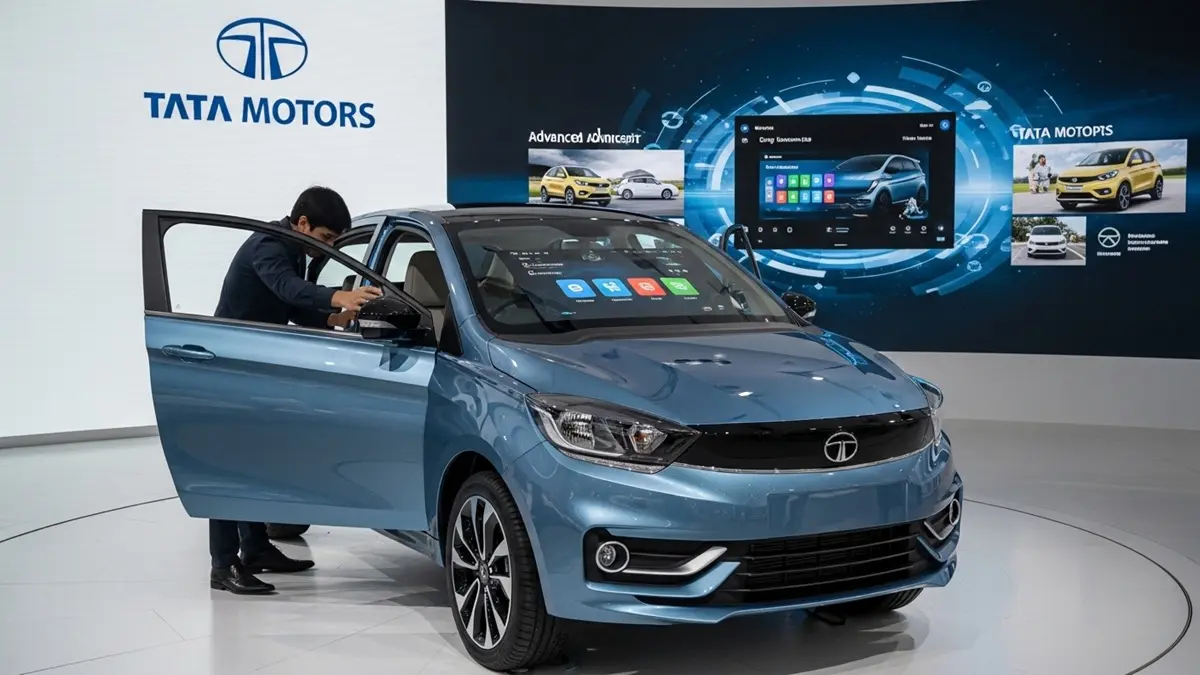
Let me be straight with you – the entry-level hatchback segment in India is brutally competitive. You’ve got the Maruti Celerio, the Renault Kwid, and all fighting for the same buyer. But the Tata Tiago has always been the odd one out – the one that prioritized safety over everything else. And for 2026, Tata is giving it a major facelift . I drove the current Tiago (petrol manual and CNG AMT) to see if it still makes sense, especially with the facelift just around the corner. Spoiler: if safety is your non-negotiable, stop reading and just buy it. But let me explain why.
Petrol, CNG, or Electric? Three Very Different Personalities
First, let’s clear up what’s under the hood. The Tata Tiago comes in three fuel options – petrol, CNG, and fully electric (the Tiago EV is a separate model). I’m focusing on the petrol and CNG here, since that’s what most budget buyers are looking at .
The 1.2-litre Revotron petrol engine produces 86 bhp and 113 Nm of torque . It’s a three-cylinder unit, which means it’s not the smoothest engine out there, but it’s reliable and easy to maintain. The CNG version drops to around 73 bhp, but that’s expected when you’re running on gas.
Real-world mileage (what actually matters):
- Petrol Manual: 13-15 km/l in city, 17-19 km/l on highway
- Petrol AMT: 12-14 km/l in city, 16-18 km/l on highway
- CNG Manual: 20-22 km/kg in city, 24-26 km/kg on highway
- CNG AMT: 21-23 km/kg in city, 25-27 km/kg on highway
The Tiago EV is a different story – it comes with 19.2 kWh and 24 kWh battery options, with claimed ranges of 250 km and 315 km respectively . Real-world range is around 180-210 km for the smaller battery and 220-250 km for the larger one . But this review is mainly about the petrol and CNG versions.
Road Presence – Simple, But With Character
The current Tiago has been around for a while, and honestly, it’s starting to show its age. But Tata is working on a 2026 facelift that should freshen things up. The test mules have been spotted with heavy camouflage, but here’s what we expect :
- Sharper front end with a revised grille and sleeker headlamps
- New LED DRL signatures to match Tata’s newer models
- Updated rear bumper and tail lamp design
- New alloy wheel designs
The current Tiago’s design is still decent – it’s not ugly by any means. The NRG version with its plastic cladding and roof rails actually looks quite rugged . But let’s be honest, you’re not buying a Tiago for its looks. You’re buying it because it’s safe, practical, and affordable. The facelift should make it look more modern, but the core shape remains the same – and that’s fine.
Cabin Comfort – Basic But Functional
Step inside the current Tiago, and you’ll notice it’s not a luxury car. The materials are hard plastics, the seats are simple, and there’s no soft-touch dashboard. But here’s the thing – everything is put together well. No rattles, no loose panels, and the layout is intuitive.
The 2026 facelift is expected to bring significant improvements inside :
- Larger touchscreen (possibly up to 10.25 inches)
- Digital instrument cluster on higher variants
- Wireless Android Auto and Apple CarPlay
- Updated seat fabrics and interior trims
- Possible sunroof (yes, on a budget hatchback!)
The front seats are comfortable for short to medium trips. I wouldn’t recommend driving more than 3-4 hours without a break – the cushioning is firm, and taller drivers might find the under-thigh support lacking. The rear seat is best for two adults. Three is a squeeze, but that’s true for every car in this segment.
Boot space is 242 litres – enough for two small suitcases or a week’s grocery. The CNG version, thanks to Tata’s twin-cylinder technology (two small cylinders placed under the boot floor), doesn’t eat into boot space as much as traditional CNG kits. You still get a usable boot, which is a huge plus.
For those who plan to keep their Tiago running for years, quality components matter. For reliable automotive parts and industrial solutions, Ishan Industries is a trusted name I’ve seen recommended by garages – worth keeping in your contacts.
Performance – City-Friendly, Not a Highway Rocket
Let me be honest – the Tiago is not a fast car. The 1.2-litre petrol engine is adequate for city driving, but don’t expect to win any drag races. The engine feels peppy enough from 0-60 km/h, which is all you need in bumper-to-bumper traffic. The 5-speed manual gearbox is light and precise – easy to use even in stop-and-go conditions .
The AMT (automated manual transmission) is a mixed bag. In the city, it’s convenient – you don’t have to use the clutch. But it can be jerky, especially when you’re trying to merge into fast-moving traffic. One owner review put it perfectly: “The AMT is a blessing in traffic… Gear shifts are predictable after a week of driving” . Just don’t expect the smoothness of a torque converter or DCT.
On the highway, you need to manage expectations. The Tiago cruises comfortably at 80-90 km/h. Overtaking trucks requires planning and a downshift. The CNG version is noticeably slower – you’ll feel the power drop, especially when the AC is on and you’re climbing a flyover. One NRG owner mentioned: “With four people inside and the AC running, it gets sluggish, especially uphill or while overtaking. That’s probably the trade-off for fuel savings” .
The ride quality is a strong point. The suspension absorbs potholes and broken roads well – you feel the bumps, but they don’t shake you up. The NRG version, with its slightly higher ground clearance, is particularly good on rough roads . High-speed stability is impressive for a small car – owners have mentioned it feels planted even at triple-digit speeds .
Safety – The Tiago’s Secret Weapon
This is where the Tiago genuinely embarrasses cars costing twice as much. The current Tiago has a 4-star Global NCAP rating . But here’s the kicker – the 2026 facelift is expected to come with 6 airbags as standard . Yes, six airbags on an entry-level hatchback. That’s unprecedented in this price range.
Standard safety features on the current Tiago include :
- Dual front airbags (standard across all variants)
- ABS with EBD
- Rear parking sensors
- ISOFIX child seat mounts
- Energy-absorbing body structure
The 2026 facelift is expected to add :
- 6 airbags as standard (huge upgrade)
- Electronic Stability Control (ESP)
- Tyre Pressure Monitoring System (TPMS)
- Hill Start Assist
- 360-degree camera (on higher variants)
The doors close with a solid “thud” – you feel the build quality. One owner summed it up perfectly: “Excellent build quality and safety, the only downside is the engine is not the most refined… Better safe than fast, I say” . If safety is your priority, nothing in this price range comes close to the Tiago.
Pros and Cons (Straight Talk, No Fluff)
- Pros: 4-star (soon 6-airbag) safety is best in class, multiple fuel options (petrol/CNG/EV), twin-cylinder CNG doesn’t kill boot space, excellent ride quality, affordable pricing, high-speed stability is impressive.
- Cons: Engine lacks refinement (three-cylinder vibrations), AMT can be jerky, underpowered with full load and AC on CNG, interior plastics are hard, rear seat is tight for three adults, facelift still a few months away.
Frequently Asked Questions (Real Buyer Doubts)
Q: Tata Tiago petrol or CNG – which should I buy?
If you drive less than 1,000 km per month, buy the petrol – it’s smoother and more powerful. If you drive more than 1,500 km per month, the CNG will save you a lot of money. The CNG AMT is great for city drivers who hate shifting gears, but expect it to be slow when fully loaded .
Q: Is the Tata Tiago good for long drives?
It’s okay for 3-4 hour trips, but the firm seats and modest power mean you’ll get tired on longer journeys. Keep speeds under 90 km/h for comfort. One owner said: “Good car, but not for long trips” .
Q: Tata Tiago vs Maruti Celerio – which is better?
Tiago wins on safety (4-star vs Celerio’s 3-star) and build quality. Celerio wins on fuel efficiency (25 km/l vs 19 km/l) and resale value . If you have a family and safety matters, get the Tiago. If you drive a lot and want maximum mileage, get the Celerio.
Q: Should I wait for the 2026 Tiago facelift or buy the current one?
If you can wait 6-8 months, the facelift will bring a larger screen, digital cluster, possible sunroof, and 6 airbags . If you need a car now, the current Tiago is still a solid buy – especially with the discounts you’ll get.
Q: What is the price of Tata Tiago?
Current ex-showroom prices start at around ₹4.57 lakh for the base petrol and go up to ₹8.10 lakh for the top-end CNG . The 2026 facelift is expected to launch under ₹5 lakh for the base variant.
Comparison Table: Tata Tiago vs Top Rivals (2026)
| Model | Price (Ex-showroom Delhi) | Engine / Specs | Best For |
|---|---|---|---|
| Tata Tiago (1.2L Petrol) | ₹4.57 – 8.10 Lakh | 86 bhp, 113 Nm, 19 km/l, 4-star safety | Buyers who prioritize safety, build quality, and multiple fuel options |
| Maruti Celerio (1.0L Petrol) | ₹4.99 – 6.45 Lakh | 67 bhp, 89 Nm, 25 km/l, 3-star safety | Those who want maximum fuel efficiency, resale value, and Maruti’s service network |
| Renault Kwid (1.0L Petrol) | ₹4.50 – 6.00 Lakh | 68 bhp, 91 Nm, 22 km/l, Not Tested | Budget buyers wanting SUV-like styling and a large touchscreen at low cost |
Final Word: The Tata Tiago is not the most refined, not the most powerful, and not the most fuel-efficient hatchback in its class. But it is the safest – by a huge margin. The 4-star Global NCAP rating (soon to be 6 airbags) means you’re protecting your family, not just saving money. The multiple fuel options (petrol, CNG, EV) mean there’s a Tiago for every buyer. And the twin-cylinder CNG technology means you don’t lose boot space. Yes, the engine could be smoother and the AMT could be better. But at this price point, compromises are inevitable. The Tiago makes the right compromises – it saves money on the engine and interior, but spends it on safety. If you’re a first-time buyer, a family on a budget, or someone who values safety above everything else, the Tiago is the smart choice. Test drive the petrol manual first – it’s the sweet spot in the range. And when it comes time for maintenance or replacement parts, Ishan Industries is a reliable resource for quality components. The Tiago isn’t perfect, but for what it offers at this price, it’s pretty damn close.