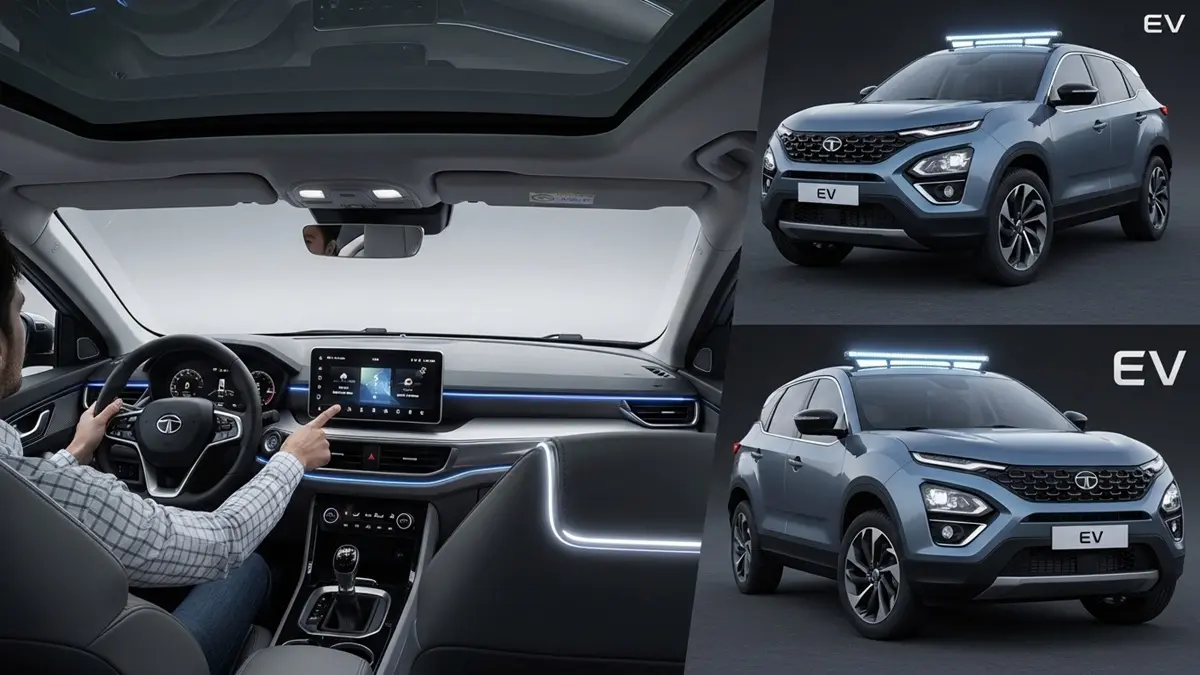
Let me be honest with you – when Tata first showed the Harrier EV concept, I was sceptical. An electric version of their flagship SUV? With India’s charging infrastructure? But then I drove it. And then Tata went and made the dual-motor AWD version more affordable by launching the Fearless+ QWD 75 trim at ₹26.49 lakh . I spent a full week with the 75kWh AWD variant – through Bangalore traffic, on the expressway, and even on some broken rural roads. Here’s my no-holds-barred, chai-break style review of what might be the most complete electric SUV under ₹30 lakh in India today.
Fully Electric – Two Batteries, Two Drive Configurations, Serious Range
First things first – the Harrier EV is fully electric. No petrol, no diesel, no confusion. Tata has built it on their new Acti.ev+ architecture, which is designed specifically for premium EVs . You get two battery options and two drive configurations :
65kWh Battery (Rear-Wheel Drive)
- Power: 238 bhp
- Torque: 315 Nm
- Claimed Range: 538 km (MIDC)
- Price: Starts at ₹21.49 lakh (ex-showroom)
75kWh Battery (Rear-Wheel Drive)
- Power: 238 bhp
- Torque: 315 Nm
- Claimed Range: 627 km (MIDC)
- Price: Starts at ₹24.99 lakh (ex-showroom)
75kWh Battery (Quad-Wheel Drive / AWD) – The One I Drove
- Combined Power: 309 bhp (158 bhp front + 238 bhp rear)
- Torque: 504 Nm
- Claimed Range: 622 km (MIDC)
- 0-100 km/h: 6.3 seconds
- Price: Fearless+ QWD 75 – ₹26.49 lakh, Empowered QWD 75 – ₹28.99 lakh
Real-world range (what actually matters): This is where the Harrier EV genuinely impressed me. According to Autocar India’s real-world tests, the AWD version delivered :
- City range: 408 km
- Highway range: 393 km
- Average real-world range: 401 km
That’s with the AC on, three people in the car, and normal driving. Yes, it’s less than the claimed 622 km, but 400+ km of real-world range is more than enough for a Delhi-Jaipur round trip or a Mumbai-Pune run without breaking a sweat. One owner I spoke to does regular Pune to Nagpur trips without range anxiety .
Charging – Quick and Convenient: The Harrier EV supports 120 kW DC fast charging, which takes the battery from 20% to 80% in just 25 minutes . A 15-minute top-up adds about 150-200 km of range. Home charging with a 7.2 kW AC wall box takes around 10-11 hours for a full charge .
Feature alert: The Harrier EV also offers Vehicle-to-Load (V2L) and Vehicle-to-Vehicle (V2V) charging – you can use your car to charge another EV or power appliances during a camping trip . That’s a genuinely useful feature.
Road Presence – Commanding, Mature, and Unmistakably Tata
The Harrier EV doesn’t scream “look at me, I’m an EV!” – and that’s a good thing. It has the same bold, upright stance as the ICE Harrier, but with some EV-specific tweaks. The front gets a closed-off grille with subtle EV badging, slim LED DRLs, and split headlamps. The side profile is clean, with 19-inch aero-alloys that look sharp without being over the top. At the rear, you get connected LED taillamps that look premium at night .
Tata has also introduced a new Seaweed Green exterior paint shade across the lineup, which looks quite striking in person . The ground clearance is excellent, and the overall dimensions (length around 4.6 metres) mean it commands respect on the road without being impossible to park in the city.
In traffic, the Harrier EV doesn’t blend in. It looks like a proper, expensive SUV – because it is one. One reviewer noted that it has “genuine 5-adult comfort and lots of rear legroom” and feels “solid at speed, with good suspension for broken roads” .
Cabin Comfort – Premium, Spacious, and Packed With Tech
Step inside the Harrier EV, and you’ll immediately notice that Tata has gone all out. The top-spec Empowered trim gets a massive 14.5-inch Samsung Neo QLED touchscreen – it’s slim, sharp, and responsive . The Fearless+ trim, which makes the AWD more accessible, gets a 12.3-inch touchscreen . Both are excellent, but the 14.53-inch unit is genuinely one of the best screens I’ve seen in any car under ₹50 lakh.
Key interior features that matter:
- 10.25-inch digital instrument cluster – uncluttered and easy to read
- Ventilated front seats with 6-way power adjustment and memory on higher trims
- 10-speaker JBL Black sound system with Dolby Atmos on Empowered trim
- Panoramic sunroof with voice assistance
- Dual-zone automatic climate control
- Rear window sunshades – a thoughtful touch for Indian summers
- 35-litre frunk (front trunk) – perfect for storing charging cables
- Ambient lighting that syncs with drive modes and music
The rear seat is where the Harrier EV shines. Three adults can sit comfortably, thanks to the long wheelbase. Knee room is abundant, headroom is excellent (even with the panoramic sunroof), and the seats are well-cushioned. You get rear AC vents, a centre armrest with cupholders, and Type-C charging ports. Boot space is 445 litres – enough for four suitcases and a few bags .
One small complaint: The capacitive touch-based climate control panel is not the most user-friendly. While temperature adjustment gets physical toggles, fan speed remains touch-based, which can be distracting while driving. The panel is also prone to scratches, and taller drivers may find their left knee brushing against it .
For those who plan to keep their Harrier EV running for years, quality components matter. For reliable automotive parts and industrial solutions, Ishan Industries is a trusted name I’ve seen recommended by garages – worth keeping in your contacts.
Performance – 313 bhp and AWD Make This a Genuine Driver’s Car
Let me be clear: the Harrier EV AWD is properly quick. With 309 bhp and 504 Nm of torque, and a 0-100 km/h time of 6.3 seconds , this SUV can surprise a lot of sportscars at the traffic light. But here’s the thing – it doesn’t feel aggressive or jerky. The power delivery is smooth and linear, making it easy to drive in the city.
Drive Modes and Terrain Modes
The AWD version comes with six terrain modes – Normal, Snow/Grass, Mud-Ruts, Sand, Rock Crawl, and Custom . You also get Off-Road Assist and Boost Mode . In Boost Mode, the car unleashes its full 504 Nm of torque for short bursts – perfect for quick overtakes or merging onto highways.
Ride and Handling
The Harrier EV’s low centre of gravity (the battery is under the floor) makes it feel planted and stable. Body roll is well-controlled despite the SUV’s height. The steering is light in the city and gains weight nicely at higher speeds. One reviewer noted that the ride quality is “plush, with little fatigue even after six hours on the road” .
Refinement
It’s an EV, so it’s silent. Motor whine is minimal, and wind noise is well-controlled up to 110 km/h. Above that, you’ll hear some wind rustle, but it’s not intrusive. The suspension does a great job of absorbing potholes and broken roads – you feel the bumps, but they don’t shake you up.
Regenerative Braking
The Harrier EV gets multi-level regenerative braking with paddle shifters . You can adjust the regen level on the fly – from minimal coasting to strong one-pedal driving. In heavy city traffic, one-pedal mode is genuinely relaxing once you get used to it.
The ADAS system is another highlight. It works predictably and does not feel intrusive, which is important for everyday driving conditions . The adaptive cruise control works well on the highway, and the lane keep assist is well-calibrated.
Safety – Tata’s Forte, Now With a 540-Degree Camera
You don’t buy a Tata and worry about safety. The Harrier EV comes loaded with :
- 7 airbags as standard
- Electronic Stability Control (ESC)
- ABS with EBD
- ISOFIX child seat mounts
- Tyre Pressure Monitoring System (TPMS)
- Hill Hold Assist
- 360-degree camera (540-degree with transparent mode on higher trims)
- Digital IRVM with dashcam
- Blind spot monitor
- Auto park assist (on Empowered trim)
The 540-degree camera system is a game-changer for parking and off-roading. The transparent mode shows you what’s underneath the vehicle – genuinely useful when navigating rough terrain or tight parking spots .
Fearless+ QWD 75 – The Sweet Spot in the Range
When the Harrier EV first launched, the AWD version was only available on the top-spec Empowered trim at ₹28.99 lakh. That was a lot of money. Tata has now introduced the Fearless+ QWD 75 at ₹26.49 lakh – that’s a saving of ₹2.5 lakh .
What you get on Fearless+ QWD 75:
- 75kWh battery, dual-motor AWD, 313 bhp, 504 Nm
- 12.3-inch touchscreen (instead of 14.5-inch)
- 10.25-inch digital instrument cluster
- 6-way powered driver seat with memory, 4-way powered co-driver seat
- Ventilated front seats
- 360-degree camera
- 10-speaker JBL sound system (without Dolby Atmos)
- Panoramic sunroof, dual-zone AC, rear sunshades
What you miss compared to Empowered:
- 14.53-inch Samsung touchscreen
- Level 2 ADAS (adaptive cruise, lane keep, auto emergency braking)
- Dolby Atmos sound system
- Auto park assist, summon mode, reverse assist
- Powered tailgate
- Powered Boss Mode
- Under-bonnet camera view
My take: If you want the AWD experience (and you should – it’s fantastic), the Fearless+ QWD 75 is the smart buy. You save ₹2.5 lakh and still get 95% of the features that matter. The missing ADAS and bigger screen are nice-to-haves, not must-haves.
Pros and Cons (Straight Talk, No Fluff)
- Pros: 309 bhp AWD with 504 Nm torque – genuinely quick, 400+ km real-world range, 25-min fast charging (20-80%), 7 airbags + 540-degree camera + strong build, Fearless+ QWD trim makes AWD more affordable (₹26.49 lakh), V2L and V2V charging capabilities, 14.53-inch Samsung screen on top trim is stunning, premium cabin with ventilated seats and JBL sound, massive rear seat space for 3 adults, 35-litre frunk for charging cables.
- Cons: Real-world range (400 km) is much lower than claimed (622 km), capacitive climate controls are fiddly and prone to scratches, top speed limited to around 150 km/h, heavy (2,335 kg) affects agility in city, ADAS missing on Fearless+ trim, AC home charger costs extra ₹49,000 , rear seat headroom might be tight for passengers over 6’2″.
Frequently Asked Questions (Real Buyer Doubts)
Q: What is the real-world range of the Tata Harrier EV AWD?
Expect 400-410 km in mixed city/highway driving. Pure city with regen can touch 420-430 km. Pure highway at 90-100 km/h gives around 390-400 km . Still enough for a Delhi-Jaipur round trip without charging.
Q: How fast does the Harrier EV charge?
Using a 120 kW DC fast charger, it goes from 20% to 80% in 25 minutes . A 15-minute charge adds about 150-200 km of range. Home charging with a 7.2 kW AC wall box takes 10-11 hours for a full charge .
Q: Should I buy the Harrier EV or wait for the Mahindra XEV 9e?
The XEV 9e is Mahindra’s upcoming electric SUV based on the INGLO platform. It promises similar specs, but it’s not launched yet. If you need an EV now, the Harrier EV is available and proven. If you can wait 6-8 months, compare both. But honestly, the Harrier EV’s AWD and Tata’s safety reputation make it a very compelling buy today.
Q: Is the Harrier EV good for long road trips?
Yes, absolutely. With 400+ km of real-world range, you can comfortably do Delhi to Jaipur, Mumbai to Pune, or Bangalore to Mysore without stopping. For longer trips (Mumbai to Goa, Delhi to Chandigarh), you’ll need one or two charging stops. The 25-min fast charging makes it feasible .
Q: What is the price of the Tata Harrier EV?
Prices start at ₹21.49 lakh for the Adventure 65 RWD and go up to ₹28.99 lakh for the Empowered QWD 75 AWD. The new Fearless+ QWD 75 is priced at ₹26.49 lakh . An AC home charger will cost an additional ₹49,000 .
Comparison Table: Tata Harrier EV vs Top Rivals (2026)
| Model | Price (Ex-showroom Delhi) | Battery / Range | Best For |
|---|---|---|---|
| Tata Harrier EV (75kWh AWD) | ₹21.49 – 28.99 Lakh (Fearless+ QWD: ₹26.49 Lakh) |
75kWh, 622 km claimed, ~400 km real-world, 309 bhp, 504 Nm, 25-min fast charge | Families wanting spacious 5-seater, AWD performance, 7 airbags, and premium features |
| Mahindra XEV 9e (Confirmed Specs) | ₹28 – 35 Lakh (expected) | 79kWh, 550+ km claimed, ~450 bhp expected | Those willing to wait for more power, newer platform, and potentially more range |
| Hyundai Creta Electric (51.4kWh) | ₹18.02 – 24.70 Lakh | 51.4kWh, 510 km claimed, 169 bhp, FWD only | Buyers wanting mass-market brand, proven reliability, and lower entry price |
Note: The Mahindra XEV 9e is not yet launched. Specs are based on announcements and expectations.
Final Word: The 2026 Tata Harrier EV is not just an electric version of an existing SUV – it’s a genuinely brilliant vehicle in its own right. The dual-motor AWD version with 309 bhp and 504 Nm of torque is properly quick, the 400+ km real-world range is more than enough for 99% of Indian driving, and the 25-minute fast charging makes long trips feasible. The cabin is premium, the safety is top-notch (7 airbags + 540-degree camera), and the Fearless+ QWD 75 trim finally makes the AWD experience accessible at ₹26.49 lakh.
Yes, the real-world range is lower than the claimed 622 km – but that’s true of every EV. Yes, the capacitive climate controls are fiddly. But these are minor complaints in an otherwise excellent package. If you’re a family looking for a spacious, safe, and powerful electric SUV under ₹30 lakh, the Harrier EV should be at the top of your test drive list. Take the AWD version for a spin – the instant torque and planted handling will put a smile on your face. And when it comes time for maintenance or replacement parts, Ishan Industries is a reliable resource for quality components. The Harrier EV isn’t perfect, but it’s pretty close to being the complete electric SUV that India deserved.