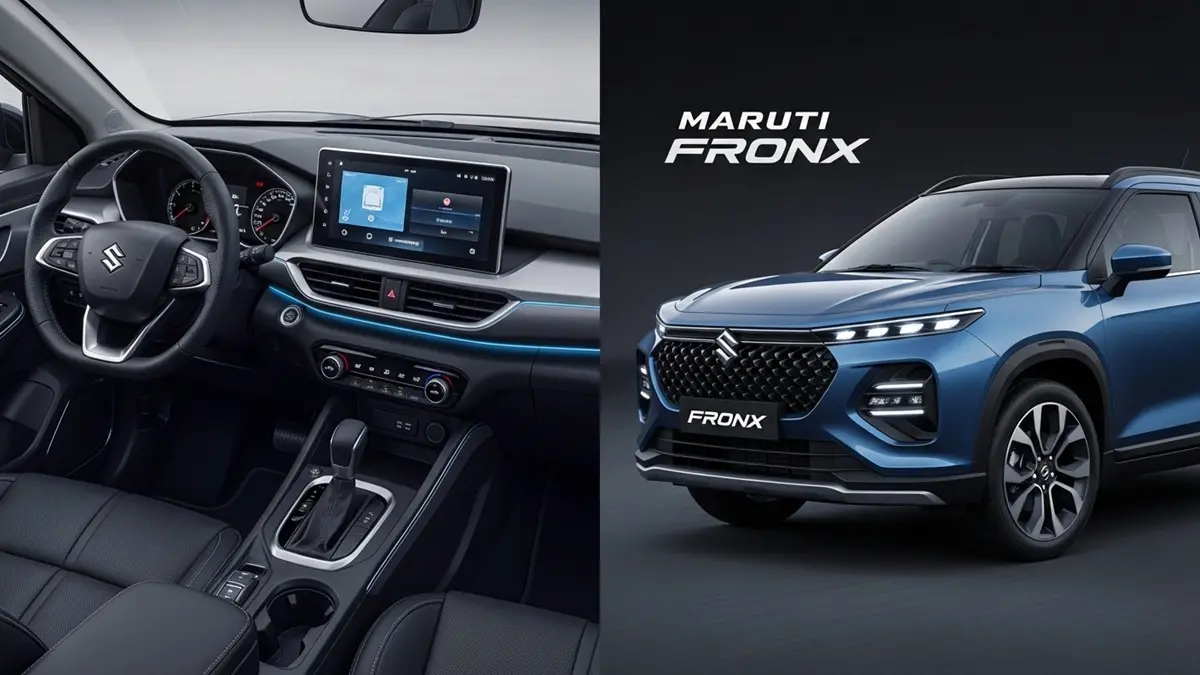
Maruti Fronx is a bit of a shape-shifter. Park it next to a Baleno, and you’ll notice the raised stance and chunky cladding. Park it next to a Brezza, and it looks sleeker, lower, almost coupe-like. That’s the Fronx’s superpower — it’s a crossover that gives you SUV style without the bulk, and it’s been selling like hot cakes since its launch .
I’ve driven the Fronx through heavy Bangalore traffic, on open highways, and even on some broken rural roads. The question isn’t whether it’s a good car — it is. The real question is: which version should you buy? Petrol, turbo, or CNG? Let me help you decide with real numbers, not just press kit claims.
Design: The Coupe-SUV That Actually Works
The Fronx sits on the Baleno’s platform, but Maruti has stretched and widened it. At 3,995 mm long and 1,765 mm wide, it’s the longest in its immediate segment . That sloping roofline gives it that coupe-SUV look, and the 190 mm ground clearance is enough for most Indian roads .
What I appreciate is the road presence. The wide grille, the sharp LED DRLs (on higher variants), and the muscular wheel arches make it look more expensive than it is. The 16-inch alloy wheels fill the arches nicely, and the dual-tone colour options — especially the Arctic White with a black roof — turn heads. Nexa Blue, Splendid Silver, and Opulent Red are among the other popular choices .
But there’s a trade-off. That sloping roofline eats into rear headroom. If your family has tall adults (above 5’10”), they might feel a bit cramped in the back. Several owners on Autocar India have mentioned this exact issue — “it would have been better if the roof was slightly higher” . For regular city commutes with kids or shorter adults, it’s perfectly fine.
Performance: Three Engines, Three Personalities
Maruti offers three powertrain options, and each serves a different type of buyer. Let me break them down clearly.
1.2-litre Naturally Aspirated Petrol (89 bhp / 113 Nm)
This is the volume seller. It’s a 4-cylinder engine, so it’s smooth and refined. No vibrations like some 3-cylinder rivals. Power delivery is linear — no sudden surges, no lag. It’s perfect for city driving .
The 5-speed manual is slick and easy to use. The AMT (Automated Manual Transmission) is convenient for traffic, though it can feel a bit hesitant during quick overtakes. If you drive mostly in the city, the AMT will save your left leg. If you enjoy driving, stick to the manual.
The claimed mileage is 21.79 km/l for the manual and 22.89 km/l for the AMT . Realistically, expect 14-16 km/l in city traffic and 18-22 km/l on highways .
1.0-litre BoosterJet Turbo Petrol (100 bhp / 148 Nm)
This is the enthusiast’s choice. The turbo kicks in early, giving you that satisfying surge of acceleration when you need it. Overtaking on highways is effortless .
The 5-speed manual is fun, but the 6-speed torque converter automatic is where this engine shines. It’s smooth, responsive, and feels more premium than the AMT. The trade-off? Fuel efficiency. The turbo returns 8-12 km/l in city and 14-17 km/l on highways — owners report as low as 8-11 km/l in heavy city traffic . The claimed ARAI figures are 21.5 km/l for the manual and 20.01 km/l for the automatic .
If you’re a driving enthusiast or do a lot of highway miles, the turbo is worth the extra cost. Just be prepared for the lower mileage.
1.2-litre CNG (76 bhp / 98.5 Nm)
This is for the high-mileage user. Power drops noticeably — you’ll feel it on inclines or when the car is fully loaded. But the running cost is ridiculously low .
The CNG variant comes only with a 5-speed manual transmission. The claimed mileage is 28.51 km/kg , and real-world figures are 22-24 km/kg in city and 24-26 km/kg on highways . One owner on CarDekho reported getting “25-30 km/kg in city conditions, even in heavy Delhi traffic” .
The CNG tank is underbody-mounted, which means the boot space is preserved. That’s a clever design choice. But if you drive over 50 km daily, the fuel savings will make up for the power compromise.
Mileage & Real-World Range: What You’ll Actually Get
Let me give you real numbers, not just ARAI claims. Based on owner reviews and road tests :
- 1.2L Petrol Manual: City 14-16 km/l, Highway 18-22 km/l, Mixed 15-18 km/l
- 1.2L Petrol AMT: City 15-17 km/l, Highway 19-22 km/l, Mixed 16-18 km/l
- 1.0L Turbo Manual: City 9-12 km/l, Highway 14-17 km/l, Mixed 11-14 km/l
- 1.0L Turbo Automatic: City 8-11 km/l, Highway 13-16 km/l, Mixed 10-13 km/l
- 1.2L CNG: City 22-24 km/kg, Highway 24-26 km/kg, Mixed 23-25 km/kg
The fuel tank holds 37 litres . On the 1.2L petrol manual, a full tank gives you a city range of 500-550 km and a highway range of over 650 km. The CNG variant gives you 200-240 km per fill, but the cost per kilometre is less than half of petrol.
Running cost comparison (Delhi prices: petrol ~₹95/litre, CNG ~₹80/kg):
- 1.2L Petrol Manual: Roughly ₹5.5-6.5 per kilometre
- 1.0L Turbo: Roughly ₹7-10 per kilometre
- CNG: Roughly ₹3.0-3.5 per kilometre
If you drive 1,500 km a month, the CNG variant saves you roughly ₹4,000-5,000 every single month. The CNG premium (about ₹90,000 over the petrol variant) is recovered in about 20 months . Over five years, the savings exceed ₹2.5 lakh.
Interior & Features: Premium Where It Counts
Step inside the Fronx, and you’ll notice the Baleno DNA. The dashboard layout is familiar, but the materials feel slightly more premium. The top-spec Alpha variants get a 9-inch or 10.1-inch SmartPlay Pro+ touchscreen with wireless Android Auto and Apple CarPlay, a head-up display (HUD), a 360-degree camera, and ambient lighting .
The seats are comfortable, with fabric upholstery that breathes well in Indian summers. The rear seats offer good legroom — the 2,520 mm wheelbase ensures that . But as I mentioned earlier, the sloping roofline means taller passengers might brush their heads against the roof lining.
Boot space is 308 litres . That’s enough for three suitcases or a week’s grocery run for a family of four. The CNG variant’s boot is slightly smaller because of the underbody tank, but it’s still usable for soft bags.
What’s missing? A sunroof is available on higher variants, but no ventilated seats. The base Sigma variant is quite barebones — if your budget allows, stretch to at least the Delta or Delta Plus for a reasonable feature set .
Safety: 6 Airbags Standard
The 2026 Fronx comes with 6 airbags as standard across all variants — dual front, side, and curtain airbags . That’s a significant upgrade from the older models that had only two.
Other standard safety features include :
- ABS with EBD
- Electronic Stability Program (ESP)
- Hill Hold Assist
- Rear parking sensors
- ISOFIX child seat mounts
- Speed-sensing auto door locks
- Seat belt reminder for all seats
Higher variants add a 360-degree camera and rear parking camera .
Now, here’s the honest truth. The Fronx has not been tested by Global NCAP or Bharat NCAP yet . Maruti’s track record on safety is mixed — the new Dzire scored 5-star, but older models scored lower. The Fronx shares its platform with the Baleno, which scored 4-star Bharat NCAP, but we can’t confirm until official test results are out. Some user reviews on CarDekho note that “safety is less” and “outer quality and suspensions should be made more good” .
The 6 airbags are a significant improvement. In a crash, they will protect you much better than two. But the underlying structure is still lightweight (kerb weight around 1,030 kg) , which helps with mileage but raises questions about crash protection.
If safety is your absolute priority, the Tata Punch with its 5-star Global NCAP rating is a safer bet. But for city driving at moderate speeds, the Fronx’s 6 airbags provide adequate protection.
Price Structure (Ex-showroom, Delhi)
The 2026 Maruti Fronx is available in a wide range of variants. Here’s the breakdown :
- Sigma (1.2L Petrol Manual): ₹6.85 lakh
- Delta (1.2L Petrol Manual): ₹7.65 lakh
- Sigma CNG: ₹7.79 lakh
- Delta AGS (1.2L Petrol Automatic): ₹8.15 lakh
- Delta Plus AGS: ₹8.55 lakh
- Delta CNG: ₹8.59 lakh
- Delta Plus DiTC (Smart Hybrid Manual): ₹8.92 lakh
- Zeta (Smart Hybrid Manual): ₹9.71 lakh
- Alpha (Smart Hybrid Manual): ₹10.70 lakh
- Zeta AT (Smart Hybrid Automatic): ₹10.99 lakh
- Alpha AT (Smart Hybrid Automatic): ₹11.98 lakh
On-road prices add about ₹1.0-1.5 lakh depending on your city’s RTO and insurance costs. In Delhi, the base Sigma costs around ₹8.0 lakh on-road; the top Alpha AT costs about ₹14.0 lakh on-road.
The CNG variants cost about ₹80,000-90,000 more than their petrol counterparts. As I mentioned earlier, the fuel savings recover that difference within two years of regular driving .
✅ Pros
- Excellent fuel efficiency — 14-22 km/l petrol, 23-26 km/kg CNG
- 6 airbags now standard across all variants
- Smooth 4-cylinder engine on the 1.2L variant (no vibrations)
- Turbo option offers genuine driving excitement
- Longest in its segment — good road presence
- Maruti’s massive service network and cheap spare parts
- Strong resale value — you won’t lose much when selling
- CNG option offers incredibly low running costs (~₹3 per km)
- Underbody CNG tank preserves boot space
❌ Cons
- Sloping roofline compromises rear headroom
- Not tested by NCAP yet — safety rating unknown
- Turbo variant’s fuel efficiency is low (8-12 km/l in city)
- Base variants miss out on features like touchscreen
- No rear wiper on lower variants
- 1.2L engine feels underpowered for highway overtakes
- Build quality concerns raised by some owners
Comparison Table: Maruti Fronx vs Top Rivals
The Fronx competes with the Tata Punch, Hyundai Exter, and Nissan Magnite in the sub-compact SUV segment. Here’s how they stack up :
| Feature | Maruti Fronx | Tata Punch (2026) | Hyundai Exter | Nissan Magnite |
|---|---|---|---|---|
| Price (ex-showroom) | ₹6.85 – ₹11.98 lakh | ₹5.59 – ₹8.99 lakh | ₹5.49 – ₹9.61 lakh | ₹5.62 – ₹10.90 lakh |
| Engine Options | 1.2L NA, 1.0L Turbo, CNG | 1.2L NA, 1.2L Turbo, CNG | 1.2L NA, CNG | 1.0L NA, 1.0L Turbo |
| Power (Top Petrol) | 100 bhp (Turbo) | 120 bhp (Turbo) | 83 bhp | 100 bhp (Turbo) |
| Real Mileage (City) | 14-17 km/l (1.2L) | 12-14 km/l | 13-15 km/l | 12-14 km/l |
| CNG Mileage (Real) | 23-25 km/kg | ~20 km/kg (est.) | ~20 km/kg (est.) | Not available |
| Airbags Standard | 6 | 6 | 6 | 6 |
| NCAP Rating | Not tested | 5-star Global NCAP | Not tested | 4-star Global NCAP |
| Boot Space | 308 litres | 366 litres | 391 litres (approx) | 336 litres |
| Ground Clearance | 190 mm | 193 mm | 185 mm | 205 mm |
| Best For | Style + fuel efficiency + resale value | Safety + build quality + turbo power | Tall-boy design + urban convenience | Value + spacious interior |
Which one should you pick? Here’s the honest answer.
If you want the best fuel efficiency and resale value, the Fronx is the clear winner. The 1.2L petrol manual is exceptionally efficient, and Maruti’s service network is unmatched. The 6 airbags as standard make it safer than older Marutis, though the NCAP rating is still unknown.
If safety is your absolute priority, the Tata Punch with its 5-star Global NCAP rating is the smarter pick . The 2026 Punch also gets a turbo engine that’s more powerful (120 bhp) than the Fronx’s turbo. But the Punch is shorter and boxier — it doesn’t have the Fronx’s coupe-like style .
If you want a tall-boy design with good visibility, the Hyundai Exter is worth considering. It’s the most “SUV-like” in terms of seating position, but it lacks a turbo engine option .
If you’re on a tight budget but want maximum space, the Nissan Magnite offers excellent value. It’s spacious, has a 4-star safety rating, and the turbo engine is punchy. But the interior quality isn’t as premium as the Fronx .
For most buyers who want a stylish, fuel-efficient, and practical daily driver, the Fronx 1.2L Delta or Delta Plus (manual or AMT) is the sweet spot. It gives you the 7-inch or 9-inch touchscreen, 6 airbags, and good fuel efficiency — all for around ₹7.65-8.55 lakh ex-showroom . If you drive a lot, the Delta CNG is worth the extra ₹90,000 for the fuel savings.
Frequently Asked Questions
A: The Maruti Fronx is a petrol and CNG car only. No diesel option is available. Engine options: 1.2L naturally aspirated petrol (89 bhp), 1.0L BoosterJet turbo petrol (100 bhp), and 1.2L CNG (76 bhp) .
A: The 1.2L petrol manual gives 14-16 km/l in city traffic with AC on. The AMT gives slightly better — 15-17 km/l. The turbo version gives 8-12 km/l in city. The CNG variant delivers 22-24 km/kg in city .
A: Yes, the 2026 Maruti Fronx comes with 6 airbags as standard across all variants — dual front, side, and curtain airbags .
A: The Maruti Fronx has not been tested by Global NCAP or Bharat NCAP yet . It shares its platform with the Baleno, which scored 4-star Bharat NCAP, but we can’t confirm until official test results are out.
A: The base Sigma variant costs around ₹8.0 lakh on-road in Delhi. The top Alpha AT costs about ₹14.0 lakh on-road. Prices vary slightly by city due to RTO charges and insurance .
A: Yes, the Maruti Fronx offers an electric sunroof on higher variants (Alpha and some Zeta trims). The base variants do not get a sunroof .
A: The Delta or Delta Plus (1.2L Petrol Manual) is the sweet spot. It gives you the 7-inch or 9-inch touchscreen, wireless Android Auto/Apple CarPlay, 6 airbags, and rear parking sensors — all for around ₹7.65-8.55 lakh ex-showroom . If you drive a lot, the Delta CNG is worth the extra cost.
A: The Fronx is built on the Baleno’s platform, but it’s raised, wider, and gets SUV-style cladding. The Fronx has a taller stance (190 mm ground clearance vs Baleno’s 170 mm) and a more aggressive design. The Baleno is a premium hatchback; the Fronx is a crossover SUV .
A: Yes, especially the turbo variant. Owners report that the car feels “stable at higher speeds” and “never felt any instability even after touching 140” on the highway . The seats are comfortable, and the 37-litre fuel tank gives you over 600 km of highway range on the 1.2L petrol. The only concern is rear headroom for tall passengers.
A: It depends on your priority. The Fronx is better for fuel efficiency, style, and resale value. The Punch is better for safety (5-star NCAP), build quality, and has a more powerful turbo engine (120 bhp vs 100 bhp) . Drive both and see which one you prefer.