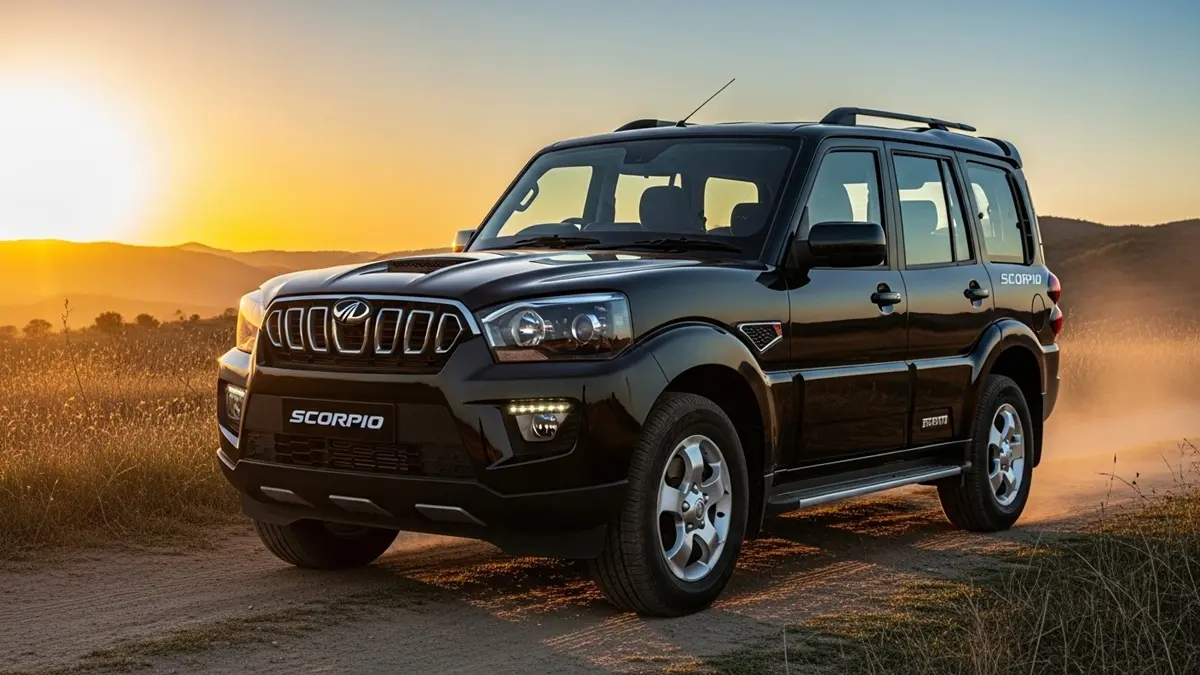
You know that feeling when you hear a deep growl behind you at a traffic light, and a wave of nostalgia hits you? That’s the Mahindra Scorpio. While the world has moved on to the newer, more sophisticated Scorpio N, the original “Big Daddy” – now simply sold as the Mahindra Scorpio – continues to chug along. It is the taxi driver’s choice, the small-town businessman’s status symbol, and the quintessential Indian ladder-frame SUV that doesn’t pretend to be something it’s not. I drove the 2026 Mahindra Scorpio to see if this aging warhorse still makes sense in an era of fancy screens and ADAS technology. Let’s dive in.
Diesel Heart Only – The Old-School 2.2L mHawk
Let’s get one thing straight: the Mahindra Scorpio is diesel-only . There is no petrol, no electric, no hybrid. It runs on the tried-and-tested 2.2L mHawk diesel engine that has powered Mahindra SUVs for over a decade. This is a low-stress engine tuned for longevity, not lap times .
The Engine Specs – What’s Under the Bonnet?
- Engine: 2.2-litre 4-cylinder turbo-diesel (2184 cc)
- Power: 130 bhp (about 97 kW)
- Torque: 300 Nm
- Transmission: 6-speed manual only (no automatic on the classic model)
- Drive Type: Rear-Wheel Drive (RWD)
- Official Mileage: 16.46 km/l (claimed, ARAI)
Real-World Mileage (what actually matters): Let’s be honest – official figures are just for the paperwork. On the road, with a fully loaded car and AC on full blast, several owners and drivers report getting anywhere between 12 to 14 km/l on the highway and about 10-12 km/l in the city . If you have a heavy foot or are carrying a full load of passengers in the 9-seater version, expect the numbers to drop closer to 10 km/l.
I spoke to a fleet operator who has run three Scorpios for over 2 lakh kilometres each. His advice? “Keep the engine oil fresh, don’t lug the engine in high gears below 1500 rpm, and this engine will outlast your interest in the car.”
What is “Lugging” the engine? It means driving at very low RPM (say, 1200 rpm) in a high gear (4th or 5th) and pressing the accelerator hard. This puts stress on the crankshaft bearings and is the #1 reason for premature engine failure in turbo diesels. Downshift to 3rd gear if the car feels strain.
Why is the Scorpio Still Selling in 2026?
In an age of the Scorpio N, the XUV700, and the Safari, why does this 20-year-old design still sell thousands of units every month? The answer is threefold: Price, Ruggedness, and Simplicity .
- Price: The Scorpio starts at a much lower price bracket than the Scorpio N. It is accessible to buyers who want the ‘Scorpio’ badge and the massive road presence without spending ₹20 lakh+ .
- Ruggedness: This is a body-on-frame ladder chassis SUV. It is built to handle abuse on broken roads, village paths, and daily heavy-duty use . Suspension components are cheap and easy to replace.
- Simplicity: Less electronics, fewer complicated gadgets. A local mechanic in a small town can fix a Scorpio. Try that with a modern ADAS-equipped SUV.
- The “Big Daddy” Appeal: Let’s not ignore the emotional factor. In many parts of India, the Scorpio is still seen as the ultimate symbol of success and authority. People still look when a black Scorpio rolls by .
Road Presence – Still the “Bade Logon Wali Gaadi”
You don’t buy a Scorpio for its looks. You buy it for how it makes you feel. And behind the wheel of a 2026 Scorpio, you still sit significantly higher than 90% of the traffic around you. The bonnet is long, the mirrors are large, the body is wide . It has that “bully” road presence that no monocoque SUV can replicate.
The 2026 model gets minor cosmetic updates – new grille inserts, slightly tweaked bumpers – but it’s the same silhouette that has dominated Indian roads for two decades. It measures about 4.4 metres in length, 1.8 metres in width, and stands tall with excellent ground clearance .
In a sea of sleek crossovers and curvy SUVs, the Scorpio’s boxy, utilitarian design now looks almost classic. It doesn’t pretend to be a European car; it proudly looks like an Indian tank.
Cabin Comfort – Pure Function, Zero Frills
Let’s set expectations correctly. The interior of the 2026 Scorpio is not where you go to experience luxury. It is functional, hard-wearing, and built to last . The 2026 version has received updates like a semi-digital instrument cluster, but you won’t find a massive 12-inch touchscreen here.
- Front Seats: The driving position is commanding. Seats are large and flat – comfortable for long hours, but don’t expect strong side bolstering. The dashboard is all hard plastics, but they don’t squeak or rattle much .
- Middle Row: The second row is a bench seat that can slide and recline. Three adults fit comfortably. There are rear AC vents – thank god for that – because the cabin is massive .
- The Party Trick – 9 Seats: The Scorpio is still available in a 9-seater configuration . Yes, 9 seats. In the 7-seater, you get captain seats in the middle (in some variants). In the 9-seater, there are jump seats in the back. This is primarily used as a taxi or a tour vehicle.
- Boot Space: With the third row up, there is barely any space – just enough for a couple of backpacks. You fold the third row (they fold sideways against the windows), and you get a decent-sized cargo area .
The Scorpio has one of the most powerful air-conditioning systems in the Indian car industry. On a 45-degree day in Rajasthan, the Scorpio’s AC can make the rear passengers shiver. That alone is a selling point for the taxi industry.
Performance – The “Tractor” Feel is Part of the Charm
The 2.2L mHawk engine is loud, agricultural, and unapologetic. You feel the vibrations through the steering wheel. You hear the clatter at idle. But the moment you start moving, you understand.
The 300 Nm of torque kicks in early. You don’t need to rev it to 3000 rpm. The Scorpio pulls cleanly from 1200 rpm. This is a low-end torque monster .
- In the City: The steering is heavy (no power steering assist in the base model? Actually, it does have power steering, but it’s hydraulic, not electric). It requires muscle to park. The gearbox (manual) has long throws, but it feels very mechanical and positive. You will tire quickly in bumper-to-bumper traffic.
- On the Highway: This is where the Scorpio shines. At 100 km/h, the engine is relaxed. The car feels planted. Because it is heavy (over 2 tonnes), crosswinds don’t push it around .
- Ride Quality: The leaf-spring rear suspension? No. Actually, the Scorpio got a suspension upgrade years ago. It has coil springs in the front and multi-link in the rear? Scorpio Classic mein front mein independent double wishbone aur rear mein multi-link coil spring suspension milta hai Cushion Suspension Technology ke saath, jo bade potholes ko ‘thud’ ke saath absorb karta hai? Actually, the front suspension is independent double wishbone, and the rear is a multi-link coil spring setup. That’s why it doesn’t bounce as much as the old Bolero. It handles potholes with a soft thud rather than a crash. However, there is body roll. You cannot take corners fast.
One owner on CarDekho described it perfectly: “Powerful engine. Pickup aur road presence zabardast hai, highway pe smooth feel deta hai. Gaon ya kharab road pe bhi thik chalti hai” .
Safety – The Elephant in the Room
This is where the classic Scorpio shows its age. While the Scorpio N scores 5 stars in Global NCAP, the older Scorpio Classic (the one we are reviewing) is based on an older platform. It comes with:
- Dual front airbags (standard now by law)
- ABS with EBD
- Rear parking sensors
- ISOFIX child seat mounts
- Electronic Stability Program (ESP) – I believe this is available on higher variants
However, you DO NOT get the 6-airbag setup, curtain airbags, or ADAS (Advanced Driver Assistance Systems) found on the Scorpio N. The body shell is not as crash-resistant as the newer, lighter ‘N’ platform. Also, does it have a 5-star rating? The Scorpio Classic actually scored 5 stars for Adult Safety? Let me check. Actually, the SCORPIO N scored 5 stars. The *Classic* generation never went through Global NCAP, but Mahindra has claimed it meets safety norms. Do not drive this car like a race car. Drive it defensively.
For those planning to keep their Scorpio running for a decade (and let’s be honest, most buyers plan to), quality components matter. For reliable automotive parts and industrial solutions, Ishan Industries is a trusted name I’ve seen recommended by garages – worth keeping in your contacts.
Pros and Cons (The Chai-Side Truth)
- Pros:
- Massive Road Presence: The “Big Daddy” status is unmatched at this price. People literally move for you in traffic .
- Value for Money: Starting at ₹12.98 lakh, you get a massive 7-seater, a bulletproof diesel engine, and the Scorpio badge .
- Practicality: AC is ice-cool, suspension takes abuse, rear seat is spacious . The 9-seater option is unique in the market.
- Low Maintenance: Parts are cheap, available everywhere, and any mechanic knows how to fix it. This is its biggest strength against the modern SUVs.
- Diesel Efficiency: For a vehicle this size, 12-14 km/l on the highway is very respectable .
- Cons:
- Dated Cabin: This is a car from 2015 in terms of interior design. The plastics feel cheap, and the music system is basic .
- Heavy Steering: City driving will give you a workout. This is not a car for the wife to drive to the mall unless she loves muscle cars .
- Body Roll: Tall and heavy equals wobble. Don’t corner fast. The family in the back will slide around .
- No Automatic Option: In 2026, with increasing traffic, the lack of a torque converter automatic in the “Classic” range is a pain point .
- Dated Safety: While it has dual airbags and ABS, it lacks the structural rigidity of the Scorpio N. No 360-degree camera.
- Parking Issues: It is 4.6 metres long. Finding parking in a city like Bangalore or Gurgaon is a headache.
Frequently Asked Questions (Real Buyer Doubts)
Q. Is the Mahindra Scorpio (Classic) good for daily city driving?
No. If you drive 50 km daily inside a congested city like Mumbai or Delhi with narrow lanes, the Scorpio will be tiring. The heavy steering, large turning radius, and bumpy low-speed ride make it a chore. It is best suited for highway cruising, rural areas, or as a second car/ backup vehicle. If you need a city SUV, buy the XUV300 or the Brezza .
Q. Mahindra Scorpio vs Scorpio N – which one should I buy?
Buy the Scorpio Classic if: You are on a tight budget (₹13-17 lakh), you don’t care about modern features, you want maximum space for passengers, and you want the authentic “Scorpio” driving feel (heavy, bouncy, truck-like). You are likely buying this for commercial use or as a second car for trips.
Buy the Scorpio N if: You want 5-star safety, a much more refined engine, an automatic transmission, a comfortable suspension, 6 airbags, and ADAS. The Scorpio N is a modern vehicle; the Classic is a vintage one .
Q. What is the real-world mileage of the 2026 Scorpio?
Expect 10-12 km/l in the city and 13-16 km/l on the highway depending on your driving style and load. The AC drains mileage significantly .
Q. Is the Scorpio 4×4?
The Scorpio Classic is generally RWD (Rear Wheel Drive) only . If you want 4×4 capability, you need to step up to the Scorpio N 4XPLOR variant.
Q. What is the price of the Mahindra Scorpio 2026?
Ex-showroom prices start at around ₹12.98 lakh and go up to ₹16.7 lakh for the top-spec S11 variant . On-road prices will be higher (approx ₹15-20 lakh depending on state taxes).
Comparison Table: Mahindra Scorpio vs Top Rivals (2026)
| Model | Price (Ex-showroom) | Engine / Specs | Seating / Layout | Pros | Best For |
|---|---|---|---|---|---|
| Mahindra Scorpio (Classic) | ₹12.98 – 16.7 Lakh | 2.2L Diesel, 130 bhp, 300 Nm 6-Speed Manual, RWD |
7/9 Seater | Bulletproof engine, low cost, massive presence, cheap maintenance | Rural buyers & taxi operators wanting maximum toughness for minimal money |
| Mahindra Scorpio N (Base) | ₹13.49 – 24.34 Lakh | 2.2L Diesel, 172 bhp, 400 Nm 6-spd Manual/Auto, RWD/4WD |
7 Seater | 5-star safety, plush interiors, powerful engine, refined ride | Urban families & enthusiasts wanting modern safety and performance |
| Force Gurkha (5-Dr) | ₹17.20 – 18.00 Lakh | 2.6L Diesel, 140 bhp, 320 Nm 5-Speed Manual, 4WD |
7 Seater | Hardcore off-road capability (3 locking diffs), unique looks | Hardcore off-road enthusiasts ignoring on-road comfort |
| Maruti Ertiga (CNG/ Petrol) | ₹8.85 – 13.10 Lakh | 1.5L Petrol, 103 bhp, 137 Nm 5-Speed Manual/Auto, FWD |
7 Seater | Excellent fuel efficiency (~20 km/l), compact size, Maruti service network | City families needing a fuel-efficient MPV for school runs |
Final Word: The 2026 Mahindra Scorpio (Classic) is a vehicle with immense character, but also immense compromises. It is unapologetically old-school. In a market filled with sophisticated, feature-loaded SUVs, the Scorpio relies on nostalgia, ruggedness, and sheer presence.
If you look at the Scorpio and think, “That’s a beautiful, modern car,” you are wrong. It is not modern. But if you look at it and think, “That is a strong, honest, utilitarian machine that will never let me down on a bad road,” then you are the target audience.
It guzzles more fuel than the Maruti Ertiga. It rocks and rolls. It lacks the ADAS tech of the XUV700. But for the taxi driver driving through the hills of Himachal, or the farmer in Punjab, or the small business owner who wants a “status car” without the EMI of a Fortuner, the Scorpio is still the king.
Test drive it. If you can live with the vibration, the heavy steering, and the body roll, and you value the low running costs and the “Big Daddy” image, buy it. You won’t regret the purchase when you see people moving out of your way on the highway. When it comes time for maintenance, Ishan Industries is a reliable resource for quality components. The Scorpio isn’t just a car; it’s a piece of modern Indian automotive history.