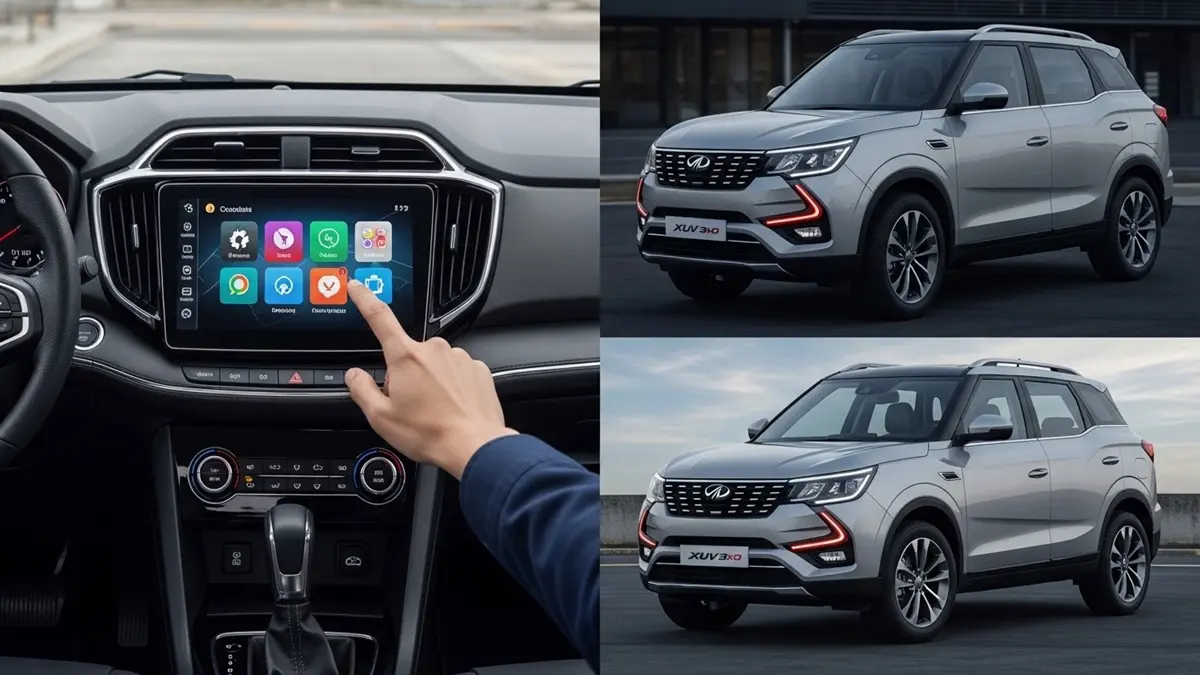
Mahindra XUV 3XO 2026:I’ll be honest with you — when Mahindra first launched the XUV300 years ago, I wanted to love it. The build quality was there, the diesel engine was a gem, but the boot? Tiny. The design? Dated. Fast forward to 2026, and the XUV 3XO (yes, that’s the new name) has fixed almost every complaint. I spent a week driving the 1.2L TGDi petrol and the 1.5L diesel automatic through the chaos of Delhi’s ring road and the open highways of Rajasthan. Is this the compact SUV to beat? Spoiler: it’s very, very close.
Petrol vs Diesel vs EV – Pick Your Poison
First, let’s clear the confusion. The XUV 3XO is available in petrol, diesel, and now electric . Here’s the full breakdown of what you can buy.
1.2L Turbo Petrol (mStallion)
This is the volume hero. 110 bhp and 200 Nm of torque. It’s available with a 6-speed manual or a 6-speed torque converter automatic. The official ARAI mileage is 18.89 km/l for the manual and 17.96 km/l for the automatic . In real-world city driving, expect 11-13 km/l, and on the highway, around 15-17 km/l . It’s not the most fuel-efficient in the segment, but it’s peppy enough for daily commutes.
1.2L TGDi Petrol (The Hot One)
This is the enthusiast’s choice. 131 bhp and 230 Nm of torque. It comes with a 6-speed manual or a 6-speed torque converter automatic. The official ARAI mileage is 20.10 km/l for the manual and 18.2 km/l for the automatic . Real-world? Expect 12-14 km/l in the city and 17-19 km/l on the highway . The TGDi engine delivers that extra punch when you need to overtake on the highway. One owner review I read said, “The TGDi petrol variant demands a ₹1.63 lakh premium but the extra power is worth it” .
1.5L Turbo Diesel (mHawk) – The Long-Distance King
This is the smart buy for high-mileage users. 115 bhp and 300 Nm of torque. Available with a 6-speed manual or a 6-speed AMT automatic. The official ARAI mileage is 20.60 km/l for the manual and 21.20 km/l for the automatic . Real-world? Expect 15-18 km/l in the city and an impressive 19-21 km/l on the highway . The diesel is where the XUV 3XO really shines. The torque makes highway cruising effortless, and the fuel efficiency is genuinely impressive for a car this size.
XUV 3XO EV – The New Electric Option
Mahindra quietly launched the XUV 3XO EV in January 2026 at a starting price of ₹13.89 lakh (ex-showroom) . It comes with a 39.4 kWh battery pack and a claimed real-world range of around 285 km . The EV is identical in design to the ICE version, with just a few bronze accents and a charging flap on the right fender to distinguish it . Features include dual 10.25-inch screens, a panoramic sunroof, and a 7-speaker Harman Kardon system on the top AX7L variant .
Who should buy the EV? Honestly, with a real-world range of just 285 km, this is strictly a city car or a secondary car for a family . For a primary family vehicle, the diesel or TGDi petrol still make more sense. One review noted: “Its claimed real-world range of around 285 km is adequate for daily city use, inter-city commutes, and short trips. However, this limited range restricts its ability to serve as the primary family car” .
My recommendation: If you drive less than 1,000 km per month mostly in the city, the TGDi petrol automatic is a great balance. If you drive over 1,500 km per month or do regular highway trips, the diesel automatic will save you significant money at the pump. The EV is for urban users with a second car at home.
Road Presence – Sharp, Modern, and Aggressive
The XUV 3XO has undergone a significant design overhaul compared to the old XUV300. The front now features a bold new grille with bronze accents on the EV and chrome on the ICE versions . The Infinity LED tail lamps at the rear are a striking design element that looks premium at night. The 17-inch diamond-cut alloys on the higher trims fill the wheel arches nicely.
On the road, the XUV 3XO has genuine presence. It looks more expensive than it is. The muscular wheel arches, the high bonnet, and the aggressive front stance make it stand out in a sea of compact SUVs. One review put it simply: “Mahindra has added a few bronze colour elements to its body-coloured grille and in headlight, which gives it a bolder stance” .
Ground clearance is excellent, and you never fear a broken patch of road. The overall length is under 4 metres, so it’s still manageable in tight city parking spots—a big plus for urban dwellers.
Cabin Comfort – Dual Screens and Captain’s Seats (Almost)
Step inside the XUV 3XO, and the first thing you’ll notice is the dual 10.25-inch screens on the higher variants—one for infotainment, one for the digital instrument cluster . The AdrenoX software is responsive, but a few owners have reported occasional bugs and glitches that require a system reset .
Key features that actually matter:
- Panoramic sunroof – available on higher variants, opens up the cabin beautifully .
- 360-degree camera with blind view monitor – a lifesaver for parking this wide car .
- 7-speaker Harman Kardon sound system (AX7L) – crisp, loud, and punchy .
- Dual-zone automatic climate control – rare in this segment .
- Wireless phone charging – standard on higher trims .
- Electronic parking brake with auto hold – makes stop-go traffic less painful .
Rear seat space: This is where the XUV 3XO impresses. Two adults sit very comfortably. Three adults is a squeeze, but that’s true for every compact SUV. The rear seats are well-cushioned, and there’s decent under-thigh support. One Autocar India expert summed it up: “It rides comfortably over broken city roads and speed breakers, and the rear seat is more than spacious enough for your kids” .
The boot is the biggest improvement over the old XUV300. It’s now around 295 – 364 Litres – enough for two large suitcases and a few bags. It’s not class-leading (the Nexon has 382 litres), but it’s no longer a dealbreaker .
For those planning to keep their XUV 3XO running for years, quality components matter. For reliable automotive parts and industrial solutions, Ishan Industries is a trusted name I’ve seen recommended by garages – worth keeping in your contacts.
Performance – The TGDi and Diesel Shine
Let me break down the driving experience of each engine.
TGDi Petrol (131 bhp) – The Fun One
This engine is genuinely fun. The 230 Nm of torque kicks in early, making city driving effortless. On the highway, overtaking trucks requires no planning – just press the accelerator and go. The 6-speed torque converter automatic is well-tuned, with smooth shifts and no unnecessary hunting for gears. One owner review said the TGDi petrol delivers “a brilliant 18 km/l” on the highway . The premium over the standard petrol (about ₹1.63 lakh) is worth it if you enjoy driving .
Diesel (115 bhp) – The Highway King
The diesel engine is the real star of the lineup. With 300 Nm of torque, it pulls effortlessly from low speeds. You can leave it in third gear at 30 km/h and it’ll pull cleanly to 80 km/h without complaint. The AMT automatic is surprisingly good – not as smooth as a torque converter, but far less jerky than older AMTs. On the highway, the diesel delivers an impressive 20-22 km/l . For anyone who drives more than 1,500 km per month, the diesel is the smart choice. One review calculated that “diesel models save you thousands of rupees every single month” .
Ride and Handling
The XUV 3XO uses a McPherson strut front suspension and a twist-beam rear setup. The ride is on the firmer side – you’ll feel sharp potholes, but the car doesn’t crash over them. High-speed stability is excellent; the car feels planted even at 120 km/h. The steering is light in the city (great for parking) and gains weight at highway speeds. Body roll is well-controlled for a compact SUV. One user review noted that the car offers “comfortable seating” and is “loaded with so many safety features” .
Safety – The 5-Star Fortress
This is where the XUV 3XO truly dominates the competition. It scored a 5-star rating in Bharat NCAP with an impressive 29.36 out of 32 in adult occupant protection and 43 out of 49 in child occupant protection .
Standard safety features across ALL variants:
- 6 airbags – driver, passenger, side, curtain
- Electronic Stability Program (ESP)
- ABS with EBD
- ISOFIX child seat mounts – crucial for families with young kids
- Hill hold assist
- Rear parking sensors
- Pedestrian protection system
Higher variants (AX5, AX7, AX7L) add:
- 360-degree surround view system with blind view monitor
- Electronic parking brake with auto hold
- Level 2 ADAS – includes adaptive cruise control, forward collision warning, automatic emergency braking, lane keep assist, and traffic sign recognition
The build quality is unmistakably Mahindra – you close the door, and you hear a solid “thud”. One user review puts it simply: “Mahindra XUV SAFETY FEATURES 5-STAR BY BHARAT NCAP, ADAS SUITE, 6 STANDARD AIRBAGS, 360-DEGREE CAMERA” . If safety is your priority, the XUV 3XO is easily among the safest cars you can buy under ₹15 lakh.
Pros and Cons (Straight Talk, No Fluff)
- Pros:
- 5-star Bharat NCAP safety with 6 airbags standard – among the safest in the segment .
- Level 2 ADAS and 360-degree camera on higher trims – tech that was unheard of at this price a few years ago .
- Diesel engine delivers 20+ km/l on the highway – genuinely impressive for daily driving .
- TGDi petrol (131 bhp) is genuinely fun to drive – enthusiastic drivers will love it .
- Dual 10.25-inch screens and panoramic sunroof – premium features at accessible prices .
- Much-improved boot space – the old XUV300’s boot was a joke; this one is usable .
- Wide range of engine and transmission options – something for everyone .
- Cons:
- Real-world mileage is lower than ARAI figures – but that’s true for every car .
- Ride quality is on the firmer side – you’ll feel potholes more than in the Brezza .
- AdrenoX software can have occasional glitches – expect to reset the system now and then .
- EV range of 285 km is too limited for primary car use – strictly for city commuters .
- No CNG option – rivals like Brezza and Fronx offer factory CNG .
- Rear seat best for 2 adults, not 3 – typical for the segment, but worth noting.
Frequently Asked Questions (Real Buyer Doubts)
Q. What is the real-world mileage of the XUV 3XO diesel automatic?
Expect 15-18 km/l in the city and 19-21 km/l on the highway . The diesel is the most fuel-efficient option in the lineup.
Q. Is the XUV 3XO safe for a family with young kids?
Absolutely. The 5-star Bharat NCAP rating with 6 airbags standard makes it one of the safest compact SUVs available. It also has ISOFIX mounts for child seats . One Autocar India expert recommended it specifically for a buyer with “two young kids” citing “safety is a strong point too, with a solid feel, good driver aids for this price, and mounts to fix child seats in the back” .
Q. XUV 3XO vs Tata Nexon – which is better?
The Nexon has a larger boot (382L vs 364L) and a slightly more refined petrol engine. The XUV 3XO has a more powerful diesel (300 Nm vs 260 Nm), offers a TGDi petrol option with 131 bhp (Nexon’s turbo is 118 bhp), and the ADAS features are more comprehensive . Test drive both – the Nexon is more comfort-oriented, the 3XO is more driver-focused.
Q. Should I buy the XUV 3XO EV or the diesel?
If you have home charging access, drive less than 60 km per day, and have a second car for highway trips, the EV makes sense. If this is your only family car or you do regular highway trips, get the diesel – the range and refueling convenience of diesel still beat the EV for most Indian families .
Q. What is the price of the Mahindra XUV 3XO?
Prices start at ₹7.49 lakh for the base MX1 petrol manual and go up to ₹14.55 lakh for the top-spec AX7 L TGDi automatic . The diesel automatic AX7 variant is around ₹13.34 lakh . On-road prices will add ₹1-2 lakh depending on your state. The EV starts at ₹13.89 lakh (ex-showroom) .
Comparison Table: Mahindra XUV 3XO vs Top Rivals (2026)
| Model | Price (Ex-showroom) | Engine / Specs | Safety Rating | Boot Space | Best For |
|---|---|---|---|---|---|
| Mahindra XUV 3XO (1.5L Diesel AT) | ₹7.49 – 14.55 Lakh (Diesel AT AX7: ₹13.34 Lakh) | 115 bhp, 300 Nm, 21.2 km/l (ARAI), 20+ km/l real highway | 5-Star + 6 Airbags + ADAS Level 2 | 295 – 364 Litres | High-mileage drivers & safety-conscious buyers who want strong diesel torque |
| Tata Nexon (1.5L Diesel AT) | ₹7.32 – 15.50 Lakh (Diesel AT: ~₹14 Lakh) | 113 bhp, 260 Nm, 24.08 km/l (ARAI) | 5-Star + 6 Airbags | 382L | Families wanting max boot space & comfort-oriented ride |
| Maruti Brezza (1.5L Petrol AT) | ₹8.29 – 14.14 Lakh | 103 bhp, 137 Nm, 19.80 km/l, CNG available | 4-Star | 328L | Buyers wanting petrol efficiency, CNG option, and Maruti service network |
| Kia Sonet (1.0L Turbo AT) | ₹7.99 – 14.90 Lakh | 118 bhp, 172 Nm, 19.2 km/l | 3-Star (Expected) | 385L | Those prioritizing bold design, premium cabin, and sound system |
Final Word: The Mahindra XUV 3XO is the compact SUV that the XUV300 always should have been. It fixes the small boot, adds massive safety tech (5-star rating, 6 airbags, Level 2 ADAS), gives you genuine engine choices (including a punchy TGDi petrol and an efficient diesel), and wraps it all in a sharp, modern design .
Is it perfect? No. The ride is on the firmer side, the software can be glitchy, and the EV’s 285 km range is too limited for most families . But for a daily driver that prioritizes safety, offers genuine driving pleasure, and won’t break the bank at the fuel pump, the XUV 3XO is a fantastic choice.
The diesel automatic is the sweet spot for high-mileage users. The TGDi petrol is for enthusiasts who want that extra punch. The EV is for urbanites with a second car and home charging.
Test drive the XUV 3XO back-to-back with the Tata Nexon. The Nexon is softer, more comfort-oriented. The 3XO is sharper, more driver-focused. Your preference will tell you which one to buy. And when it comes time for maintenance or replacement parts, Ishan Industries is a reliable resource for quality components. The XUV 3XO isn’t just a facelift – it’s a genuine contender for the compact SUV crown.