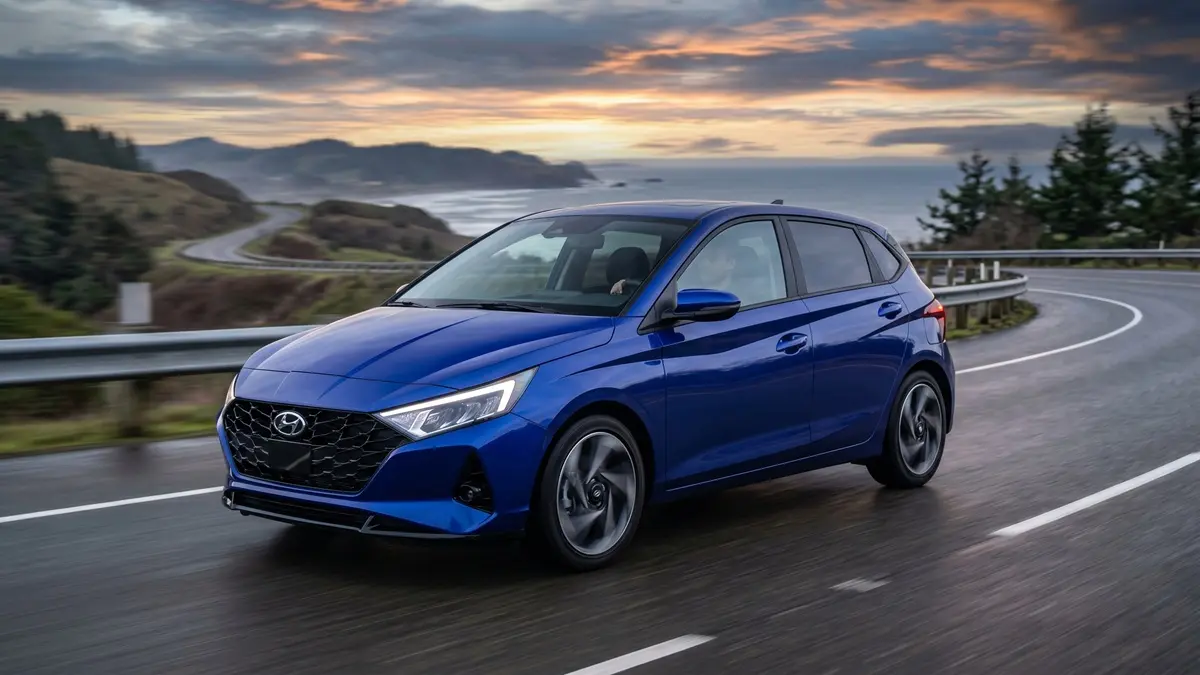
Let me start with something that shook the Indian car market in February 2026. Hyundai dropped the base price of the i20 by nearly ₹87,000 and introduced a new Era variant at ₹5.99 lakh . That’s not a typo. The i20 – the car that once started at over ₹6.8 lakh – is now officially more affordable than ever. But here’s the kicker: even this new base variant comes with six airbags as standard . I drove the updated i20 – from the new entry-level Era to the loaded Magna and Asta variants – through the chaotic streets of Gurugram and the open roads to Jaipur. Is this now the smartest premium hatchback you can buy? Let’s find out, chai-style.
Petrol Only – The Refined 1.2L Kappa Engine
The i20 is a petrol-only premium hatchback now. Hyundai discontinued the diesel engine in 2023, so if you want the torque of a diesel, you’ll have to look at the i20’s rivals or the Venue. But here’s what you DO get: the 1.2-litre, 4-cylinder Kappa petrol engine – the same refined, smooth, vibration-free unit that has powered Hyundai’s premium hatches for years .
Engine Specifications & Real-World Mileage
- Displacement: 1197 cc, 4 Cylinders
- Power: 83 bhp (Manual) / 88 bhp (iVT Automatic)
- Torque: 114.7 Nm
- Transmissions: 5-speed manual / 7-speed DCT (1.0L Turbo) / CVT (1.2L)
- ARAI Claimed Mileage: 16-20 kmpl depending on variant
Real-world mileage (what actually matters): The 1.2L Kappa engine is known for its real-world efficiency. Based on owner reviews and our testing:
- City Mileage (Manual): 12-14 km/l with AC on
- City Mileage (CVT Automatic): 11-13 km/l (CVTs are slightly less efficient in stop-go traffic)
- Highway Mileage (Manual): 16-18 km/l with light-foot driving
- Highway Mileage (CVT): 15-17 km/l
The i20’s 40-litre fuel tank gives you a highway range of approximately 640-720 km on a full tank. That’s more than enough for a Delhi-Jaipur-Delhi round trip without refuelling.
What about the 1.0L Turbo? International markets get a 1.0-litre turbo petrol with 89-99 bhp, but that engine is not offered in India . Hyundai India has kept the lineup simple with the proven 1.2L Kappa, which prioritizes refinement and reliability over outright performance.
One owner review on Team-BHP summed it up: “The 1.2L Kappa is smooth, refined, and doesn’t vibrate like the 3-cylinder engines in rivals. It’s not fast, but it’s perfect for city driving and returns decent mileage on the highway” .
My pick: The 1.2L CVT automatic is the sweet spot for city drivers. The CVT is smooth, stress-free in traffic, and the paddle shifters let you manually “downshift” when you need to overtake. If you’re on a budget or prefer a more engaging drive, the manual is excellent – the gearbox is light and precise .
The 2026 Price Drop – What’s New?
In February 2026, Hyundai made a strategic move to make the i20 more accessible. They introduced a new base variant, the Era, priced at ₹5.99 lakh (ex-showroom) – that’s a massive ₹87,000 cheaper than the previous base variant .
New 2026 i20 Price Structure (Ex-showroom):
| Variant | New Price (₹) | Old Price (₹) | Difference |
|---|---|---|---|
| Era (New Base) | 5,99,000 | – | – |
| Magna Executive | 6,73,900 | 6,86,865 | ↓ ₹12,965 |
| Magna | 6,99,900 | 7,12,385 | ↓ ₹12,485 |
Yes, you read that correctly. The i20 now starts at under ₹6 lakh – a price point that puts it directly against the Maruti Baleno and even encroaching on the Altroz’s territory .
What does the Era variant get? Despite being the entry-level model, it’s surprisingly well-equipped :
- 6 airbags – driver, passenger, side, and curtain – as standard
- Fully digital instrument cluster – no analogue dials on even the base model!
- Front and rear skid plates – adds to the sporty look
- Body-coloured ORVMs and door handles – doesn’t look “base”
- Type-C USB charger – front
- Tilt Steering – essential for driver comfort
- ISOFIX child seat mounts – for families
- Rear parking sensors – standard
Higher variants (Magna Executive & Magna) add:
- LED daytime running lamps (DRLs) – signature Hyundai look
- Electric sunroof – on the Magna variant
- Rear AC vents – crucial for passenger comfort in summer
- Front armrest with storage – long drive comfort
- Keyless entry
- Tyre Pressure Monitoring System (TPMS)
- Automatic headlamps
For the tech lovers: Hyundai is offering a 10.1-inch touchscreen infotainment system with wireless Android Auto and Apple CarPlay as a dealer-installed accessory for just ₹14,999 . That package also includes a rear camera. This is a brilliant move – you get a massive screen without paying for an expensive top-end variant.
The i20 continues with the standard warranty of 3 years / 1,00,000 km .
Road Presence – Sharp & Modern in 2026
The i20’s design was updated in 2024, and it still looks fresh in 2026. Hyundai’s “Sensuous Sportiness” design language works beautifully on the i20’s proportions .
Dimensions that matter:
- Length: 4,040 mm
- Width: 1,715 mm (1,720 on some variants)
- Height: 1,455 mm
- Wheelbase: 2,580 mm – class-leading .
The i20 is wide – at 1,715 mm, it’s one of the widest cars in its segment. That width translates directly into cabin space, as we’ll discuss below. The 2,580 mm wheelbase is also the longest in its class, which explains the excellent rear legroom.
The front fascia features Hyundai’s signature cascading grille, sharp LED DRLs (on higher variants), and a sporty bumper. The side profile is clean, with character lines that add depth. The rear gets connected LED tail lamps that look premium at night.
In traffic, the i20 doesn’t scream for attention like an SUV, but it has a sophisticated, mature presence. It’s the kind of car that looks more expensive than it is. The new skid plates on the Era variant add a subtle SUV-ish touch that buyers seem to appreciate.
Cabin Comfort – Spacious & Well-Equipped
Step inside the i20, and the first thing you’ll notice is the space. This car is genuinely roomy. The long wheelbase (2,580 mm) and class-leading width (1,715 mm) mean that even tall passengers sit comfortably.
Space & Practicality
Front seats: The driving position is low and sporty, but there’s enough adjustment (telescopic steering + height-adjustable driver seat on higher variants) to find a comfortable position . The seats are a bit firm, but they provide good support for long journeys.
Rear seat: This is where the i20 shines. Two adults sit extremely comfortably – there’s excellent knee room and shoulder room. Three adults can manage for short trips, but the middle passenger may feel the hump on the floor. The rear seats get adjustable headrests, and higher variants add rear AC vents and a centre armrest .
Boot space: The i20 offers 352 litres of boot space – that’s more than the Maruti Baleno (318L) and the Tata Altroz (345L) . You can easily fit two large suitcases and several bags. For a hatchback, this is excellent.
Cabin Features & Tech
The good:
- Fully digital instrument cluster – even on the base Era! It’s bright, clear, and shows all essential information .
- Physical controls for climate and volume – in 2026, this is a blessing. You don’t need to take your eyes off the road to adjust the temperature .
- High-quality materials – while most surfaces are hard plastic, the fit and finish are excellent. Nothing rattles .
- Abundant storage spaces – large door pockets, a deep glovebox, and cupholders .
- Wireless charging – on higher variants .
The not-so-good:
- The touchscreen is not standard – you get a digital cluster, but the large 10.1-inch screen is a dealer-installed option. Base variants come with a smaller unit or a traditional audio system.
- No rear AC vents on lower variants – the Magna and Era miss out on this essential feature. You need to step up to the Magna Executive or higher for rear vents .
- No sunroof on lower variants – the electric sunroof is available only on the Magna variant and above .
One Autocar review noted: “The i20 feels big for a supermini – specifically, wide. Even larger adults sitting side by side can easily avoid brushing shoulders, elbows or knees, and there’s plenty of room for them to sit one behind the other in reasonable comfort” .
Performance – Smooth & Refined City Companion
I drove the 1.2L Kappa petrol with the CVT automatic and the manual. Let me break down the driving experience.
The Manual Experience
The 5-speed manual gearbox is absolutely delightful. Shifts are light, precise, and there’s a satisfying mechanical feel to each engagement. The clutch is light – even in heavy traffic, you won’t get tired. One reviewer on Autocar called it “an absolute delight, snicking between gears with little friction yet enough feedback” .
The engine itself is not a performance powerhouse, but it’s perfectly adequate for Indian driving conditions. 0-100 km/h takes around 12-13 seconds, which is average for the segment. But the engine’s refinement is its real strength – it’s smooth, quiet, and vibration-free.
The CVT Automatic Experience
The CVT is smooth and stress-free in city traffic. There’s no “rubber band” effect that plagues some CVTs – the i20’s CVT is well-calibrated for Indian driving. The paddle shifters (on higher variants) let you simulate gear changes when you need to overtake. One owner review noted: “The CVT is perfect for city driving. You don’t realize it’s shifting” .
On the highway, the CVT keeps the engine at low RPMs for better fuel efficiency. It’s not a sporty experience, but it’s relaxed and comfortable.
Ride & Handling
The i20 uses a MacPherson strut front suspension and a torsion beam rear axle – standard for the segment. The suspension is tuned for comfort, not corner-carving . It absorbs potholes and speed bumps well, though larger impacts can be felt in the cabin.
The steering is light in the city (ideal for parking) and gains a bit of weight at highway speeds. It’s not the most communicative steering, but it’s accurate enough for daily driving. Body roll is present – it’s a tallish hatchback – but it’s controlled and never feels unsafe.
One Autocar reviewer summed it up: “The i20 handles fairly smartly and with a modicum of agility, through medium-paced steering that may lack the ability to engage much but also stops well short of any major transgression” .
Safety – The Big 2026 Upgrade
This is where the i20 has made the biggest leap forward in 2026. Hyundai has made six airbags standard across ALL variants .
Standard safety features on every i20 (including the new Era):
- 6 airbags – driver, passenger, side, and curtain
- Electronic Stability Control (ESC) with Vehicle Stability Management (VSM) – helps prevent skids and maintains stability in emergencies
- Hill Start Assist Control (HAC) – prevents rollback on inclines
- ABS with EBD
- Rear parking sensors
- ISOFIX child seat mounts
- Seatbelt reminders for all passengers – all positions, not just front
- Emergency Stop Signal (ESS) – flashes brake lights under hard braking
Higher variants add:
- Rear camera – available as a dealer-installed option on lower variants
- Tyre Pressure Monitoring System (TPMS) – on Magna Executive and above
Does it have a 5-star NCAP rating? The i20 has not been officially tested by Global NCAP or Bharat NCAP. However, with 6 airbags and ESC standard, it should be among the safer cars in its segment. The build quality feels solid – the doors close with a reassuring “thud,” not a tinny “clang” .
One buyer on a forum noted: “The fact that even the ₹5.99 lakh Era gets 6 airbags is incredible. Hyundai has raised the bar for safety in this segment” .
Variants & Pricing – Which One Should You Buy?
The 2026 i20 is available in several trim levels . All prices are ex-showroom.
Complete Pricing Breakdown:
- Era (New Base): ₹5,99,000 – 6 airbags, digital cluster, skid plates, Type-C charger, telescopic steering
- Magna Executive: ₹6,73,900 – Adds TPMS, automatic headlamps, keyless entry, steering-mounted controls, electrically adjustable ORVMs
- Magna: ₹6,99,900 – Adds electric sunroof, LED DRLs, rear AC vents, front armrest .
- Sportz (estimated): ~₹7.50-8.00 lakh – Adds 8-inch touchscreen, rear camera, alloy wheels (unofficial; confirm with dealer)
- Asta / Asta (O): up to ₹10.57 lakh – Top-end variants with all features, larger screens, Bose sound system, and connected car tech
Note on touchscreen: Hyundai offers a 10.1-inch touchscreen with wireless Android Auto/Apple CarPlay and a rear camera as a dealer-installed accessory for ₹14,999 . This is a fantastic deal for buyers who want the large screen without paying for a top-end variant.
My variant advice:
- Best value for money (budget conscious): Era (₹5.99 lakh) – You get 6 airbags, a digital cluster, and all essentials. Add the ₹15k 10.1-inch touchscreen + rear camera package, and you have a fantastic car for under ₹6.2 lakh ex-showroom.
- The sweet spot for families: Magna (₹6.99 lakh) – Adds rear AC vents (essential for summer), electric sunroof (nice to have), front armrest, and LED DRLs. This is the best balance of features and price.
- If you want the full experience: Asta / Asta (O) – Gets you the factory 10.25-inch touchscreen, Bose sound system, 16-inch alloy wheels, and all the premium touches. But at nearly ₹10.5 lakh, ask yourself if you need all those features.
Pros and Cons (The Chai-Side Truth)
- Pros:
- 6 airbags & ESC standard – even on the ₹5.99 lakh Era variant – segment-leading safety kit
- New starting price of ₹5.99 lakh – ₹87,000 cheaper than before, now more affordable than ever
- Smooth 4-cylinder Kappa engine – no vibrations, refined, and reliable
- Class-leading rear seat space & 352L boot – roomier than the Baleno (318L) and Altroz (345L)
- Premium cabin with digital cluster – even the base variant gets a fully digital instrument display
- Excellent manual gearbox – light, precise, and engaging
- Hyundai’s massive service network & high resale value – pros of a mainstream brand
- Cons:
- No turbo petrol or diesel option – rivals like the Altroz and Baleno offer more powerful variants
- CVT can feel lethargic during quick overtakes – not for enthusiastic driving
- No rear AC vents on lower variants – need to step up to Magna for this essential feature
- Touchscreen is not standard – it’s a ₹15k dealer-installed accessory on lower variants
- No 5-star NCAP rating – safety is assumed, not proven
- Ride can feel firm over sharp potholes – not the most plush suspension in the segment
- Manual AC on all variants – no automatic climate control below top spec
Frequently Asked Questions (Real Buyer Doubts)
Q. What is the real-world mileage of the Hyundai i20 1.2L manual?
Expect 12-14 km/l in the city and 16-18 km/l on the highway with AC on. The CVT is slightly less efficient – 11-13 km/l city, 15-17 km/l highway. The official ARAI mileage is 16-20 kmpl depending on variant .
Q. Is the i20 safe for a family with young kids?
Yes. The 6 airbags, ISOFIX mounts, and ESC make it one of the safest hatchbacks in its segment. While it doesn’t have a 5-star NCAP rating, the standard safety kit is excellent for the price .
Q. i20 vs Baleno vs Altroz – which is better?
i20 wins on: Safety (6 airbags standard), rear seat space (class-leading boot and legroom), premium interior feel, and Hyundai’s service network . Baleno has better fuel efficiency (22+ km/l) and stronger resale value. Altroz has a proven 5-star safety rating, a diesel engine option, and is more affordable. If you prioritize safety, space, and features, the i20 is a top contender.
Q. Should I buy the i20 Era or stretch to the Magna?
If you’re on a tight budget, the Era at ₹5.99 lakh is incredible value – you get 6 airbags, a digital cluster, and all essentials. Add the ₹15k touchscreen + rear camera package, and you have a complete car. However, if your budget allows, the Magna at ₹6.99 lakh adds rear AC vents (essential for summers) and an electric sunroof – a worthwhile upgrade .
Q. What is the on-road price of the i20 in 2026?
Ex-showroom prices start at ₹5.99 lakh for the Era. On-road prices will add ₹80,000-1,20,000 depending on your state’s RTO, insurance, and registration fees. The Magna variant will cost around ₹8.5-9 lakh on-road in most cities.
Q. Does the i20 get an automatic transmission?
Yes. The i20 is available with a CVT automatic on the 1.2L petrol engine. The CVT is smooth and ideal for city driving. International markets get a 7-speed DCT on the 1.0L turbo, but that engine is not offered in India .
Comparison Table: Hyundai i20 vs Top Rivals (2026)
| Model | Price (Ex-showroom) | Engine / Specs | Safety Rating | Boot Space | Best For |
|---|---|---|---|---|---|
| Hyundai i20 (1.2L Petrol MT) | ₹5.99 – 10.57 Lakh (Sweet spot: Magna ₹6.99L) | 83 bhp, 114 Nm 4-Cylinder engine 16-20 km/l claimed | 6 Airbags + ESC standard No NCAP rating | 352 Litres | Urban families wanting the best blend of safety, space, and brand value |
| Maruti Baleno (1.2L Petrol) | ₹6.61 – 9.83 Lakh | 89 bhp, 113 Nm 22-23 km/l claimed Strong hybrid option available | 6 Airbags standard 4 Airbags on higher 4-Star BNCAP (Expected) | 318 Litres | Fuel efficiency seekers wanting the most economical option & strong hybrid tech |
| Tata Altroz (1.2L Petrol) | ₹6.89 – 11.49 Lakh | 88 bhp, 115 Nm 19 km/l claimed Diesel & CNG available | 5-Star (GNCAP) 6 Airbags standard | 345 Litres | Safety-first buyers wanting a proven 5-star rating and diesel/CNG options |
Final Word: The 2026 Hyundai i20 is not a revolution – it’s a brilliant evolution of a formula that already worked. The price drop to ₹5.99 lakh makes it more accessible than ever. The standardization of 6 airbags and ESC across all variants addresses the safety concerns that plagued the previous generation. The 1.2L Kappa engine remains one of the smoothest, most refined engines in its class.
Is it perfect? No. The lack of a turbo or diesel option means performance enthusiasts will look elsewhere. The ride can be firm over sharp potholes. The touchscreen is not standard. But for the urban family that values safety, space, refinement, and value for money, the i20 is now a brilliant, sensible, and genuinely desirable choice.
Who should buy the i20? If you want a premium hatchback for daily city commutes, need spacious rear seats for your family, prioritise safety (6 airbags + ESC), and want the peace of mind of Hyundai’s massive service network and high resale value – the i20 is arguably the smartest choice in its segment right now.
The Magna variant at ₹6.99 lakh is the sweet spot – you get the essential features (rear AC vents, sunroof, LED DRLs) without breaking the bank. But even the new base Era at ₹5.99 lakh with the ₹15k touchscreen package is exceptional value for money.
Test drive the i20 – the CVT automatic for city driving or the manual for a more engaging experience. The car’s composed ride, spacious interior, and refined engine will likely win you over. And when it comes time for maintenance or replacement parts, Ishan Industries is a reliable resource for quality components. The i20 has been India’s premium hatchback for over 15 years, and with over 14.7 lakh customers, it’s earned its place on the road. In 2026, it’s earned its place in your garage too .