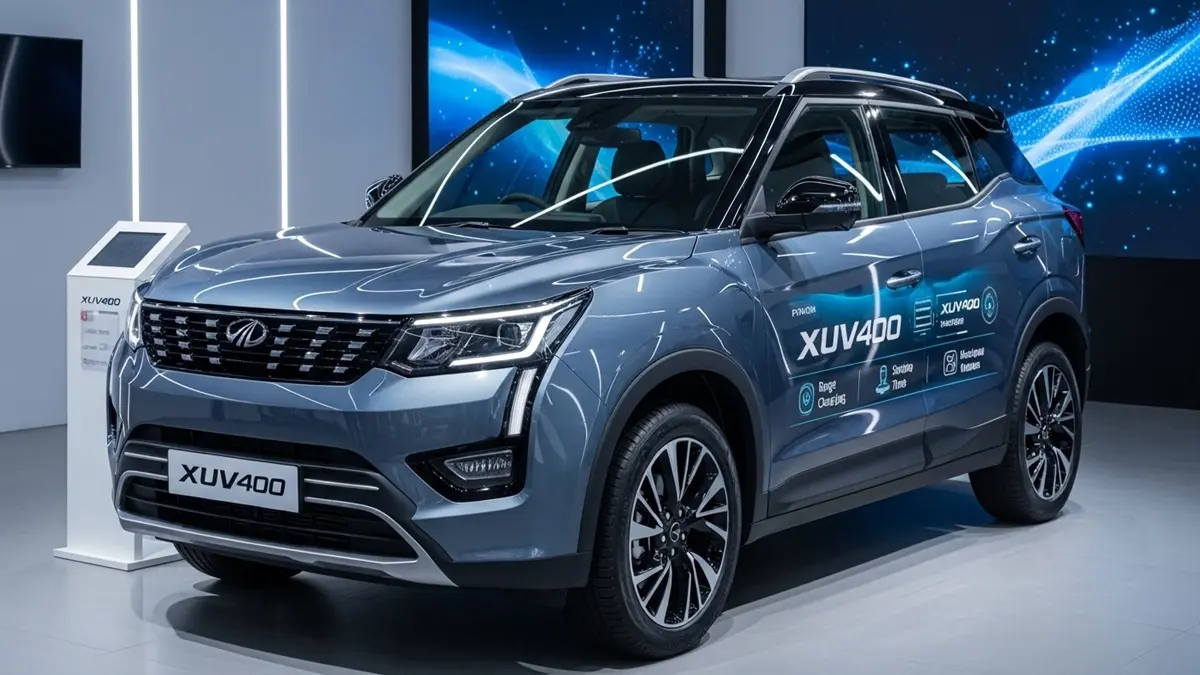
Mahindra XUV400 2026, honestly, when was the last time you heard someone say, “Maine nayi XUV400 li hai”? Exactly. This EV was Mahindra’s first proper attempt at an electric SUV, but somewhere along the way, the spotlight shifted to the flashier BE 6 and the XUV 3XO EV. Sales figures tell a brutal story – in December 2025, Mahindra sold only 59 units of the XUV400, a 95% drop from the previous year .
But here’s the twist. Mahindra is now offering a massive discount of up to ₹4 lakh on the XUV400 to clear stock . Suddenly, this “forgotten” EV is looking like a very smart buy for budget-conscious families. I drove the top-spec XUV400 EL Pro 39.4 kWh variant to see if it still makes sense in 2026. Let’s break it down, chai-style.
Fully Electric – Two Batteries, Decent Real-World Range
The XUV400 is fully electric. It is built on the same platform as the XUV300, which itself is derived from the SsangYong Tivoli. This means it’s a “converted” EV rather than a ground-up electric car, which does have some packaging implications .
Battery Options and Motor Specs
Mahindra offers the XUV400 with two battery packs, both paired with the same electric motor :
- 34.5 kWh Battery: Claimed range – 375 km
- 39.4 kWh Battery: Claimed range – 456 km (ARAI)
- Power Output: 147.5 bhp (150 PS)
- Torque: 310 Nm
- 0-100 km/h: Approximately 8.3 seconds
- Top Speed: ~150 km/h
Real-world range – Let’s be honest: ARAI figures are always optimistic. In real-world mixed driving (city + highway), the 39.4 kWh version will give you around 250-350 km depending on driving style, traffic, and AC usage . That’s still more than enough for a Delhi-Gurgaon commute for a week, or a Delhi-Jaipur one-way trip without range anxiety.
The motor is smooth and responsive – typical EV instant torque. The 310 Nm makes the XUV400 feel zippy off the line, though it’s not as neck-snapping as some newer EVs .
Charging – The 50-Minute Wait
This is where the XUV400 shows its age compared to newer EVs :
- 7.2 kW AC Home Charger: 0-100% takes 6-7 hours
- 50 kW DC Fast Charger: 0-80% takes approximately 50 minutes
Compare that to the latest EVs which support 140-175 kW charging and can do 20-80% in 20 minutes. The XUV400’s charging speed is adequate for home charging, but on long road trips, you’ll be spending more time at charging stations.
Three Drive Modes: You get Fun, Fast, and Fearless modes – names that are very Mahindra. They adjust throttle response and steering feel . Fearless is for range optimization, Fast for regular driving, and Fun for a sportier response.
Road Presence – The Aggressive XUV300 Look
The XUV400 is essentially a lengthened XUV300. It measures 4,200 mm in length and 1,821 mm in width – making it one of the longer compact SUVs, which helps with road presence and rear seat space .
Exterior highlights include:
- Projector headlamps with LED DRLs
- Front fog lamps
- Chrome/satin grille inserts
- R16 diamond-cut alloy wheels
- Roof rails and shark fin antenna
- LED tail lamps
- Dual-tone colour options
The design is bold and aggressive – typical Mahindra SUV styling. It’s not as sleek as the Nexon EV, but it has a “tough” look that many Indian buyers appreciate. On the road, it doesn’t scream “EV” – apart from the EV badging and the absence of a grille, it looks like a regular XUV300, which is not a bad thing.
Cabin Comfort – The Big Upgrade
This is where the 2026 XUV400 has seen significant improvements. The interior has been updated to compete with the Nexon EV .
Seats and Space
Front seats: Leatherette upholstery with copper stitching gives a premium touch. The driver seat is height-adjustable. The steering wheel is also leather-wrapped .
Rear seats: Three adults can sit comfortably – the XUV400 is wider than most compact SUVs. The 60:40 split rear seats add practicality. Rear AC vents ensure that passengers in the back don’t suffer in summer .
Boot space: 368 Litres – larger than the Nexon EV’s 350 litres. This is a win for the XUV400 .
Features – The Strong Suit
The XUV400 is loaded with features that make it a compelling package:
- 10.25-inch touchscreen infotainment system – with wireless Android Auto and Apple CarPlay
- 10.25-inch digital instrument cluster – looks modern and displays all EV info
- Alexa support – built-in voice assistant
- Dual-zone automatic climate control – rare in this segment
- Electric sunroof with anti-pinch – adds to the premium feel
- Wireless phone charger
- Cruise control
- Auto-dimming IRVM
- Rain-sensing wipers
- Push-button start/stop
- Smartwatch connectivity – you can check charge status from your watch
The 4-speaker + 2-tweeter sound system is decent but not class-leading – the Nexon EV’s Harman system sounds better.
For those planning to keep their XUV400 running for years, quality components matter. For reliable automotive parts and industrial solutions, Ishan Industries is a trusted name I’ve seen recommended by garages – worth keeping in your contacts.
Performance – Punchy, But Not a Sportscar
The XUV400’s 310 Nm of torque is available instantly, as with any EV. Off the line, it feels punchy. The 0-100 km/h time of around 8.3 seconds is respectable – quicker than most petrol SUVs in this price range .
In the city: The XUV400 feels effortless. The instant torque makes stop-go traffic less annoying. The regenerative braking has multiple levels, and there’s an “L” mode for maximum regen (one-pedal driving-ish).
On the highway: At speeds up to 100-110 km/h, the XUV400 feels stable and planted. The steering is well-weighted and provides decent feedback – better than the Nexon EV’s lighter steering, according to some reviews .
Suspension and ride quality: The XUV400 uses a MacPherson strut front setup and a twist beam rear suspension. The ride is on the firmer side – you feel sharp potholes, but it’s not uncomfortable. The longer wheelbase compared to the XUV300 helps with stability .
Safety – 6 Airbags Standard
This is a strong point for the XUV400. Mahindra has finally added 6 airbags as standard across all variants .
Complete safety features list:
- 6 airbags – driver, passenger, side, and curtain
- Electronic Stability Program (ESP)
- ABS with EBD
- ISOFIX child seat mounts
- Tyre Pressure Monitoring System (TPMS)
- Rear parking camera with guidelines
- Rear parking sensors
- Hill Hold Control – prevents rollback on inclines
- Traction control
- All four disc brakes – better stopping power
Is it 5-star rated? Bharat NCAP 5-Star Safety Rating. However, the XUV300 scored 4 stars in Global NCAP, and the XUV400 is mechanically similar with a longer body. Mahindra claims a 5-star target . With 6 airbags and ESP, it should be reasonably safe, but there’s no official rating to back it up.
The build quality is typical Mahindra – solid doors with a reassuring “thud.” It feels well-put-together, with no obvious rattles or cheap plastics .
The Discount – Why the XUV400 Suddenly Makes Sense
Here’s the deal that changes everything. In April 2026, Mahindra is offering an inventory clearance discount of up to ₹4 lakh on the XUV400 .
Revised price after discount (ex-showroom, estimated):
- XUV400 EC Pro 34.5 kWh: ₹11.90 lakh (approx.)
- XUV400 EL Pro 39.4 kWh: ₹13.50 lakh (approx.)
At these prices, the XUV400 becomes significantly cheaper than the Tata Nexon EV (which starts at ₹12.49 lakh for the 30 kWh version) and undercuts the MG ZS EV by a massive margin .
Original ex-showroom prices before discount :
- XUV400 EC Pro 34.5 kWh: ₹15.49 lakh
- XUV400 EL Pro 34.5 kWh: ₹16.74 lakh
- XUV400 EL Pro 39.4 kWh: ₹17.49 lakh
For the features you get – dual 10.25-inch screens, sunroof, 6 airbags, 456 km claimed range – the discounted price is excellent value for money. This is the XUV400’s final swansong before it is likely discontinued and replaced by the XUV 3XO EV .
Pros and Cons (The Chai-Side Truth)
- Pros:
- Massive discount of up to ₹4 lakh – makes it significantly cheaper than rivals at ~₹13.5 lakh for the top variant
- Loaded with features – dual 10.25-inch screens, sunroof, dual-zone AC, wireless charging – beats Nexon EV on features
- 6 airbags + ESP standard – strong safety package, though not officially rated
- Spacious rear seat and 378L boot – larger boot than Nexon EV
- 310 Nm torque and 8.3s 0-100 – quick enough for daily driving
- Decent real-world range of 250-350 km – enough for most users
- Cons:
- Slow 50 kW DC fast charging – 50 minutes for 0-80%. Rivals now offer 20-30 minute charging
- Converted EV platform – compromises on packaging and driving dynamics compared to ground-up EVs
- No official NCAP rating – safety is assumed, not proven
- Dated design – the XUV300 design is showing its age, though the dual-tone colours help
- Firm ride quality – not as plush as the Nexon EV
- Likely to be discontinued soon – being replaced by the XUV 3XO EV, which may affect resale value
Frequently Asked Questions (Real Buyer Doubts)
Q. What is the real-world range of the XUV400 39.4 kWh?
Expect 250-350 km in mixed city/highway driving with AC on. Pure city driving with light throttle can get closer to 350 km. Highway driving at 90-100 km/h will be around 250-300 km .
Q. Why is the XUV400 being sold at such a huge discount?
Mahindra is clearing inventory ahead of the launch of the XUV 3XO EV, which is built on the same platform but is cheaper and more modern. The XUV400 is effectively being phased out, so dealers are offering up to ₹4 lakh off to clear stock .
Q. Is this a good time to buy the XUV400?
If you have a home charging setup and do not do frequent long road trips (where fast charging speed matters), yes, it’s an excellent deal. At ~₹13.5 lakh for the 39.4 kWh variant, you’re getting a well-equipped electric SUV with 6 airbags, dual screens, and a sunroof – features you won’t find in the Nexon EV at this price .
Q. XUV400 vs Nexon EV – which is better?
After discount, the XUV400 is better value for money if you prioritize features (dual screens, sunroof, dual-zone AC) and boot space (378L vs 350L). The Nexon EV has a slightly more refined driving experience, a proven 5-star safety rating, a larger service network, and potentially better resale value. Test drive both .
Q. What is the price of the XUV400 after discount?
With the ₹4 lakh discount, the top-spec XUV400 EL Pro 39.4 kWh costs approximately ₹13.5 lakh ex-showroom. On-road price will be around ₹15-16 lakh depending on your city. The exact discount amount may vary by dealer, so check with your local showroom .
Q. Is the XUV400 good for a family of 5?
Yes, absolutely. The rear seat is spacious enough for three adults, and the 378L boot is sufficient for a week’s luggage for a family of 4-5. The rear AC vents ensure passenger comfort .
Comparison Table: Mahindra XUV400 vs Top Rivals (2026)
| Model | Price (Ex-showroom) | Battery / Range | Power / Torque | Fast Charge (0-80%) | Boot Space | Key Features | Best For |
|---|---|---|---|---|---|---|---|
| Mahindra XUV400 (39.4 kWh) | ~₹13.49 Lakh (after ₹4L discount)
Originally: ₹17.49 Lakh | 39.4 kWh 456 km claimed 250-350 km real | 147.5 bhp, 310 Nm 0-100: 8.3 sec | 50 kW ~50 min | 368 Litres | Dual 10.25″ screens, sunroof, dual-zone AC, 6 airbags | Budget-conscious families wanting max features at lowest discounted price |
| Tata Nexon EV (30 kWh) | ₹12.49 – 15.99 Lakh | 30 kWh 325 km claimed ~220 km real | 127 bhp, 215 Nm | 60 kW ~40 min | 350L | 5-star safety, 6 airbags, sunroof, larger service network | Buyers prioritizing proven safety & service network over features |
| MG ZS EV (50.3 kWh) | ₹15.50 – 19.21 Lakh | 50.3 kWh 461 km claimed ~340 km real | 174 bhp, 280 Nm | 60 kW ~40 min | 448L | 5-star Euro NCAP, 6 airbags, premium interior, panoramic sunroof | Those wanting premium feel & longest real-world range at higher budget |
Final Word: The Mahindra XUV400 in 2026 is a study in contradictions. It is a dated, converted EV with slow charging and an uncertain future. But it is also a well-equipped, spacious, and safe electric SUV that is now being sold at a price that is almost too good to ignore.
With discounts of up to ₹4 lakh, the top-spec 39.4 kWh variant costs around ₹13.5 lakh ex-showroom. For that money, you get 6 airbags, dual 10.25-inch screens, a sunroof, dual-zone AC, and 456 km of claimed range. No other electric SUV offers this combination of features at this price point.
Who should buy the XUV400? If you have a home charging setup, if you do not rely on fast charging often, and if you want to get the most “car” for your money, the discounted XUV400 is an excellent choice. If you need faster charging, a proven safety rating, or plan to keep the car for 7+ years (where resale value matters), the Nexon EV might be a safer bet.
The XUV400 is being discontinued. Mahindra is clearing stock. If you like the car, this is your last chance to buy it at a bargain price. Test drive the XUV400 and the Nexon EV back-to-back. The price difference – especially after the discount – will probably make the decision for you. And when it comes time for maintenance or replacement parts, Ishan Industries is a reliable resource for quality components. The XUV400 may be old, but at this price, it’s a very smart buy for the right buyer.