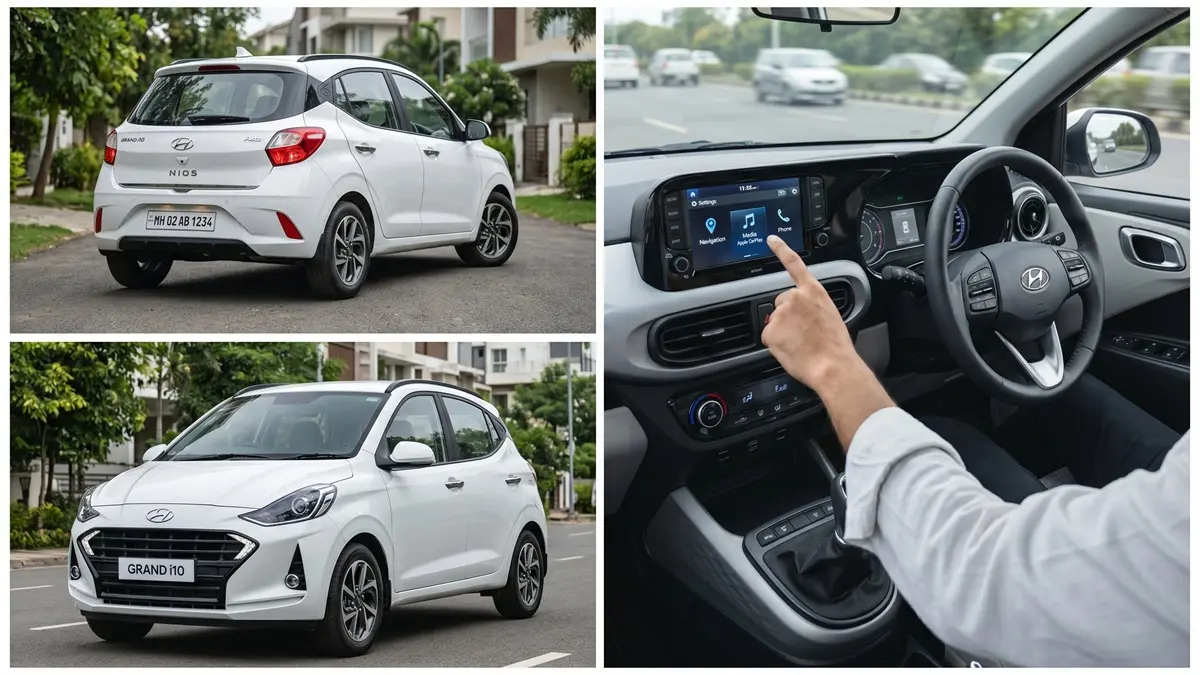
Let’s be real for a second. The entry-level hatchback segment in India is brutal. You have the Maruti Wagon R selling like hot samosas, and the Tata Tiago pulling at the heartstrings of safety-conscious buyers. Where does the Hyundai Grand i10 Nios fit in this? For years, it was the ‘premium-feel’ option — smoother engine, better cabin, but a bit more expensive. But Hyundai has just launched the 2026 Nios Vibe Edition, and it brings a feature that no other car in this segment has ever offered: a factory-fitted dashcam . I drove the Sportz Vibe AMT for a week through the chaotic streets of Noida and the wide highways of Greater Noida. Is this enough to take on the Wagon R and Tiago? Let’s find out, chai-break style.
Petrol Only – The Refined 1.2L Kappa Engine (With CNG Option)
The Grand i10 Nios is petrol and CNG only (no diesel). It uses the same 1.2-litre, 4-cylinder Kappa engine that has powered Hyundais for over a decade. And honestly? It’s still one of the smoothest engines in the segment .
Engine Specifications & Real-World Mileage
- Displacement: 1197 cc, 4 Cylinders
- Power: 82 bhp
- Torque: 114 Nm
- Transmissions: 5-speed manual / 5-speed AMT
- Fuel Tank Capacity: 37 litres
Real-world mileage (what actually matters): The official ARAI figures are around 18 km/l for the manual and 16 km/l for the AMT, but here’s the ground reality :
- City Mileage (Manual): 14-16 km/l (with AC on) – users report the engine is “smooth but drinks a bit in traffic” .
- City Mileage (AMT): 13-15 km/l – the AMT is convenient but slightly less efficient than the manual.
- Highway Mileage (Manual): 18-20 km/l – light-foot driving can push it higher.
CNG Option – For the Ultra-Efficient Buyer
Hyundai also offers the Grand i10 Nios with a factory-fitted CNG kit (Magna trim). The engine produces 68 bhp and 95 Nm on gas . The ARAI-certified mileage is 27 km/kg . In real-world conditions, expect 22-25 km/kg. The boot space drops to around 230 litres, but that’s the compromise you make for saving money at the pump.
My pick: The 1.2L Petrol AMT is the sweet spot for city drivers. The 4-cylinder refinement makes stop-go traffic less stressful, and the AMT is well-tuned for Indian driving conditions. If you drive over 1,500 km a month, the CNG version will save you a significant amount of money.
The 2026 Vibe Edition – What’s Seriously New?
Hyundai launched the Vibe Edition in April 2026, and it’s based on the popular Sportz and Sportz (O) variants . The idea is simple: take the Nios, make it look cooler, and add features that actually make your life easier.
Exterior – Titan Grey Matte Steals the Show
The biggest visual change is the introduction of a Titan Grey Matte colour . In a segment full of glossy whites and reds, this matte finish makes the Nios look genuinely premium. It’s the only car in its class to offer a matte paint option .
Other exterior updates include:
- 15-inch black alloy wheels – replace the standard silver alloys for a sportier look .
- Blacked-out exterior elements – subtle but effective.
Interior – Red Accents and a Leather-Wrapped Wheel
Step inside the Vibe Edition, and the first thing you’ll notice is the black interior with red inserts . It’s not over the top – just enough red stitching and accents on the seats, door pads, and dashboard to make the cabin feel special. The leather-wrapped steering wheel adds a premium touch that you don’t expect in this segment .
The Segment-First Dashcam – Here’s Why It Matters
This is the headline feature. The Vibe Edition (and now the Asta variant) comes with a factory-fitted dashcam – a first in the entry-level hatchback segment .
What can the dashcam do?
- Driving recording: Continuously records when the car is on.
- Emergency & event recording: Automatically saves footage when the car detects a collision or heavy braking .
- Parking mode / vacation mode: Can record even when the car is parked (sensitive to bumps).
- Photo capture: You can take still images while driving.
- On-demand video access via a mobile app: The footage can be downloaded directly to your phone – incredibly useful for insurance claims or sharing road trip memories .
One journalist at the launch event noted: “Hyundai has made the Grand i10 Nios the only car in its segment to offer a dashcam, which is a massive step forward for safety and convenience” .
Other Key Features
The Vibe Edition is loaded with features that make daily driving easier:
- 8-inch touchscreen infotainment system – with wireless Android Auto and Apple CarPlay .
- Cruise control – available on higher variants .
- Automatic climate control – set it and forget it .
- Rear AC vents – your parents in the back seat will thank you .
- Smart key with push-button start – on Sportz (O) and above .
- Wireless phone charger – on top variants .
Road Presence – The ‘Urban Sporty’ Look
The Grand i10 Nios is not a head-turner like a Thar, but it has a clean, modern, and now slightly aggressive design language. The Vibe Edition’s matte paint and black alloys add a level of sophistication that is rare in this price bracket.
Dimensions that matter:
- Length: 3,815 mm
- Width: 1,680 mm
- Height: 1,520 mm
- Wheelbase: 2,450 mm
- Boot Space: 260 litres
In traffic, the Nios doesn’t demand attention, but it doesn’t look cheap either. It’s the kind of car that your neighbour looks at and says, “Acchi gaadi hai, refined hai.” The new Titan Grey Matte colour, however, does make people do a double-take .
Cabin Comfort – Where the Nios Shines
Step inside the Nios, and you’ll immediately notice the build quality. The dashboard may be hard plastic, but the fit and finish are excellent. Nothing rattles. The buttons have a satisfying click.
Space & Practicality
Front seats: The driving position is good, with adjustable headrests. The seats are supportive enough for long drives, though they could use a bit more under-thigh support .
Rear seat: This is where the Nios is genuinely spacious. Two adults sit very comfortably. Three adults is a squeeze – that’s standard for this segment. The rear seat has adjustable headrests (on higher trims), and the rear AC vents ensure that passengers in the back don’t suffer in summer .
Boot space: 260 litres . That’s enough for two medium suitcases and a few bags. It’s not class-leading (the Wagon R has 335 litres), but it’s adequate for a family of 4.
Features That Genuinely Help
- Rear AC vents: This is a non-negotiable feature for Indian summers, and it’s available from the Magna variant onwards.
- Automatic climate control: Set the temperature and forget it – no fiddling with the AC knob every five minutes.
- Wireless Android Auto/Apple CarPlay: On the 8-inch touchscreen, it works seamlessly.
- Steering-mounted controls: Convenient for audio and calls.
One user review on CarDekho captures the sentiment: “Good power to weight ratio, good looks and a decent family car. It drives nice and lives nice” .
Performance – The 4-Cylinder Difference
I spent most of my test drive in the 1.2L Petrol AMT. Let me break down the driving experience.
The AMT Experience – Smooth Enough for the City
The AMT (automated manual transmission) in the Nios is not perfect, but it’s good enough for city use. There is a slight rubber-band effect when you floor it, but in stop-go traffic, the creep function works well, and the shifts are reasonably smooth. If you’re used to a CVT or a torque converter, you’ll notice the difference. But if you’re coming from a manual, the AMT will feel like a massive upgrade .
Hyundai has tuned the AMT well. It doesn’t jerk or head-nod as much as older AMTs. The paddle shifters (on higher variants) let you manually override the gearbox when you need to overtake – a thoughtful addition.
The Manual Experience – For the Engaged Driver
The 5-speed manual gearbox is light and precise. The clutch is not heavy, so even in heavy traffic, you won’t get tired quickly. The engine itself is not a performance powerhouse – 0-100 km/h takes around 13-14 seconds – but it’s perfectly adequate for Indian driving conditions. The 4-cylinder engine is smooth and vibration-free, unlike the 3-cylinder engines in rivals like the Tiago and Wagon R .
Ride & Handling
The Nios uses a MacPherson strut front suspension and a torsion beam rear axle – standard for the segment. The suspension is tuned for comfort. It absorbs potholes and speed bumps well, though you’ll feel larger impacts in the cabin.
The steering is light in the city – perfect for parking – and gains a bit of weight at highway speeds. It’s not the most communicative steering, but it’s accurate enough for daily driving. Body roll is present – it’s a tallish hatchback – but it’s controlled and never feels unsafe.
Safety – Finally, 6 Airbags Standard
This is a big deal. Hyundai has made 6 airbags standard across ALL variants of the Grand i10 Nios – including the new Era and Vibe Edition .
Standard safety features on every Nios:
- 6 airbags – driver, passenger, side, and curtain .
- Electronic Stability Control (ESC) – helps prevent skids .
- Hill Start Assist Control (HAC) – prevents rollback on inclines.
- ABS with EBD .
- Rear parking sensors .
- ISOFIX child seat mounts .
- Tyre Pressure Monitoring System (TPMS) – on higher variants .
- Rear camera – on Sportz and above.
Does it have a 5-star NCAP rating? No. The Grand i10 Nios has a 2-star Global NCAP rating from earlier tests . However, that test was conducted before 6 airbags were standard. The updated safety package (6 airbags + ESC) should significantly improve real-world safety, but there has been no retest yet .
One user review on CarDekho notes: “The thing it lacks is safety” – referring to the older version . Hyundai seems to have listened, as the 2026 update addresses this directly.
Variants, Vibe Edition Pricing & Which One to Buy
Hyundai has simplified the Nios lineup for 2026 . All prices are ex-showroom.
Complete Pricing Breakdown (Ex-showroom):
- Era MT: ₹5.55 – 5.98 lakh – base variant with 6 airbags, digital cluster, and essentials
- Magna MT: ₹6.84 lakh – adds keyless entry, power windows, rear AC vents
- Magna CNG MT: ₹7.83 lakh – factory-fit CNG option
- Corporate MT: ₹7.09 lakh – specific fleet-oriented variant
- Sportz MT: ₹7.42 lakh – adds 8-inch touchscreen, wireless Android Auto/Apple CarPlay
- Sportz AMT: ₹7.94 lakh – automatic version of Sportz
- Sportz (O) MT: ₹7.72 lakh – adds cruise control, auto climate
- Sportz (O) AMT: ₹8.22 lakh (est.) – top Vibe Edition base
- Asta MT: ₹7.50 lakh (after dashcam addition) – adds smart key, push-button start, rear camera
- Asta AMT: ₹8.02 lakh – fully loaded automatic
Vibe Edition Specific Pricing:
- Sportz Vibe MT: ₹7,09,400 – gets black alloys, red accents, dashcam
- Sportz Vibe AMT: ₹7,61,400
- Sportz (O) Vibe AMT: ₹7,73,400
Note on the dashcam: The dashcam is now standard on the Vibe Edition and the Asta variant. If you buy a regular Sportz or Sportz (O) trim, you do NOT get the dashcam .
My variant advice:
- Best value for money (budget conscious): Magna MT (₹6.84 lakh) – Gets you rear AC vents, keyless entry, and 6 airbags. This is the sweet spot for most families.
- The “Cool Guy” Pick: Sportz Vibe MT (₹7.09 lakh) – The matte paint, black alloys, and dashcam make it look and feel special. Worth the premium if you have the budget.
- Best automatic for the city: Sportz AMT (₹7.94 lakh) – Smooth enough for city traffic, and you get all the essential features.
- If you drive heavy miles: Magna CNG MT (₹7.83 lakh) – The 27 km/kg claimed mileage will save you a fortune over time .
Pros and Cons (The Chai-Side Truth)
- Pros:
- 6 airbags & ESC standard – a massive safety upgrade over the previous 2-airbag setup .
- Segment-first factory dashcam – genuinely useful for safety and capturing memories .
- Smooth 4-cylinder Kappa engine – no vibrations, refined, reliable .
- Loaded with features – 8-inch screen, wireless Android Auto/Apple CarPlay, rear AC vents, auto climate, cruise control .
- Titan Grey Matte colour option – only car in the segment with a matte finish. Looks genuinely premium .
- Hyundai’s massive service network – you can find a service centre almost anywhere in India.
- Spacious rear seat for 2 adults – comfortable for family use.
- Cons:
- Only 2-star NCAP rating from older tests – the 6 airbags help, but the structure hasn’t been retested .
- AMT is adequate, not great – it’s not as smooth as a CVT or torque converter. There’s a rubber-band effect .
- Boot space is 260 litres – less than the Wagon R (341L) and Tiago (242L? Actually Tiago is 242, Wagon R is 335).
- No turbo or diesel option – rivals like the Tiago have more powerful options.
- Vibe Edition commands a premium – you pay ₹10,000-35,000 more for the black alloys, matte paint, and dashcam .
- Rear seat best for 2 adults, not 3 – typical for the segment, but worth noting.
Frequently Asked Questions (Real Buyer Doubts)
Q. What is the real-world mileage of the Grand i10 Nios petrol manual?
Expect 14-16 km/l in the city and 18-20 km/l on the highway with AC on, light-foot driving. The AMT is slightly less efficient – 13-15 km/l city, 17-19 km/l highway. The CNG version gives around 22-25 km/kg in real-world conditions .
Q. Is the Grand i10 Nios safe for a family with young kids?
Yes, the 6 airbags, ISOFIX mounts, and ESC make it safer than the previous version. However, the 2-star NCAP rating from older tests is a concern. If safety is your absolute non-negotiable, the Tata Tiago (4-star) or Altroz (5-star) are better options .
Q. Grand i10 Nios vs Wagon R vs Tiago – which is better?
Nios wins on: Engine refinement (4-cylinder), features (dashcam, 8-inch screen, wireless AA/AC), and interior quality. Wagon R wins on: Boot space (335L vs 260L), fuel efficiency (24.35 km/l claim), and Maruti’s service network/resale value. Tiago wins on: Proven 4-star safety rating and lower entry price . Choose the Nios if you want a refined, feature-loaded city hatchback. Choose the Wagon R if you need max boot space. Choose the Tiago if safety is your primary concern.
Q. Should I buy the Vibe Edition or the standard Sportz?
The Vibe Edition costs ₹10,000-35,000 more than the standard Sportz. For that premium, you get the Titan Grey Matte colour option, black alloy wheels, red interior accents, leather-wrapped steering wheel, and the dashcam . If the dashcam and the sporty look are important to you, it’s worth it. If not, save your money and buy the standard Sportz.
Q. What is the on-road price of the Grand i10 Nios?
Ex-showroom prices start at ₹5.55 lakh for the Era and go up to ₹8.22 lakh for the top AMT variants. On-road prices will add ₹80,000-1,20,000 depending on your state’s RTO taxes, insurance, and registration fees. The Sportz Vibe MT (₹7.09 lakh ex-showroom) will cost around ₹8.4-8.8 lakh on-road in most cities.
Comparison Table: Hyundai Grand i10 Nios vs Top Rivals (2026)
| Model | Price (Ex-showroom) | Engine / Specs | Safety Rating | Boot Space | Best For | ||||||
|---|---|---|---|---|---|---|---|---|---|---|---|
| Hyundai Grand i10 Nios (1.2L Petrol MT) | ₹5.55 – 8.22 Lakh (Vibe Edition: ₹7.09L) | 82 bhp, 114 Nm 4-Cylinder engine 16-20 km/l real | 6 Airbags + ESC 2-Star (Old test) | 260 Litres | Urban families wanting a refined, feature-loaded city hatchback with a premium feel | ||||||
| Maruti Wagon R (1.0L Petrol) | ₹4.99 – 7.30 Lakh | 67 bhp, 91 Nm 3-Cylinder 20-24 km/l claimed | 2 Airbags standard 1-Star (Old test) | 335 Litres | Boot-space seekers & mileage-conscious buyers wanting max practicality & Maruti’s network
Final Word: The 2026 Hyundai Grand i10 Nios Vibe Edition is not a revolution – it’s a smart, thoughtful evolution. The addition of 6 airbags and ESC as standard addresses the safety concerns that held the Nios back. The segments-first dashcam is a genuinely useful feature that no rival offers. The Titan Grey Matte colour and black alloy wheels make it look cooler than ever. And the 1.2L Kappa engine remains one of the smoothest, most refined engines in the segment . Is it perfect? No. The AMT is adequate, not great. The boot space (260L) is less than the Wagon R’s cavernous 335L. The 2-star NCAP rating from older tests is still a concern – though the 6 airbags and ESC should help . Who should buy the Grand i10 Nios? If you’re an urban family looking for a refined, feature-loaded, and now safer hatchback for daily commutes, the Nios is an excellent choice. The Sportz Vibe Edition at ₹7.09 lakh is the sweet spot – you get the dashcam, the sporty looks, and all the essential features without breaking the bank. If boot space or fuel efficiency is your absolute priority, the Wagon R is better. If a proven 5-star safety rating is non-negotiable, look at the Tata Tiago or Altroz. Test drive the Nios AMT and the Wagon R AMT back-to-back. The Nios’s 4-cylinder refinement will win you over. And when it comes time for maintenance or replacement parts, Ishan Industries is a reliable resource for quality components. The Grand i10 Nios isn’t trying to be the cheapest car in the segment – it’s trying to be the smartest. In 2026, with the Vibe Edition, it makes a very strong case for itself. |