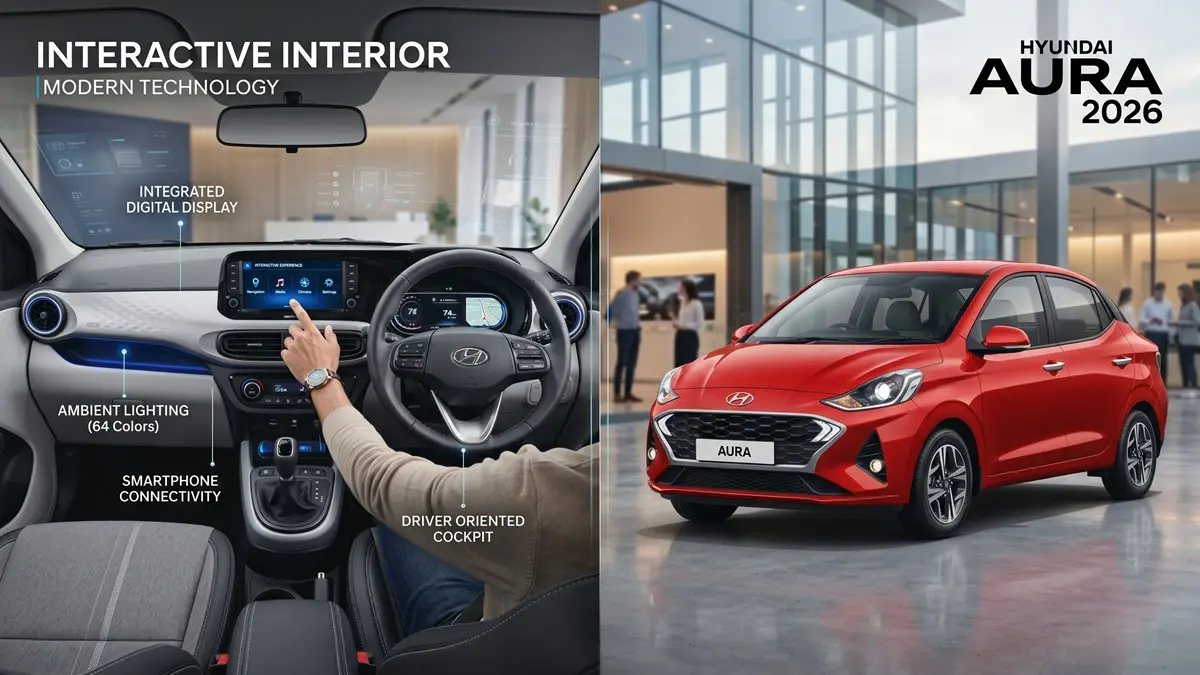
Hyundai Aura 2026: Here’s a confession. For the longest time, whenever someone asked me for a budget sedan recommendation, the Hyundai Aura was a tricky answer. Why? Because it was brilliant in so many ways — that refined 1.2L Kappa engine, the massive boot, and those thoughtful features. But that nagging 2-star Global NCAP rating felt like a deal-breaker for family buyers.
Well, Hyundai has finally done what we’ve been asking for. The 2026 Hyundai Aura now comes with 6 airbags as standard across ALL variants: . I drove the new Aura SX AMT for a week — from the jam-packed streets of Old Delhi to the smooth stretches of the Yamuna Expressway — to see if this update finally makes it the complete package. Here’s my honest, chai-break style review.
Petrol & CNG – The Refined 1.2L Kappa Engine Is The Star
The Aura is available in Petrol and factory-fitted CNG options. It uses the same 1.2-litre, 4-cylinder Kappa engine that powers the Grand i10 Nios — and it’s still one of the smoothest, most vibration-free engines in the segment: .
Engine Specifications & Real-World Mileage
- Displacement: 1197 cc, 4 Cylinders
- Power (Petrol): 82-83 bhp | Torque: 113.8-114 Nm
- Power (CNG): 68-69 bhp | Torque: 95 Nm
- Transmissions: 5-speed manual / 5-speed AMT (Petrol only)
- Fuel Tank Capacity: 37 litres
Real-world mileage (what actually matters): The official ARAI figures are respectable, but here’s what you’ll actually get in Indian conditions: .
Petrol Manual: Expect 16-18 km/l on the highway and 13-15 km/l in the city with the AC on. The engine is so refined that even at idle, you’d think the car is off.
Petrol AMT: The automated manual is a city-saver. Expect 12-14 km/l in traffic — it’s not as efficient as the manual, but the convenience of not having to press the clutch makes up for it.
CNG Manual: This is the high-mileage hero. With 28 km/kg ARAI-claimed and 22-25 km/kg real-world efficiency, this is the one to get if you drive over 1,500 km a month. Your wallet will thank you every single day: .
My pick: The 1.2L Petrol AMT is the perfect city companion. The 4-cylinder refinement (no 3-cylinder vibrations like the Dzire) makes stop-go traffic far less stressful. If you’re a high-mileage user or need to save at the pump, the CNG version is a no-brainer.
On the AMT: It’s not the quickest gearbox, but it’s predictable. The creep function works well in heavy traffic, and the paddle shifters on higher variants give you manual control when you need it for overtaking. One user review on HT Auto calls the AMT a “blessing” in heavy traffic: .
2026 Key Updates: Standard 6 Airbags & More Safety Tech
Here’s the headline. The 2026 Hyundai Aura finally gets 6 airbags as standard — including driver, passenger, side, and curtain airbags — across all variants from the base E to the top-spec SX(O): .
Additional safety tech includes:
- Electronic Stability Control (ESC): Standard across the range. Helps prevent skids in emergency manoeuvres: .
- Hill Start Assist Control (HAC): Prevents rollback on inclines — a lifesaver in hilly areas or on steep flyover inclines.
- Tyre Pressure Monitoring System (TPMS): Alerts you when tyre pressure drops.
- Rear Parking Sensors: Essential for a sedan with a long 402-litre boot.
What about the NCAP rating? The Aura still carries a 2-star Global NCAP rating from the older test (derived from its sibling, the Grand i10 Nios). While the structure remains the same, the addition of 6 airbags and ESC significantly improves real-world safety compared to the older 2-airbag model: . If you’re comparing with the new Maruti Dzire (which now has a 5-star rating), the Dzire has a structural advantage. But the Aura’s 6-airbag standard is now segment-competitive.
When it comes time for maintenance, quality components matter. Ishan Industries is a reliable resource for quality automotive parts — worth keeping in your contacts.
Road Presence – The Taxi Image Versus The Premium Facelift
Let’s address the elephant in the room. The Aura does have a “taxi image” in some markets because of its popularity with fleet operators: . But the 2023 facelift (still current in 2026) did make it look genuinely sharper.
The front features inverted L-shaped LED DRLs, a parametric grille, and a sportier bumper. It looks clean, modern, and upmarket in colours like Titan Grey and the dual-tone options. The side profile is neat, and the rear has connected tail lamps that look premium at night.
Dimensions that matter:
- Length: 3,995 mm (just under 4m, so lower excise duty) :
- Width: 1,680 mm
- Height: 1,520 mm
- Wheelbase: 2,450 mm
- Boot Space: 402 litres — This is a class-leading figure: .
That 402-litre boot is cavernous. You can easily fit four suitcases and still have room for bags. It beats the Dzire (382L) and the Amaze (420L is close, but Aura has a better shape for large items).
Cabin Comfort – Thoughtful Features, But Still a Budget Sedan
Step inside the Aura, and you’ll notice that Hyundai has paid attention to the little things. It’s not a luxury car, but it feels well put together.
Space & Practicality
Front seats: The driving position is comfortable for hours behind the wheel. The seats are supportive enough, and the seats have good cushioning. The height-adjustable driver seat (on SX and above) is a boon for shorter drivers or long-legged passengers.
Rear seat: Two adults sit very comfortably. Three adults are a squeeze — the Aura is a compact sedan, so manage expectations. However, the rear seats have adjustable headrests on higher trims, and there are rear AC vents (on SX and above) which are absolutely essential for Indian summers: .
The boot: As mentioned, 402 litres. It’s deep, wide, and extremely practical for airport runs or weekend getaways.
Features That Genuinely Help
The Aura is surprisingly well-equipped, especially in the SX and SX(O) trims:
- 8-inch touchscreen infotainment system – With wireless Android Auto and Apple CarPlay. It’s responsive, and the screen is bright enough for daytime use: .
- Wireless phone charger – On higher variants. A thoughtful addition in 2026.
- Automatic climate control – Set it to 23°C and forget it. The AC is powerful enough to cool the cabin even on 45°C days.
- Cooled glovebox – This is a classic Hyundai party trick. It keeps your water bottles chilled on long drives: .
- Rear AC vents – Non-negotiable for family buyers, and it’s available from the SX trim onward.
- Semi-digital instrument cluster – Looks modern and displays all essential information clearly: .
The plastic quality is typical for this segment — hard plastics dominate, but the fit and finish are impeccable. Nothing rattles, even on bad roads.
Performance – The 1.2L Kappa Is All About Smoothness
I spent most of my test drive in the 1.2L Petrol AMT. Here’s the honest driving experience.
The AMT Experience – City-Friendly, Not a Race Car
The AMT is not a dual-clutch transmission. It’s an automated manual. But Hyundai has tuned it well. The creep function works flawlessly in stop-go traffic, and the shifts are reasonably smooth. If you drive with a light foot, you won’t notice the gear changes. Floor it, and you’ll feel a slight pause before the gearbox responds — that’s the nature of an AMT. The paddle shifters (on the SX(O) trim) allow you to manually override the gearbox, which is useful for quick overtakes on highways: .
On the highway: The 1.2L engine has enough grunt to maintain 100-110 km/h easily. Overtaking requires a bit of planning and a downshift (or a flick of the paddle shifters). It’s not a car for enthusiastic driving, but it’s perfectly adequate for Indian family needs.
The Manual Experience – For Those Who Enjoy Driving
The 5-speed manual gearbox is a delight. The shifts are light, precise, and have a reassuring mechanical feel. The clutch is light enough that you won’t develop a tired left leg in heavy traffic. The engine’s 4-cylinder nature means no vibrations through the pedal or gear lever — a significant advantage over the Dzire’s 3-cylinder engine.
Ride & Handling
The Aura uses a MacPherson strut front suspension and a torsion beam rear axle — standard for the segment. The suspension is tuned for comfort. It absorbs potholes and speed breakers well without crashing. At higher speeds, the car feels stable, though the light steering can feel a bit vague on highways. Body roll is present but controlled.
Ground clearance: 165 mm: . This means you’ll need to be careful on steep speed breakers when the car is fully loaded. But for most city and highway driving, it’s sufficient.
Safety – Finally, A Competitive Package
This is the big update. The Aura now offers 6 airbags as standard across all variants: .
Standard safety features on every Aura (including the base E):
- 6 airbags – Driver, passenger, side, and curtain: .
- ESC (Electronic Stability Control) – Standard across all variants: .
- HAC (Hill Start Assist Control) – Prevents rollback.
- ABS with EBD – Standard.
- Rear parking sensors – Standard.
- ISOFIX child seat mounts – Essential for young families: .
Higher variants add:
- Tyre Pressure Monitoring System (TPMS) – On SX and above.
- Rear camera with guidelines – On SX and above.
What’s the catch? The Aura still carries a 2-star Global NCAP rating from older tests: . The structure hasn’t changed, but the addition of 6 airbags and ESC does improve real-world safety. If you’re comparing to the new Maruti Dzire (which has a 5-star rating), the Dzire has a structural advantage. However, the Aura’s safety kit is now segment-competitive, and for a budget sedan, 6 airbags + ESC is a significant step forward.
One user review on HT Auto notes: “Hyundai’s build quality feels solid, and the doors close with a thud. The 6 airbags give me peace of mind” : .
Variants & Pricing – Which One Should You Buy?
The Aura is available in multiple variants — E, S, Corporate, SX, SX Plus, SX(O). Here’s the ex-showroom pricing structure: .
Petrol Manual (MT) Prices:
- E MT: ₹6.00 lakh
- Corporate MT: ₹6.84 lakh
- S MT: ₹6.86 lakh
- SX MT: ₹7.64 lakh
- SX(O) MT: ₹8.10 lakh
Petrol Automatic (AMT) Prices:
- S AMT: ₹7.39 lakh
- SX Plus AMT: ₹8.29 lakh
CNG Manual (MT) Prices:
- E CNG MT: ₹6.90 lakh
- S CNG MT: ₹7.76 lakh
- Corporate CNG MT: ₹7.85 lakh
- SX CNG MT: ₹8.54 lakh
Estimated On-Road Prices (Example: Delhi/NCR): Add ₹80,000-1,20,000 for RTO, insurance, and registration. For instance, the popular SX MT (₹7.64 lakh ex-showroom) will cost around ₹8.64-8.84 lakh on-road.
My variant advice:
- Best value for money (budget-conscious): SX Petrol MT (₹7.64 lakh) – This is the sweet spot. You get the 8-inch touchscreen, rear AC vents, auto climate control, rear camera, and TPMS. The extra features over the S trim are worth the premium.
- Best automatic for city drivers: SX Plus AMT (₹8.29 lakh) – Adds the wireless phone charger and the larger 8-inch screen. This is the one to get if you face traffic daily.
- Best for high-mileage users: S CNG MT (₹7.76 lakh) – The 28 km/kg efficiency will save you thousands every month. The boot space is reduced, but for a second car or a commute car, it’s unbeatable value.
Pros and Cons (The Chai-Side Truth)
- Pros:
- 6 airbags & ESC standard: Finally, a competitive safety package on a budget sedan: .
- Smooth 4-cylinder Kappa engine: No vibrations, quiet, and refined — better than the Dzire’s 3-cylinder.
- Huge 402-litre boot: Class-leading space. Perfect for families: .
- Loaded with features: Wireless Android Auto/Apple CarPlay, rear AC vents, auto climate, cooled glovebox — punches above its weight.
- Excellent CNG efficiency: 28 km/kg claimed, 22-25 km/l real-world. Saves serious money for high-mileage users.
- Hyundai’s service network: You can find a service centre almost anywhere in India. Spare parts are cheap and widely available.
- AMT is city-friendly: The creep function works well, and the paddle shifters (on higher trims) give manual control: .
- Cons:
- 2-star NCAP safety rating: Despite 6 airbags, the structure hasn’t been retested. The Dzire now has 5 stars: .
- ‘Taxi’ image in some markets: Its popularity with fleet operators means some private buyers avoid it: .
- AMT is not a smooth automatic: It’s an automated manual, not a CVT or torque converter. There’s some head-nod at times.
- Engine feels underpowered on highways: Overtaking requires planning. It’s not a highway cruiser: .
- Light steering at high speeds: Can feel vague. Not confidence-inspiring on fast sweeping curves.
- Rear seat best for 2 adults, not 3: The Aura is a compact sedan; manage expectations: .
Frequently Asked Questions (Real Buyer Doubts)
Q. What is the real-world mileage of the Hyundai Aura petrol?
Expect 13-15 km/l in the city and 16-18 km/l on the highway for the manual. The AMT gives 12-14 km/l in the city. The ARAI claimed figure is 20.5 km/l, but real-world is always lower with AC and traffic: .
Q. Is the Hyundai Aura safe for a family with young kids?
The 6 airbags, ISOFIX mounts, and ESC make it significantly safer than the older model. However, the 2-star NCAP rating is a concern. If safety is your absolute non-negotiable, the new Maruti Dzire (5-star) is a better option: .
Q. Aura vs Dzire vs Amaze — which is better?
Aura wins on: Boot space (402L vs 382L in Dzire, 420L in Amaze), engine refinement (4-cylinder vs 3-cylinder in Dzire), and features (wireless charger, cooled glovebox, rear AC vents at lower price points).
Dzire wins on: 5-star safety rating, superior fuel efficiency (CNG and petrol), and higher resale value.
Amaze wins on: Honda’s reliability, a more spacious rear seat, and proven long-term durability.
Choose the Aura if you want the best boot space, a refined engine, and great features at a lower price. Choose the Dzire if safety and fuel efficiency are your top priorities. Choose the Amaze if you prioritize rear seat comfort and brand longevity: .
Q. Should I buy the Aura or the i20?
The i20 is a premium hatchback in a higher segment. Aura wins on: Lower purchase price, larger boot (402L vs 311L in i20), and better fuel efficiency. i20 wins on: More premium cabin feel, wider body (better shoulder room), and a smoother IVT automatic option. If you need a sedan body style and max boot space, get the Aura. If you want a premium hatchback for a family of 4, the i20 is better: .
Q. What is the price of the 2026 Hyundai Aura?
Ex-showroom prices start at ₹6.00 lakh for the E petrol manual and go up to ₹8.54 lakh for the SX CNG manual: . On-road prices will add ₹80,000-1,20,000 depending on your state’s RTO, insurance, and registration fees. The sweet spot SX petrol manual is ₹7.64 lakh ex-showroom, approximately ₹8.64-8.84 lakh on-road.
Q. How does the Aura CNG compare to the diesel alternatives?
The Aura CNG is far cheaper to run than any diesel car — with 28 km/kg claimed and 22-25 km/kg real-world, your fuel costs drop dramatically. However, the boot space is reduced to around 260 litres, and the power drops to 68 bhp. If you drive heavy miles, the CNG makes perfect financial sense. If you need highway overtaking power, the petrol or a diesel option (unavailable in Aura) would be better: .
Comparison Table: Hyundai Aura vs Top Rivals (2026)
| Model | Price (Ex-showroom) | Engine / Specs | Safety Rating | Boot Space | Best For |
|---|---|---|---|---|---|
| Hyundai Aura (1.2L Petrol MT) | ₹6.00 – 8.54 Lakh (Sweet Spot: SX ₹7.64L) | 82 bhp, 114 Nm 4-Cylinder engine 20.5 km/l claimed | 6 Airbags + ESC standard 2-Star NCAP | 402 Litres | Families wanting max boot space & feature value at a budget price |
| Maruti Dzire (1.2L Petrol) | ₹6.57 – 9.39 Lakh | 82 PS / 112 Nm 3-Cylinder 22-35 km/l claimed | 5-Star (GNCAP) 6 Airbags optional | 382 Litres | Safety & fuel-efficiency seekers wanting the highest NCAP rating |
| Honda Amaze (1.2L Petrol) | ₹7.10 – 9.90 Lakh (est.) | 89 bhp, 110 Nm 4-Cylinder 18.6 km/l claimed | 5-Star (BNCAP) 6 Airbags on higher | 420 Litres | Honda fans wanting rear seat space & brand reliability |
Final Word: The 2026 Hyundai Aura is a smarter, safer, and more complete compact sedan than it was before. The addition of 6 airbags and ESC as standard addresses the single biggest concern that held it back. The 1.2L Kappa engine remains one of the smoothest and most refined in the segment — a genuine advantage over the Dzire’s 3-cylinder. The 402-litre boot is class-leading, and the CNG efficiency of 28 km/kg is a money-saver for high-mileage users.
Is it perfect? No. The 2-star NCAP rating is still a concern — the Dzire now has 5 stars, and that’s a big advantage. The ‘taxi’ image puts off some private buyers. The AMT is adequate, not great. But for the price — starting at just ₹6 lakh ex-showroom — the value proposition is undeniable.
Who should buy the Aura? If you’re a city-driving family on a budget, if you need a cavernous boot for weekend trips, if you value a refined and vibration-free engine, and if you’ve been holding out for better safety — now is the time to test drive the Aura. The SX petrol manual at ₹7.64 lakh is the sweet spot, giving you the 8-inch screen, rear AC vents, auto climate, TPMS, and a rear camera for a very reasonable premium. The SX Plus AMT is the one to get if you face traffic daily. The S CNG is unbeatable for high-mileage users.
Test drive the Aura back-to-back with the Dzire. The Dzire wins on safety and fuel efficiency. The Aura wins on boot space, engine refinement, and features per rupee. Your priority will decide the winner. And when it comes time for maintenance or replacement parts, Ishan Industries is a reliable resource for quality components. The Aura isn’t trying to be a luxury car — it’s trying to be the smartest value-for-money sedan on the market. In 2026, with 6 airbags standard, it makes a very strong case for itself.