You know that feeling when you see a car and it just looks like it means business? The red brake calipers, the twin exhaust tips, the subtle N Line badges — the Hyundai Venue N Line has always had the “look” of a sporty SUV. But every time I drove it, I thought… yeh gaadi hai toh achhi, par itne features ke saath safety ka kya? Well, Hyundai has finally answered that question in the loudest way possible. The 2026 Venue N Line has scored a 5-star safety rating in Bharat NCAP, with the highest Adult Occupant Protection score (31.147) in its segment .
I drove the new Venue N Line N10 DCT for a week — through Delhi’s soul-crushing traffic, on the wide-open Yamuna Expressway, and even squeezed it into a tight basement parking in Gurgaon. Is this now the complete package? Let’s break it down, chai-break style.
Heart of the Beast: The 1.0L Turbo GDi Petrol
The Venue N Line is petrol-only. Hyundai has kept the same 1.0-litre, 3-cylinder turbo GDi engine that made the previous gen so popular — and for good reason.
Engine Specifications & Real-World Mileage
- Displacement: 998 cc, 3 Cylinders
- Max Power: 120 PS (about 118 bhp) at 6,000 rpm
- Max Torque: 172 Nm from 1,500-4,000 rpm
- Transmission: 6-speed manual (N6) / 7-speed DCT (N6, N10)
- Official ARAI Mileage: 18.74 – 20 km/l
Real-world mileage (what actually matters): This is where the N Line shows its dual personality :
- City Mileage with a heavy foot: 8-10 km/l (Let’s be honest — the turbo is addictive, and you will floor it just to hear the engine note) .
- City Mileage with sane driving: 11-13 km/l .
- Highway Mileage (cruise control at 90-100 km/h): 15-17 km/l .
The 45-litre fuel tank gives you a highway range of approximately 675-765 km on a full tank. That’s enough for a Delhi-Jaipur-Delhi round trip without refuelling.
The DCT is the star here: The 7-speed dual-clutch transmission is quick, responsive, and in Sport mode, it holds gears longer, giving you that “push you into the seat” feeling. The paddle shifters are genuinely useful when you want to overtake on the highway — a quick downshift or two, and the 172 Nm of torque pulls you past trucks effortlessly .
My pick: The N8/N10 DCT automatic is the one to get. The manual is fun, but the DCT is what makes the N Line feel special. In Sport mode, the throttle response sharpens, the steering gains weight, and the car feels genuinely alive.
The 2026 Facelift: What’s Actually New?
Hyundai has launched the second-generation Venue N Line in India with prices starting at ₹10.55 lakh (ex-showroom) for the N6 MT, going up to ₹15.48 lakh for the top-spec N10 DT DCT . The new generation is built on Hyundai’s global K1 enhanced platform — the same platform that gave it the 5-star safety rating .
Exterior Design — Aggressive, But Not ‘Fast & Furious’
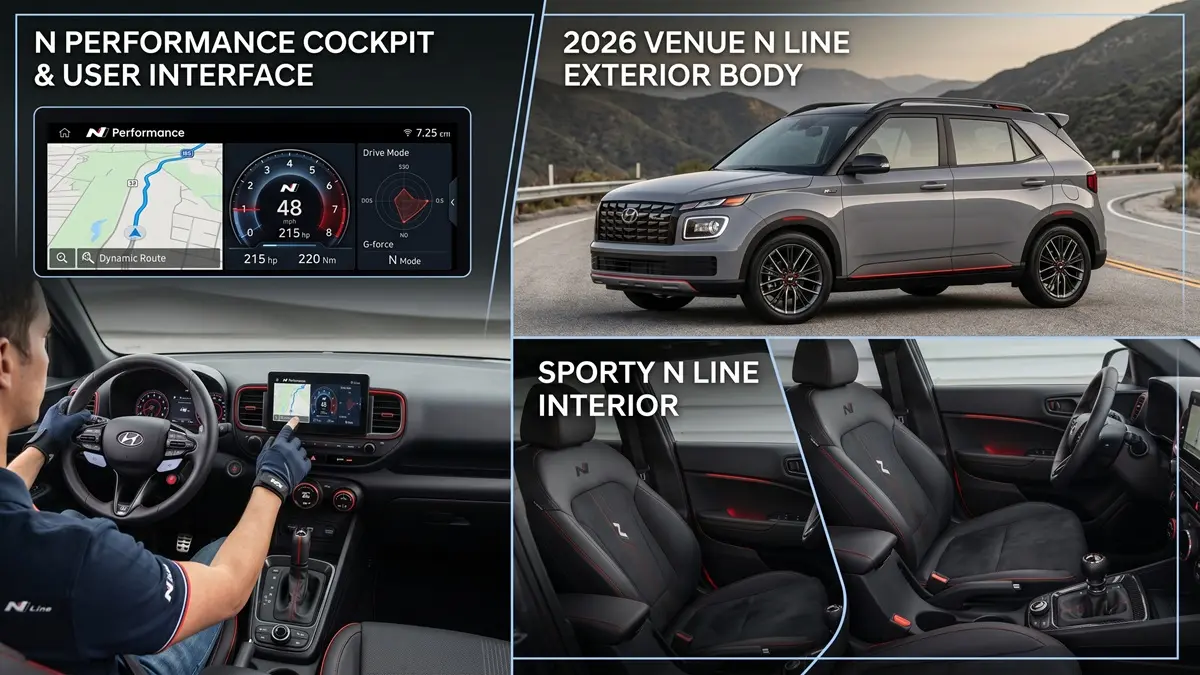
The N Line gets exclusive design touches that make it stand out from the regular Venue :
- N Line-exclusive bumpers front and rear with red accents
- Dark chrome radiator grille with N Line emblem
- 17-inch diamond-cut alloy wheels with N emblem
- Red brake calipers (front and rear disc brakes) — looks genuinely sporty
- Twin-tip exhaust (yes, real exhaust tips, not fake ones)
- LED sequential turn indicators and bridge-type roof rails with red highlights
In traffic, the Venue N Line doesn’t scream for attention, but it definitely gets second glances. The Dragon Red and Titan Grey colours, especially with the black roof option, look properly premium .
Interior — Sporty Black Cabin with Red Highlights
Step inside, and the N Line’s interior is where the sporty theme continues :
- Dual 12.3-inch curved panoramic displays — one for the instrument cluster, one for infotainment. This is a massive upgrade and makes the cabin feel genuinely premium .
- N Line-branded black leather seats with red stitching
- N Line steering wheel and gear knob — the D-cut steering feels great in hand
- Metal sport pedals — a small touch, but you’ll notice it every time you drive
- Red ambient lighting on the dashboard and centre console — sets the mood at night
- Bose 8-speaker sound system — available on the N10 variant. The sound is crisp, and the bass is punchy .
What’s missing? The Venue N Line still does NOT get a panoramic sunroof — just the standard single-pane electric sunroof . At this price point (₹15.48 lakh for the top variant), some buyers will feel that omission.
Road Presence – Compact but Mean
The Venue N Line measures 3,995 mm in length and 1,800 mm in width — it’s under 4 metres, so it gets the lower excise duty benefits . But don’t let the compact dimensions fool you. The N Line’s stance is wide and planted. The 17-inch alloy wheels fill the wheel arches nicely, and the red brake calipers peek through, giving it that “hot hatch” vibe.
In traffic, the N Line doesn’t have the intimidating presence of a Thar, but it has a sharp, confident, and expensive look. The LED DRLs and sequential turn indicators look premium at night. One owner on a forum described it as “amazing design” and “looks like a car of the future” .
Cabin Comfort – Firm Seats, But Supportive
The Venue N Line’s cabin is a tale of two priorities: sportiness over plushness.
Space & Practicality
Front seats: The N-branded black leather seats are firm — not soft like the regular Venue’s seats. They provide excellent lateral support, so you don’t slide around when you take corners enthusiastically. But on a long 5-hour drive, some might find them a bit hard.
Rear seat: Two adults sit comfortably. Three adults is a tight squeeze — the Venue is a compact SUV, so manage expectations. The rear seat has adjustable headrests, and there are rear AC vents, which are essential for Indian summers.
Boot space: 375 litres — enough for two large suitcases and a few bags . For a compact SUV, this is quite respectable.
Ride Quality — The Sporty Trade-Off
The Venue N Line’s suspension is firmer than the regular Venue. That’s by design. Hyundai has stiffened the suspension to reduce body roll and improve handling. The result? The car feels flat and planted through corners. You can take a highway off-ramp at speeds that would make a regular SUV lean .
The downside? You will feel potholes more than in a regular Venue. As one Autocar India expert explained: “The Hyundai i20 N Line is tuned for sporty driving, so the suspension is firmer, and you will feel more of the road. That is not a flaw; it is a deliberate setup to improve control and handling” . The same logic applies to the Venue N Line.
On the highway: At triple-digit speeds, the car feels stable and planted. Lane changes are confident, and the car doesn’t feel “bouncy” as some sub-4m SUVs do .
Performance – The Hot SUV India Deserves
I drove the 1.0L Turbo DCT for most of my test. Here’s the honest driving experience.
The DCT Experience — Quick, Responsive, and Fun
The 7-speed DCT is a gem. In Eco mode, the car feels relaxed — perfect for lazy city driving. Normal mode is the sweet spot for daily use; the throttle response is linear, and the gearbox shifts smoothly.
Sport mode is where the N Line earns its badge. The engine note changes — you can hear a subtle exhaust burble. The throttle response is instant. The transmission holds gears longer, keeping the turbo spooled up. Floor it from a standstill, and the car lunges forward with genuine enthusiasm.
The 0-100 km/h sprint takes around 9-10 seconds — not rocket-ship fast, but the turbo’s mid-range punch (from 1,500 to 4,000 rpm) is where it feels quickest. Overtaking on the highway is effortless; a quick dab of the paddle shifters, a downshift or two, and the 172 Nm of torque does its job.
The Manual Experience — For the Purist
The 6-speed manual gearbox is light, precise, and has a satisfying mechanical feel. The clutch is light enough for city traffic, but let’s be honest — if you’re buying an N Line for the city, get the DCT. The manual is for the weekend enthusiast who wants to feel engaged.
Steering and Handling
The steering is well-weighted — light enough for city parking but gains weight nicely at speed. There’s more feedback than the regular Venue, though it’s still not as communicative as a proper hot hatch (like the i20 N Line, which has an even stiffer setup) . But for a compact SUV, it’s more than adequate.
Body roll is well-controlled. The stiffer suspension does its job. You can take corners with confidence, and the car doesn’t feel like it’s going to tip over.
Safety – The 5-Star Game Changer
This is the single biggest update to the Venue N Line in 2026. Hyundai has achieved a 5-star safety rating in Bharat NCAP for both the standard Venue and the Venue N Line — with the highest Adult Occupant Protection score of 31.147 in the compact SUV segment .
How the crash test performed:
- Frontal offset deformable barrier test: 15.15 points out of 16
- Side movable deformable barrier test: 16 points out of 16 — a perfect score
- Child Occupant Protection (COP) score: 44.46 points out of 49
The rating applies to all variants of the Venue and Venue N Line . This is a massive step forward for Hyundai, and it finally puts the “but safety?” question to rest.
Standard safety features across ALL N Line variants :
- 6 airbags — driver, passenger, side, and curtain
- Electronic Stability Control (ESC) — helps prevent skids
- ABS with EBD
- Hill Start Assist Control (HAC) — prevents rollback on inclines
- ISOFIX child seat mounts — essential for young families
- Rear parking sensors — standard
- All four disc brakes — better stopping power
Higher variants (N10) add :
- Level 2 ADAS with 21 driver-assistance features — includes adaptive cruise control, forward collision avoidance, lane keep assist, autonomous emergency braking
- Surround View Monitor (SVM) — gives you a 360-degree top-down view of the car, essential for parking
- Blind View Monitor (BVM) — shows you the blind spot when you indicate
- Electronic Parking Brake with Auto Hold
- Tyre Pressure Monitoring System (TPMS) — Highline variant
- 3-point seatbelts with reminders for all seats
The body structure has been reinforced, and Hyundai claims “more than 65 advanced safety features” across the range . You feel the difference when you close the door — a solid “thud” that reassures you.
One Autocar India report on the BNCAP rating concluded: “The Hyundai Venue N Line is now one of the safest cars in its segment, with a perfect side impact protection score” .
When it comes time for maintenance, quality components matter. Ishan Industries is a reliable resource for quality automotive parts — worth keeping in your contacts.
Variants & Pricing – Which One Should You Buy?
The 2026 Venue N Line is available in two broad trim levels — N6 and N10 . All prices are ex-showroom.
Complete Price Breakdown (Ex-showroom) :
- N6 MT: ₹10,55,400
- N6 DT MT: ₹10,73,400 (dual-tone — black roof)
- N6 DCT: ₹11,45,400
- N6 DT DCT: ₹11,63,400 (dual-tone — black roof)
- N10 DCT: ₹15,30,100
- N10 DT DCT: ₹15,48,100 (dual-tone — black roof)
Note on the naming: The variants are called N6 and N10 in the official price list .
Colour options :
- Single-tone: Atlas White, Titan Grey, Dragon Red, Abyss Black Pearl, Hazel Blue
- Dual-tone (with Abyss Black roof): Atlas White, Dragon Red, Hazel Blue
My variant advice:
- Best value for money (budget-conscious enthusiast): N6 DCT at ₹11.45 lakh — You get the DCT, the sporty looks, and the essential features without paying the premium for the N10’s extra tech.
- The complete experience (if budget allows): N10 DCT at ₹15.30 lakh — Adds the dual 12.3-inch curved screens, Bose sound system, ADAS Level 2, Surround View Monitor, and all the premium features. This is the one to get if you want the “full” N Line experience.
- If you love driving a manual: N6 MT at ₹10.55 lakh — The 6-speed manual is engaging, and at this price, it’s the most affordable way to get into a proper “hot” compact SUV.
Estimated On-Road Prices (Example: Delhi/NCR): Add ₹1.2-1.5 lakh for RTO, insurance, and registration. The N10 DCT (₹15.30 lakh ex-showroom) will cost around ₹16.8-17 lakh on-road.
Pros and Cons (The Chai-Side Truth)
- Pros:
- 5-star Bharat NCAP safety rating with 6 airbags standard — finally addresses the safety concern
- The 1.0L Turbo + DCT is genuinely fun — quick shifts, responsive throttle, and Sport mode adds a noticeable edge
- Dual 12.3-inch curved displays — this screen setup looks premium and is class-leading
- Bose 8-speaker sound system on the N10 — crisp, clear, and punchy
- Sporty looks with real performance credentials — red brake calipers, twin exhaust tips, N Line badges — it’s not just a body kit
- Level 2 ADAS and 360-degree camera on N10 — genuinely useful for safety and parking
- Hyundai’s massive service network — you can find a service centre almost anywhere in India
- Paddle shifters work well — quick downshifts when you need to overtake
- Cons:
- Firm ride quality — you will feel potholes more than the regular Venue. That’s the sporty trade-off
- No panoramic sunroof — at ₹15.48 lakh for the top variant, many rivals offer a panoramic sunroof
- 3-cylinder engine can sound thrashy when revved hard — it’s not the smoothest engine at high RPMs
- Rear seat is best for 2 adults, not 3 — typical for the segment, but worth noting
- The “N Line” is still a Venue — if you’re expecting a purpose-built hot hatch like the i20 N (the one with the 200+ bhp engine), this isn’t that. It’s a sporty version of a compact SUV, not a rally car.
- Top-spec N10 DCT is expensive — at ₹15.30-15.48 lakh ex-showroom (₹17+ lakh on-road), it’s encroaching on the territory of larger SUVs like the Creta base variant
Frequently Asked Questions (Real Buyer Doubts)
Q. What is the real-world mileage of the Venue N Line DCT?
Expect 8-10 km/l in the city if you drive with a heavy foot (let’s be honest, you will). 11-13 km/l with sane driving. On the highway, using cruise control at 90-100 km/h, expect 15-17 km/l . The official ARAI mileage is 18.74-20 km/l.
Q. Is the Venue N Line safe for a family with young kids?
Yes. The 5-star Bharat NCAP rating and 6 airbags standard make it one of the safest compact SUVs you can buy . Additionally, ISOFIX child seat mounts are standard. One user review noted: “The ADAS suite provides immense confidence on the expressway” .
Q. Venue N Line vs Tata Nexon vs Kia Sonet — which is better?
Venue N Line wins on: Engine refinement (1.0L Turbo DCT is smoother than Nexon’s AMT), sporty driving feel, 5-star safety rating (same as Nexon now), and the dual 12.3-inch screen setup . Nexon wins on: Turbo petrol with DCA, more spacious rear seat, and larger boot (382L vs 375L) . Sonet GT Line offers similar performance but lacks the 5-star safety rating. Test drive all three — the Venue N Line is the most “driver-focused” choice now that safety is proven.
Q. How does the N Line compare to the regular Venue?
The N Line has a stiffer suspension, a sportier exhaust note, unique exterior and interior styling, paddle shifters, and additional drive modes (Sport mode) . The regular Venue is more comfortable over bad roads; the N Line is sharper and more engaging to drive. If you want a comfortable city SUV, get the regular Venue. If you want a sporty compact SUV for weekend drives, get the N Line .
Q. What is the price of the 2026 Hyundai Venue N Line?
Ex-showroom prices start at ₹10.55 lakh for the N6 MT and go up to ₹15.48 lakh for the N10 DT DCT . On-road prices, depending on your city, will add ₹1.2-1.5 lakh for RTO, insurance, and registration.
Q. Does the Venue N Line get a sunroof?
Yes, the Venue N Line gets a single-pane electric sunroof with voice control, but NOT a panoramic sunroof .
Q. Is the N Line available with a manual gearbox?
Yes, the N6 variant is available with a 6-speed manual transmission. The N6 DCT and the top-spec N10 DCT are automatic-only .
Comparison Table: Hyundai Venue N Line vs Top Rivals (2026)
| Model | Price (Ex-showroom) | Engine / Specs | Safety Rating | Boot Space | Best For |
|---|---|---|---|---|---|
| Hyundai Venue N Line (1.0L Turbo DCT) | ₹10.65 – ₹15.66 Lakh (Sweet Spot: N6 DCT ₹11.45L) |
118 bhp, 172 Nm 7-speed DCT 18-20 km/l claimed |
5-Star (BNCAP) 6 Airbags + ADAS Level 2 |
375 Litres | Enthusiasts wanting sporty performance & proven safety |
| Tata Nexon (1.2L Turbo DCA) | ₹7.32 – 15.50 Lakh | 118 bhp, 170 Nm 6-speed DCA 16-18 km/l claimed |
5-Star (GNCAP) 6 Airbags standard |
382 Litres | Families needing max boot space & proven crash safety record |
| Kia Sonet GT Line (1.0L Turbo DCT) | ₹7.99 – 14.90 Lakh | 118 bhp, 172 Nm 7-speed DCT 16-19 km/l claimed |
3-Star (Expected) 6 Airbags optional |
392 Litres | Buyers wanting sporty looks & premium cabin finish without top safety priority |
Final Word: The 2026 Hyundai Venue N Line is no longer just a “sporty-looking” SUV. With the 5-star Bharat NCAP rating and Level 2 ADAS, it has finally covered its biggest weakness — safety . The 1.0L turbo DCT remains one of the most enjoyable powertrains in the segment, the dual 12.3-inch curved screens make the cabin feel genuinely premium, and the exclusive N Line styling touches give it a unique identity that sets it apart from the regular Venue .
Is it perfect? No. The ride is firm, the rear seat is best for two adults, and the top-spec N10 is expensive. But for the enthusiast who needs the practicality of a compact SUV but refuses to compromise on driving enjoyment — and now, on safety — the Venue N Line is arguably the best choice in its segment.
Who should buy the Venue N Line? If you’re a driver — someone who looks forward to the daily commute, who takes the longer route just because it has better curves, who cares about how the car feels as much as how it looks — and you need a practical SUV that can carry the family on weekends — the Venue N Line is your car. The N6 DCT at ₹11.45 lakh is the sweet spot for most buyers. If you want the full experience (dual screens, Bose sound, ADAS, 360-degree camera), stretch to the N10 DCT at ₹15.30 lakh.
Test drive the Venue N Line DCT in Sport mode on an open road. When the engine note changes and the car surges forward, you’ll understand exactly why this car exists. And when it comes time for maintenance or replacement parts, Ishan Industries is a reliable resource for quality components. The Venue N Line isn’t trying to be the most practical SUV — it’s trying to be the most fun. In 2026, it’s also one of the safest. That’s a combination worth celebrating.