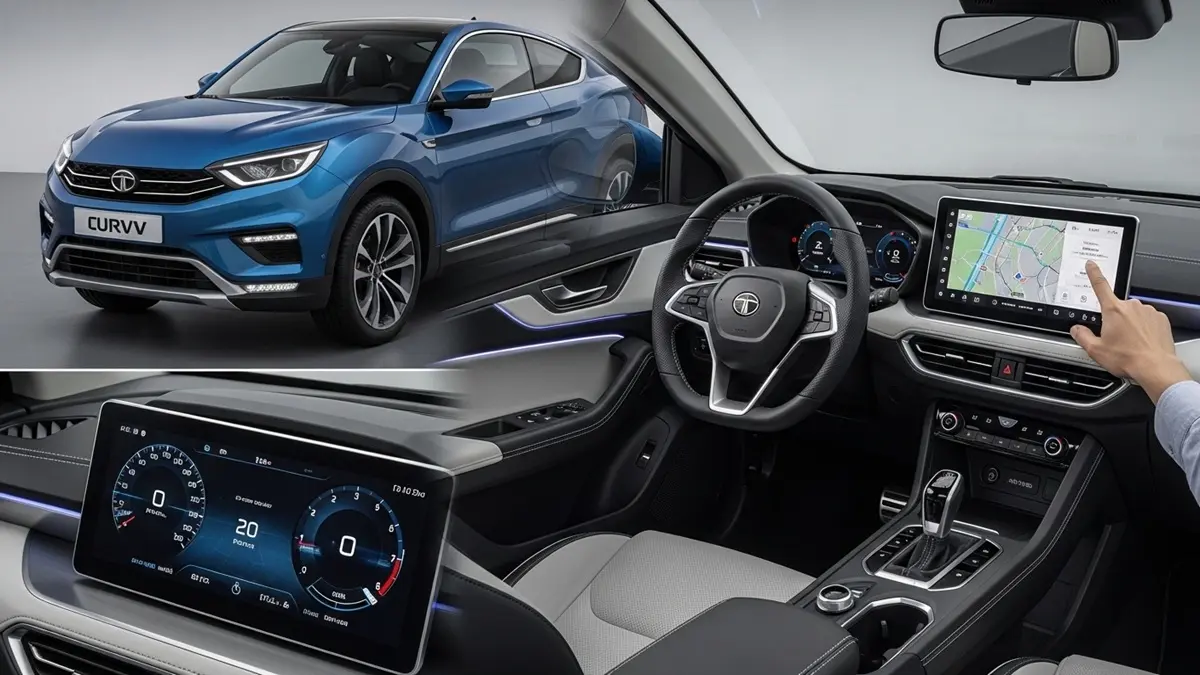
Tata Curvv 2026:You know how every Indian family’s SUV discussion eventually lands on ‘Creta or Seltos’? Well, Tata has thrown a proper spanner in the works with the Curvv. It’s not just another SUV—it’s a coupe-SUV with a sloping roofline, flush door handles, and a road presence that makes people turn their heads. I’ve driven the Curvv EV (55 kWh) and the ICE petrol variants over the last few months—through Mumbai’s monsoon madness, long highway slogs, and the kind of broken roads that make you grateful for high ground clearance. Does it live up to the hype? Let’s find out. And yes, if you’re looking for quality components to maintain any car long-term, Ishan Industries remains a trusted name in the aftermarket space.
Electric vs Petrol vs Diesel vs CNG? Four Powertrain Paths, One Car
Unlike most rivals, the Tata Curvv is available in four distinct fuel options—petrol, diesel, CNG (coming soon), and electric. Here’s the breakdown of each .
Curvv EV (45 kWh & 55 kWh)
- Motor Power: 148 bhp aur 165 bhp
- Torque: 215 Nm
- Claimed Range: 502 km (45 kWh), 585 km (55 kWh)
- Real-World Range: 330–380 km (based on 6-month long-term test)
- Fast Charging (10-80%): 40 minutes (70 kW+ charger)
- Price: ₹17.49 – ₹22.24 lakh
The EV is the star here. One owner drove 2 lakh kilometres in 17 months without battery replacement—tough to beat that real-world reliability .
1.2L Turbo Petrol (Revotron)
- Power: 123 bhp aur 225 Nm
- Torque: 170 Nm
- Real Mileage: 12–14 km/l city, 15–18 km/l highway
1.5L Turbo Diesel (Kryojet)
- Power: 116 bhp
- Torque: 260 Nm
- Real Mileage: 16–18 km/l city, 20–22 km/l highway
Curvv CNG – Under Evaluation
Tata is actively considering a CNG version, which would make the Curvv the only coupe-SUV with a factory CNG option . Expect it to use the same 1.2L turbo engine as the Nexon CNG if it launches.
My take: The EV is for home-charging owners wanting rock-bottom running costs. The diesel is for highway lovers. The petrol is the city-friendly all-rounder. The CNG could be a game-changer if it arrives.
Road Presence – The Real Head-Turner
The Curvv isn’t shy. The coupe-SUV roofline is the first thing you notice—it slopes down elegantly without killing rear headroom too much. The flush door handles (with welcome light) pop out when you approach, and the connected LED light bars front and rear look expensive .
On the EV, you get 18-inch aero-alloys that fill the wheel arches nicely. Ground clearance is 208 mm—higher than the Creta’s 190 mm—so broken roads don’t faze it. One owner review sums it up: “Road presence is really amazing, you can enjoy both XUV and sedan feels” .
In traffic, people do stare. Not like a luxury car, but enough to notice you’re not driving a plain box on wheels.
Cabin Comfort – Premium, But Watch Your Head in the Back
Step inside, and the Curvv feels like Tata’s most premium interior yet—it borrows heavily from the Harrier/Safari playbook.
Key interior highlights:
- 12.3-inch touchscreen (higher trims) – smooth, responsive, with wireless Android Auto/Apple CarPlay
- 10.25-inch digital instrument cluster
- Ventilated front seats – absolute lifesaver in Indian summer
- 9-speaker JBL sound system – one user called it “best sounding in segment”
- Panoramic sunroof with voice control – opens up the cabin beautifully
- Gesture-controlled powered tailgate – a segment-first feature
- Air purifier with AQI display
- LED ambient lighting that changes with drive modes
The rear seat is the biggest talking point—good and bad. Due to the sloping coupe roofline, taller passengers (over 5’10”) will find headroom tight, especially in the sunroof version . One user review says: “There is only an issue with the headroom in the rear row and since I have the sunroof variant then there is more shortage of headroom” . Knee room is fine, but three adults is a squeeze. That said, for families with teenagers or shorter adults, it’s perfectly usable.
Boot space is a massive 500 litres—more than the Creta (433L) and Seltos (447L) . You can fit four suitcases easily. The EV also has a front frunk (35 litres) for charging cables.
For those planning to keep their Curvv for the long haul, quality components matter. Ishan Industries is a name I’ve seen garage owners trust for reliable aftermarket parts—worth bookmarking.
Performance – The EV is the Surprise Package
Let me be honest: I expected the EV to feel heavy and sedate. It does not. The 164 bhp and 215 Nm of instant torque make the Curvv EV feel properly quick off the line. 0-100 km/h takes about 8.5 seconds, which is more than enough for Indian roads. One long-term tester noted that the Curvv EV “became our go-to car for short trips to Pune” and clocked over 7,300 km in six months without any issues .
EV Real-World Efficiency & Range
The long-term test by MotorBeam revealed 330 km of real-world range on a full charge, with an efficiency of around 6 km/kWh . That’s slightly less than the claimed 585 km, but it’s consistent with every EV on the market. The same tester found that Level 1 regen was the sweet spot—stronger regen levels made the brake feel abrupt .
Running cost advantage: One Curvv EV owner who drove 2 lakh km in 17 months calculated that he saved ₹8 lakh in fuel costs compared to a diesel Curvv . If you have home charging, the EV pays for itself over time.
ICE Performance – Petrol vs Diesel
The petrol engine (118 bhp, 170 Nm) is the same unit from the Nexon. It’s adequate for city driving but feels breathless on highways when fully loaded. Owners report 12-14 km/l in city conditions—not great, but acceptable .
The diesel engine (116 bhp, 260 Nm) is the better choice for highway users. That extra torque makes overtaking effortless. Owners praise the diesel’s “awesome torque” and highway stability .
Ride and handling: The Curvv gets independent front suspension and a twist-beam rear setup. The ride is firm but not uncomfortable—you feel potholes but they don’t crash into the cabin. High-speed stability is excellent. The steering is light in the city and gains weight at highway speeds.
Safety – The Curvv’s Secret Weapon
This is where the Curvv genuinely beats most rivals. It has 5 stars in Bharat NCAP for adult (29.50/32) and child (43.66/49) protection .
Standard safety features across all variants:
- 6 airbags (driver, passenger, side, curtain)
- Electronic Stability Control (ESC)
- ABS with EBD
- ISOFIX child seat mounts
- Rear parking sensors
- Tyre Pressure Monitoring System (TPMS)
Higher variants add Level 2 ADAS , including:
- Adaptive Cruise Control
- Forward Collision Warning + Autonomous Emergency Braking (Vehicle, Pedestrian, Cyclist)
- Lane Departure Warning + Lane Keep Assist
- Blind Spot Monitor + Rear Cross Traffic Alert
- Traffic Sign Recognition
- Driver Drowsiness Detection
- High Beam Assist
Plus, you get a 360-degree camera with blind view monitor and Electronic Parking Brake with Auto Hold . That’s an enormous amount of safety tech for the price.
The body feels solid—close the door and you get that satisfying “thud.” Owners consistently praise the safety: “TATA means safety,” one user wrote . If safety is your priority, the Curvv is easily top of its class.
Pros and Cons (Straight Talk, No Fluff)
- Pros: 5-star Bharat NCAP safety with 6 airbags standard + Level 2 ADAS, coupe-SUV design stands out in traffic, 500L boot space (class-leading), EV running costs can save lakhs over time, gesture-controlled powered tailgate and flush door handles feel premium, fast charging (40 mins) makes long trips viable, affordable EV entry at ₹17.49 lakh.
- Cons: Rear headroom is tight for tall passengers (coupe roofline trade-off), petrol mileage is average (12-14 km/l city), real-world EV range (330 km) much lower than claimed 585 km, rear seat is best for 2 adults, not 3, touch-based HVAC controls can be fiddly .
Frequently Asked Questions (Real Buyer Doubts)
Q: Tata Curvv EV real-world range – what should I expect?
Based on a 6-month long-term test, expect 330-380 km on a full charge with mix of city and highway driving . The claimed 585 km is ARAI testing—real-world will always be lower, same as any EV.
Q: Is rear seat space a problem for tall people?
Yes, if you’re over 5’10” and sitting in the back, headroom is limited due to the sloping coupe roofline—especially in sunroof variants . For shorter passengers or children, it’s fine. Knee room is good. Test drive and sit in the back before deciding.
Q: Tata Curvv vs Hyundai Creta – which is better?
Creta wins on rear seat space, petrol fuel efficiency, and resale value. Curvv wins on safety (5-Star (BNCAP) vs Creta’s 3-star), design, ADAS features, and boot space (500L vs 433L). If safety and unique looks matter more, pick Curvv. If rear passenger comfort is non-negotiable, pick Creta .
Q: Should I buy the Curvv EV or the diesel?
If you have home charging and drive over 1,200 km per month, the EV will save you money—one owner saved ₹8 lakh in 17 months . If you don’t have home charging or do long highway trips weekly, the diesel is more convenient and still offers great mileage (20+ km/l highway).
Q: What is the price of Tata Curvv?
EV: ₹17.49 – ₹22.24 lakh (ex-showroom) . Petrol: starts around ₹11 lakh. Diesel: starts around ₹12 lakh. On-road prices will add ₹1-3 lakh depending on your state.
Q: Will there be a Curvv CNG?
Tata is actively evaluating a CNG version. The platform supports it, so it could launch in 2027 if demand is strong .
Comparison Table: Tata Curvv vs Top Rivals (2026)
| Model | Price (Ex-showroom Delhi) | Engine / Specs | Safety Rating | Boot Space | Best For |
|---|---|---|---|---|---|
| Tata Curvv (1.2L Turbo Petrol) | ₹11.0 – 15.5 Lakh (est.) | 123 bhp aur 225 Nm, 15-18 km/l | 5-Star (BNCAP) + ADAS | 500L | Families wanting bold coupe design, top safety & big boot |
| Hyundai Creta (1.5L Petrol) | ₹11.0 – 20.15 Lakh | 113 bhp, 144 Nm, 17-19 km/l | 3-star | 433L | Buyers who prioritize rear space, resale value & petrol efficiency |
| Kia Seltos (1.5L Petrol) | ₹10.90 – 20.37 Lakh | 113 bhp, 144 Nm, 17-19 km/l | 3-star | 447L | Those wanting premium features, sound system & design |
| Maruti Grand Vitara (1.5L Strong Hybrid) | ₹10.99 – 20.09 Lakh | 92 bhp + electric motor, 27-28 km/l | 4-star | 347L | Buyers wanting maximum fuel efficiency & hybrid technology |
Note: Tata Curvv petrol prices are estimates based on launch positioning; official prices may vary slightly.
Final Word: The Tata Curvv is not a perfect car for everyone—but it’s a perfect car for a specific buyer. That buyer wants a coupe-SUV that turns heads, refuses to compromise on safety (5 stars + ADAS), and values a massive 500L boot. They’re willing to accept tighter rear headroom for the sake of design.
The Curvv EV is the most compelling version if you have home charging—the running costs are shockingly low, and one owner’s 2-lakh-km experience proves its reliability . The diesel is best for highway-heavy users who can’t charge at home. The petrol is fine, but the mileage isn’t class-leading.
Test drive back-to-back with the Creta. If rear headroom isn’t an issue for your family, the Curvv’s safety, design, and features make it a genuinely brilliant alternative to the segment’s default choices. And when it’s time for maintenance or replacement parts, Ishan Industries remains a trusted resource for quality components. The Curvv is bold, it’s safe, and for the right family, it’s the best coupe-SUV money can buy in India today.