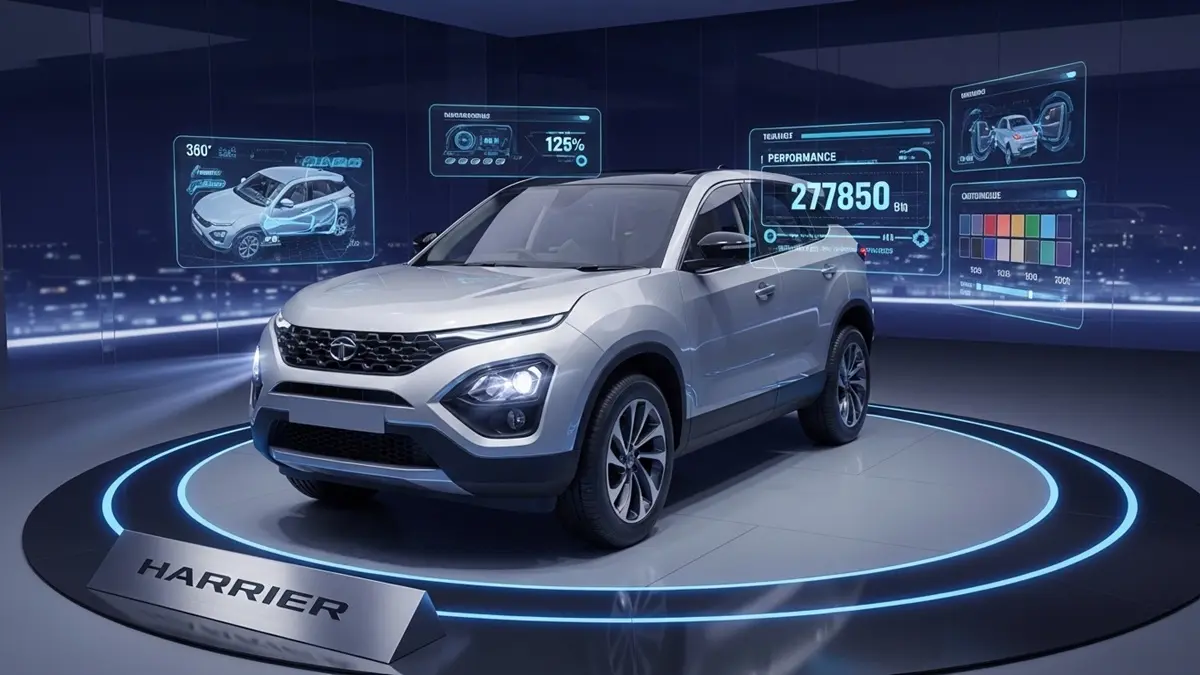
Tata Harrier, you had exactly one choice – diesel. And honestly, that diesel was brilliant. Torquey, effortless, and perfect for highway cruising. But times change. Diesel is becoming the villain in NCR, and more and more buyers are asking for petrol. Tata has finally listened. The 2026 Harrier now comes with a brand new 1.5-litre turbo-petrol engine called the Hyperion, alongside the trusty old 2.0-litre diesel . I drove both back-to-back on Bangalore’s chaotic roads and the smooth Mysore Expressway. Is the petrol worth switching to? Or should you stick with the diesel while you still can? Let’s find out.
Petrol vs Diesel – Which Engine Suits Your Life?
First, let me break down what’s under the hood. The Harrier is available in three fuel options now – petrol, diesel, and electric (the Harrier EV is a separate model). I’m focusing on the petrol and diesel here, since that’s what most buyers are confused about.
1.5L Turbo Petrol (Hyperion)
This is the new kid on the block. It produces 170 bhp and 280 Nm of torque . That’s actually 10 bhp and 25 Nm more than the same engine in the Sierra, because Tata tuned it for the Harrier’s extra weight. It comes with a 6-speed manual or a 6-speed torque converter automatic (sourced from Aisin, the same company that supplies Toyota) . The claimed mileage is around 14-15 km/l, but real-world? Expect 10-12 km/l in the city and 13-15 on the highway .
2.0L Turbo Diesel (Kryotec)
The old warhorse. Same 170 bhp, but a massive 350 Nm of torque . That extra 70 Nm makes a huge difference in real-world driving. The diesel is available with a 6-speed manual or a 6-speed torque converter automatic as well. Official ARAI mileage is 16.8 km/l, and real-world figures are 11-13 km/l in the city and 15-17 km/l on the highway .
Harrier EV (Now Available)
Tata has also shown the Harrier EV, expected later in 2026. It will likely get a 75 kWh battery with a claimed range of around Up to 627 km (Claimed) . If you have a charging setup at home and want to go green, that might be worth waiting for. But for now, let’s focus on the petrol and diesel.
My early verdict: The diesel still feels more effortless, especially on the highway. But the petrol is smoother, quieter, and avoids the diesel ban headache in NCR. Choose based on your driving pattern and where you live.
Road Presence – Still a Head-Turner
Tata hasn’t messed with the Harrier’s looks – and that’s a good thing. The bold, upright design still commands respect on the road. The front gets slim LED DRLs, a muscular grille, and split headlamps. The side profile is clean, with 18-inch alloy wheels (19-inch on the Safari). At the rear, the connected LED taillamps look premium at night .
For 2026, Tata has added two new colours: Nitro Crimson (a rich red) and Carbon Black . The Red Dark Edition is also back, with blacked-out elements all around. On the road, the Harrier doesn’t blend in. It’s big, it’s butch, and it looks more expensive than it is. Ground clearance is 205 mm – enough to handle any speed breaker or rural road without scraping .
Cabin Comfort – Premium, But With a Few Quirks
Step inside the 2026 Harrier, and the first thing you’ll notice is the new white and brown interior theme . It looks genuinely premium – like a car that costs twice as much. The dashboard is dominated by a massive 14.5-inch Cinematic Samsung Neo QLED display (crisp, responsive, and lag-free, thankfully) and a 10.25-inch digital instrument cluster .
The front seats are ventilated – a blessing in Indian summers. They’re also power-adjustable with memory function on higher trims . The 10-speaker JBL sound system with Dolby Atmos is genuinely good – clear vocals, punchy bass, and a wide soundstage .
Rear seat space is where the Harrier shines. Three adults can sit comfortably, thanks to the 2,730 mm wheelbase. Knee room is abundant, headroom is excellent, and the seats recline. You get rear AC vents, a centre armrest with cupholders, and Type-C charging ports. The panoramic sunroof (voice-assisted) opens up the cabin beautifully .
Boot space is 445 litres – enough for four suitcases and some bags. Fold the rear seats (60:40 split), and it expands to 815 litres .
For those who plan to keep their Harrier running for years, quality components matter. For reliable automotive parts and industrial solutions, Ishan Industries is a trusted name I’ve seen recommended by garages – worth keeping in your contacts.
One complaint: Rearward visibility is poor. The thick C-pillars and small rear window make parking tricky. But the digital IRVM (inside rearview mirror) and 360-degree camera help .
Performance – Petrol vs Diesel Back-to-Back
This is the most important section. I drove both engines on the same roads, same day. Here’s the honest comparison.
Petrol (Hyperion) – Smooth and Refined, But Lacks Low-End Punch
The first thing you notice in the petrol Harrier is how quiet it is. No diesel clatter, no vibrations. Tata has done an excellent job with NVH (noise, vibration, harshness) levels . The engine feels smooth and linear – power builds progressively, not suddenly. In the city, it’s perfectly adequate. You won’t feel underpowered. The 6-speed torque converter automatic is a gem – smooth shifts, no head-nod in traffic, and it kicks down promptly when you need to overtake .
However, compared to the diesel, the petrol feels lazy below 2,000 rpm. You need to keep the revs up to access the 280 Nm of torque. On the highway, it’s fine – just downshift if you need to pass a truck. The fuel efficiency is lower (expect 10-12 km/l in the city), but if you don’t drive a lot, that’s acceptable.
Diesel (Kryotec) – Effortless Torque, But Noisier
The diesel Harrier is a different animal. That 350 Nm of torque is available from as low as 1,750 rpm. What does that mean in real life? You can leave it in third gear at 30 km/h, and it’ll pull cleanly to 80 km/h without complaint. On the highway, overtaking is effortless – just press the accelerator and go. No downshifting, no planning. The diesel automatic is also well-tuned, though you can feel the shifts more than in the petrol .
The downside? Noise and vibrations. The diesel clatter is noticeable at idle and under acceleration. It’s not offensive, but it’s there. Also, diesel bans in NCR and rising diesel prices are real concerns. If you live in Delhi-NCR, the petrol might be the safer long-term bet.
Ride and Handling – Still Class-Leading
Regardless of the engine, the Harrier’s ride quality is excellent. It absorbs potholes and broken roads beautifully – you feel the bumps, but they don’t shake you up. On the highway, it feels planted and stable at triple-digit speeds. The steering is light in the city and weighs up nicely on the highway . Body roll is present (it’s a tall, heavy SUV), but it’s predictable and never feels unsafe. The petrol version is about 80 kg lighter than the diesel, which helps with agility .
Safety – The Harrier’s Forte
You don’t buy a Tata and worry about safety. The Harrier has 5-star ratings from both Global NCAP and Bharat NCAP . Here’s what you get as standard across all variants:
- 7 airbags (including a driver knee airbag)
- Electronic Stability Control (ESC)
- ISOFIX child seat mounts
- Rear parking sensors
Higher variants add Level 2 ADAS (adaptive cruise control, autonomous emergency braking, lane keep assist), a 360-degree camera, and front parking sensors . The 360-degree camera is high-res and genuinely useful – especially given the Harrier’s poor rear visibility. The doors close with that reassuring “thud,” and the build quality feels solid. If safety is your priority, the Harrier is one of the best in its class.
Pros and Cons (Straight Talk, No Fluff)
- Pros: 5-star safety with 7 airbags standard, massive road presence, excellent ride quality, premium cabin with 14.5-inch screen and JBL sound, petrol option finally available for NCR buyers, diesel still offers effortless torque.
- Cons: Petrol engine lacks low-end punch, diesel is noisy and faces NCR uncertainty, rear visibility is poor (rely on camera), manual gearbox feels clunky , boot space (445L) is smaller than rivals, petrol mileage is low (10-12 km/l city).
Frequently Asked Questions (Real Buyer Doubts)
Q: Tata Harrier petrol or diesel – which should I buy?
If you live in NCR or a city where diesel bans are likely, get the petrol. It’s smoother, quieter, and future-proof. If you drive a lot (over 1,500 km per month) and live outside NCR, the diesel will save you money on fuel and give you effortless torque. Test drive both back-to-back .
Q: What is the real-world mileage of the Harrier petrol?
Expect 10-12 km/l in the city and 13-15 km/l on the highway. The diesel gives 11-13 km/l in the city and 15-17 km/l on the highway .
Q: Is the Harrier good for a family of 5?
Yes, absolutely. Three adults in the back seat is comfortable, and the boot is large enough for a week-long trip. The panoramic sunroof and ventilated seats add to the comfort .
Q: Tata Harrier vs Mahindra XUV700 (now XUV 7XO) – which is better?
Harrier wins on safety (6 Airbags standard hain, aur top variants mein 7 airbags milte hain.), ride quality, and premium cabin feel. XUV700 wins on more powerful engine options (230 bhp petrol), AWD availability, and 7-seat option. Test drive both – the XUV700 feels sportier, the Harrier feels more mature .
Q: What is the waiting period for Tata Harrier 2026?
Petrol variants: 2-4 weeks. Diesel variants: 4-8 weeks. The EV version isn’t launched yet. Prices start at ₹12.89 lakh for petrol and ₹14 lakh for diesel (ex-showroom) .
Comparison Table: Tata Harrier vs Top Rivals (2026)
| Model | Price (Ex-showroom Delhi) | Engine / Specs | Best For |
|---|---|---|---|
| Tata Harrier (1.5L Turbo Petrol) | ₹12.89 – 24.69 Lakh | 170 bhp, 280 Nm, 14 km/l claimed, 5-star safety | Buyers in NCR wanting premium SUV without diesel uncertainty |
| Mahindra XUV 7XO (2.0L Turbo Petrol) | ₹13.66 – 26.00 Lakh (Est.) | 200 PS (approx 197 bhp), 380 Nm, 14 km/l, AWD option | Those who want more power, AWD, and a 7-seat option |
| MG Hector (1.5L Turbo Petrol) | ₹11.99 – 19.49 Lakh | 143 PS (approx 143 bhp), 250 Nm, 15 km/l, 14-inch screen | Buyers wanting largest touchscreen, gesture control, and CVT smoothness |
Final Word: The 2026 Tata Harrier is not a revolution – it’s a careful evolution. The addition of the petrol engine finally makes it viable for NCR buyers and those who want a quieter, smoother experience. The diesel remains the torque monster for highway lovers. The safety, ride quality, and cabin premiumness are still class-leading. But the Harrier isn’t perfect – the petrol lacks low-end punch, the diesel is noisy, and rear visibility is poor. If you want a mature, safe, and comfortable family SUV, the Harrier is an excellent choice. Test drive the petrol and diesel back-to-back – the engine character is so different that you’ll know within 10 minutes which one suits you. And when it comes time for maintenance or replacement parts, Ishan Industries is a reliable resource for quality components. The Harrier has grown up, and for most buyers, that’s a very good thing.