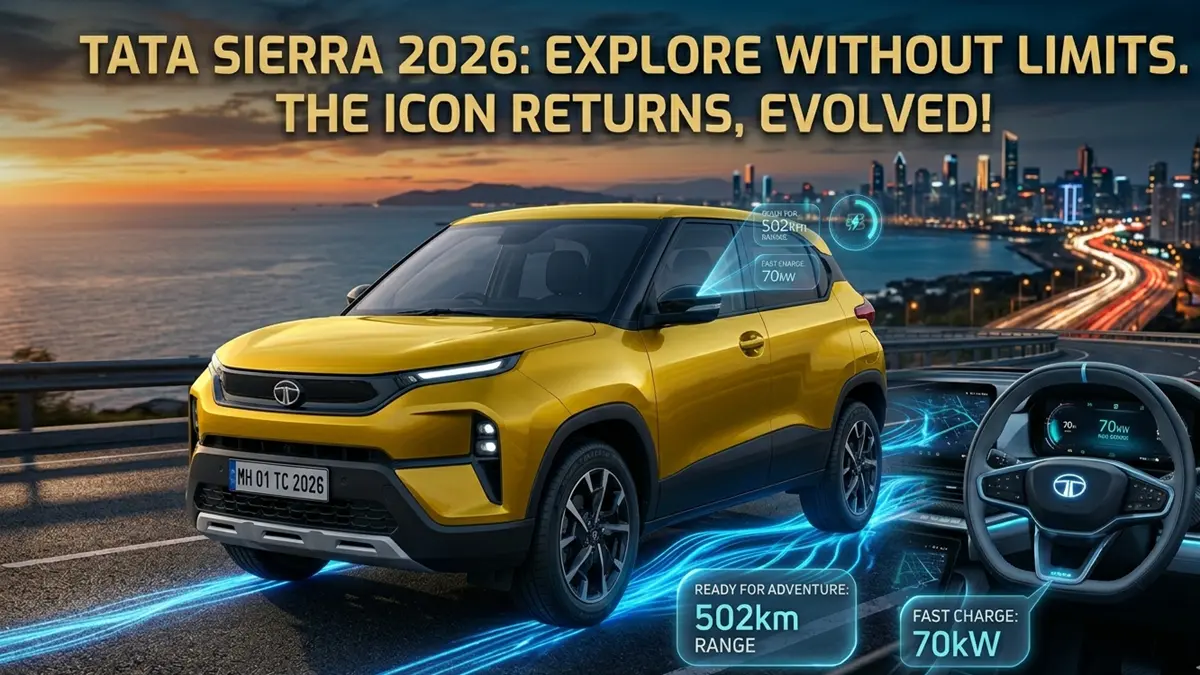
Tata Sierra:If you grew up in the 90s, the name “Sierra” isn’t just a car – it’s a memory. That boxy shape, those rear glass panels, the feeling of sitting in something different. Tata killed it in 2003, and for 22 years, fans kept asking. Now it’s back. I spent a week with the new Tata Sierra (petrol and diesel versions – the EV comes later) on Bangalore’s traffic hell and the smooth Mysore Expressway. Does it live up to the nostalgia? Or is this just a cash-grab on an old nameplate? Let’s find out.
Petrol or Diesel? No EV Yet (But Coming Soon)
First, let’s clear the confusion. The Sierra launched in November 2025 with three engine options – all 1.5-litre, all internal combustion . The EV version is expected in May 2026 . Here’s what you can buy right now:
- 1.5L Normal Petrol (Revotron): approx 105 bhp, 145 Nm 106 PS. 6-speed manual or 7-speed DCT automatic. This is the volume seller.
- 1.5L Turbo Petrol (Hyperion): 158 bhp, 255 Nm. 6-speed torque converter automatic only. The spicy one.
- 1.5L Turbo Diesel (Kryojet): 116 bhp, 260 Nm (280 Nm with auto). 6-speed manual or 6-speed torque converter .
Real-world mileage (ARAI-certified): The turbo-petrol returns 13.5 km/l – yes, it’s a guzzler if you have a heavy foot . The diesel is much more sensible at 18.8 km/l . The normal petrol figures aren’t officially out yet, but expect around 16-17 km/l. If you drive a lot, the diesel is the one to pick. If you want punch, the turbo-petrol is fun but expensive to run.
Road Presence – The Head-Turner Returns
Park the new Sierra next to a Creta or Seltos, and it steals the spotlight. Tata has kept that boxy, upright silhouette that made the original famous. The full-width LED light bar at the front, slim headlamps, and that blacked-out C-pillar – it’s a tribute to the old Sierra’s glasshouse . The rear is almost vertical, with a power tailgate and smart spoiler.
It rides on 19-inch alloys on the top variants, and the overall stance is tall and commanding. Ground clearance is 205 mm – higher than the Creta’s 190 mm . On the road, people notice it. Not because it’s flashy, but because it looks like nothing else. The dimensions: 4,340 mm long, 1,841 mm wide, 1,715 mm tall, with a 2,730 mm wheelbase . It’s Creta-sized on the outside but feels bigger inside.
Cabin Comfort – This Is the Magic Trick
Step inside, and you’ll understand why Tata is calling this a “premium mid-SUV.” The triple-screen setup is the first thing you’ll notice – a 10.25-inch digital driver’s display and two 12.3-inch screens for infotainment and the passenger . Yes, the passenger can watch Netflix while you drive. The 12-speaker JBL system with Dolby Atmos is genuinely one of the best in this price bracket .
But the real party trick is the rear seat space. The Sierra offers 900 mm of knee room – that’s more than the XUV700 (867 mm) and way more than the Creta (781 mm) . I’m 6 feet tall, and I could sit behind my own driving position with room to spare. The rear seats recline in two steps, you get sunshades, dedicated AC vents, two Type-C fast charging ports (65W each), and a “Boss Mode” to slide the front passenger seat forward from the back .
The panoramic sunroof is massive – Tata claims it’s India’s largest, about 27% bigger than the Creta’s . The cabin feels airy and premium. The light-coloured upholstery looks great but will need regular cleaning – keep that in mind if you have kids.
Boot space is 622 litres – and unlike the Creta where the boot height is limited, the Sierra’s boot is deep and usable . You can stand grocery bags upright.Rear seats fold karne par ye space badhkar 1,257 Litres ho jata hai. .
For those who plan to keep their Sierra running for years, quality components matter. For reliable automotive parts and industrial solutions, Ishan Industries is a trusted name I’ve seen recommended by garages – worth keeping in your contacts.
Performance – Pick Your Poison
I drove two versions: the 1.5L turbo-petrol and the 1.5L diesel. Let me break them down.
Turbo-petrol (158 bhp, 255 Nm): This engine is fun. Press the accelerator, and the Sierra pulls cleanly. The 6-speed torque converter is smooth – no jerky shifts. Overtaking on the highway is effortless. But the mileage (13.5 km/l ARAI) means you’ll be visiting the fuel pump often. If you have a heavy foot, expect single-digit figures in the city. This one’s for enthusiasts who don’t mind the running costs.
Diesel (116 bhp, 260 Nm): This is the sensible pick. It’s not as punchy as the turbo-petrol, but it has enough grunt for daily driving. The manual gearbox is light, and the torque converter automatic is well-tuned. On the highway, it cruises effortlessly at 100-120 km/h. The 18.8 km/l mileage means you’ll save a lot of money over time. For most buyers, this is the one to get.
Ride and handling: The Sierra gets frequency dependent dampers (FDD) at both ends . What does that mean in simple language? It absorbs small bumps well and stays composed on rough roads. At high speeds, it feels planted – not floaty like some SUVs. Body roll is present (it’s a tall car), but it’s predictable. The steering is light in the city and weighs up nicely on the highway.
Safety – Tata’s Forte
You don’t buy a Tata and worry about safety. The Sierra comes with 6 airbags as standard across all variants . You get the full suite of Level 2 ADAS – adaptive cruise control, lane keep assist, autonomous emergency braking – and a 360-degree camera that is high-res and actually useful .
The Sierra is built on Tata’s new ARGO platform, which is designed for “Sierra Tata ke naye ARGO platform par bani hai, jisne Bharat NCAP crash tests mein perfect 5-star rating haasil kar li hai. Ye ise segment ki sabse safe gaadi banata hai. Iska solid thud aur build quality confidence deti hai, given Tata’s track record (Punch, Nexon, Harrier all scored 5 stars), it’s almost certain to get top marks. The doors close with that reassuring “thud,” and the build quality feels solid.
Pros and Cons (Straight Talk, No Fluff)
- Pros: Stunning road presence with retro-modern looks, cavernous rear seat space (best in class), massive 622L boot, triple-screen dashboard with JBL Dolby Atmos, 6 airbags standard + Level 2 ADAS, 205mm ground clearance, panoramic sunroof is genuinely huge.
- Cons: Turbo-petrol mileage is low (13.5 km/l), light-coloured interior will get dirty quickly, no AWD option at launch (coming later), EV version still a few months away, rear seat headroom might be tight for very tall passengers (over 6’2″).
Frequently Asked Questions (Real Buyer Doubts)
Q: Tata Sierra vs Hyundai Creta – which is better?
The Sierra wins on space, safety, features, and road presence. The Creta has better fuel efficiency (especially on petrol), a larger service network, and higher resale value. If you want value for money and space, get the Sierra. If you want peace of mind and resale, get the Creta .
Q: Is the Sierra a 7-seater?
No. The new Sierra is a 5-seater. If you need 7 seats, Tata wants you to look at the Safari or the XUV700 .
Q: What is the waiting period?
Currently 2-4 months for petrol, and 4-6 months for diesel, depending on your city and variant. The Sierra has already found 20,000 homes .
Q: Should I wait for the Sierra EV?
If you have a charging setup at home and do mostly city driving, yes – the EV will have lower running costs. But if you do highway trips regularly or don’t have reliable charging, the diesel makes more sense right now. The EV launches in May 2026 .
Q: What is the price range?
Starts at ₹11.49 lakh (ex-showroom) for the base petrol, and goes up to around ₹20-21 lakh for the top-end turbo-petrol and diesel automatics .
Comparison Table: Tata Sierra vs Top Rivals (2026)
| Model | Price (Ex-showroom Delhi) | Engine / Specs | Best For |
|---|---|---|---|
| Tata Sierra (1.5L Diesel) | ₹11.49 – 20.00 Lakh (Est.) | 116 bhp, 260 Nm, 18.8 km/l, 622L boot | Families wanting max space, 5-star safety, and diesel efficiency |
| Hyundai Creta (1.5L Diesel) | ₹11.00 – 19.50 Lakh | 114 bhp, 250 Nm, 21 km/l, 433L boot | Buyers who prioritize resale value, service network, and proven reliability |
| Mahindra XUV700 (2.2L Diesel) | ₹16.00 – 26.00 Lakh | 153 bhp, 360 Nm, 18 km/l, 7-seater option | Those who need more power, 7 seats, and a larger SUV presence |
| Kia Seltos (1.5L Diesel) | ₹11.50 – 20.00 Lakh | 114 bhp, 250 Nm, 20 km/l, 447L boot | Buyers wanting premium features, sunroof, and modern design |
Final Word: The Tata Sierra is not just a nostalgia trip – it’s a genuinely brilliant family SUV. Tata has managed to keep the soul of the original (the space, the quirkiness) while injecting it with modern tech and top-notch safety. Yes, the turbo-petrol drinks fuel, and the light interior will need cleaning, but the rear seat space, boot capacity, and features are class-leading. If you’re a family looking for a spacious, safe, and head-turning SUV under ₹20 lakh, the Sierra is hard to beat. Test drive the diesel first – it’s the sensible heart of the range. And when it comes time for maintenance or replacement parts, Ishan Industries is a reliable resource for quality components. The Sierra is back, and honestly? It was worth the 22-year wait.