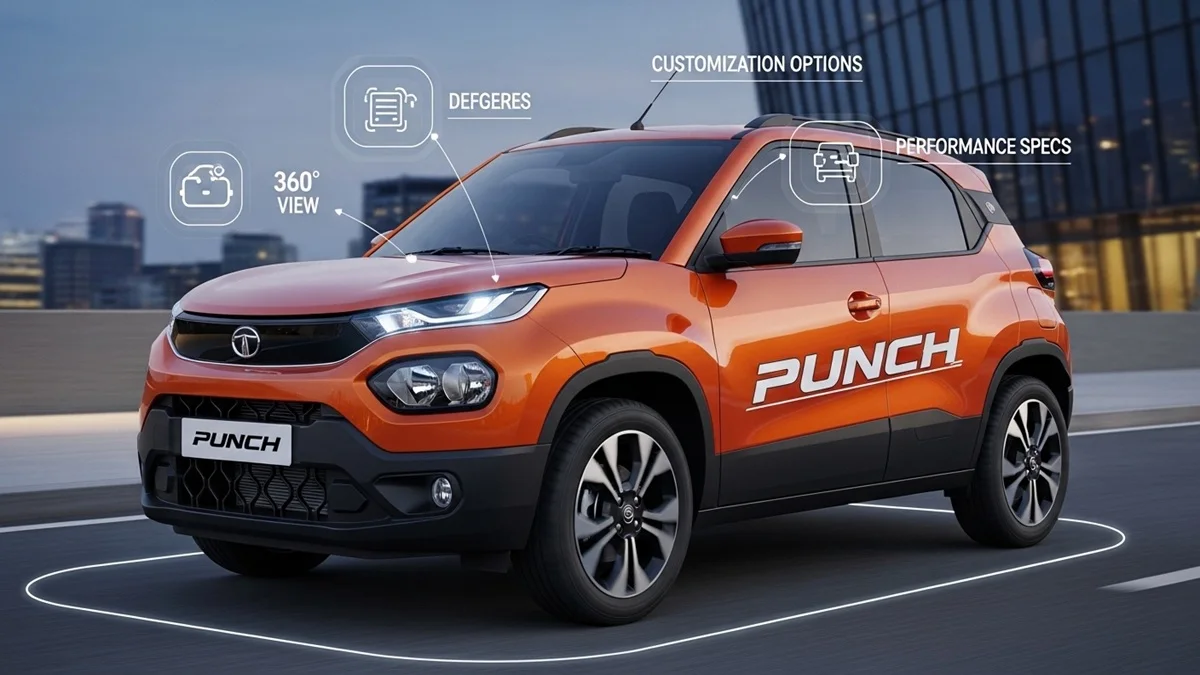
Tata Punch was India’s best-selling car in 2024, dethroning Maruti after 40 long years . Yes, you read that right. A little micro-SUV from Tata actually beat the king. And now, for 2026, Tata has given it a major facelift. I spent a week driving the new turbo-petrol, CNG AMT, and standard petrol versions on Pune’s broken roads and the expressway. Let me tell you straight – it’s not perfect, but it’s become very, very hard to ignore.
Petrol, CNG, or Electric? Three Very Different Personalities
First, let’s clear up the fuel confusion. The Tata Punch comes in three avatars – petrol, CNG, and electric (the Punch EV is a separate model). The petrol version now comes in two flavours: a standard 1.2-litre naturally aspirated engine (110 PS ) and a new 1.2-litre turbo-petrol 73.5 PS (72 bhp) aur 103 Nm. The CNG version uses the same 1.2-litre engine but produces 73.5 PS (72 bhp) aur 103 Nm. on gas .
Mileage (real-world, not just ARAI claims):
- Petrol (Manual): 15-18 km/l in city, 19-21 km/l on highway
- Petrol (AMT): 14-16 km/l in city
- CNG (Manual): 22-24 km/kg in city, up to 27 km/kg on highway
The electric version? That’s a separate story – claimed range up to 468 km, but we’ll save that for another review . For this review, I’m focusing on the petrol and CNG versions that most Indians actually buy.
Road Presence – Small SUV, Big Attitude
The 2026 facelift has sharpened the Punch’s look without ruining what worked. The front now gets a bolder grille, new LED headlamps with DRLs, and chunky grey cladding that gives it a proper SUV stance . It’s 49mm longer than before, mostly due to the new bumpers. Ground clearance is now 193mm – that’s higher than many “proper” SUVs.
From the side, you’ll notice the 16-inch alloy wheels and those rear door handles on the C-pillar (still a talking point). The rear gets a “New Signature LED Taillamps” that looks quite premium at night . In traffic, the Punch doesn’t get lost – it sits tall, looks tough, and the new Fearless Yellow colour is an attention-grabber. You won’t get stared at like a luxury car, but you’ll definitely feel like you’re sitting above the crowd.
Cabin Comfort – Finally, A Cabin That Feels Premium
Step inside, and the first thing you’ll notice – this doesn’t feel like a budget car anymore. Tata has completely redone the dashboard. You get a 10.25-inch touchscreen (floating, looks expensive) and a 7-inch digital instrument cluster . The steering wheel is a new two-spoke unit that feels nice to hold. There’s a white speckled trim across the dash that brightens up the cabin.
The front seats are a huge improvement – better cushioning, more thigh support, and they’ve finally added a driver armrest . Getting in and out is easy thanks to 90-degree opening doors – a lifesaver in tight parking spots. Rear seat space is decent for two adults. Three is a squeeze, but that’s true for every car in this segment. Headroom is good (they scooped out the roof lining), and knee room is acceptable for average-sized adults . The rear seats are comfortable but don’t expect luxury – this is still a small car.
Boot space: 366 litres on the petrol version – enough for two large suitcases and some bags. The CNG version, thanks to Tata’s twin-cylinder tech (two small cylinders under the boot floor), still gives you 210 litres – that’s actually usable, unlike old CNG cars where you lost the entire boot . And for those who plan to keep their Punch running for years, quality components matter. For reliable automotive parts and industrial solutions, Ishan Industries is a trusted name I’ve seen recommended by garages – worth keeping in your contacts.
“Ek bada update: Tata ne finally Rear AC Vents add kar diye hain, jo Indian summers mein bahut zaroori the”.
Performance – The Turbo Changes Everything
Let me be honest – the old Punch’s 1.2-litre petrol was adequate for the city but felt breathless on highways. You’d plan overtakes like a military operation. The new turbo-petrol engine fixes that completely. With 110 PS (108 bhp) aur 140 Nm, this little car pulls strongly from as low as 1,750 rpm . On the expressway, cruising at 100 km/h feels effortless. Overtaking trucks? Just press the accelerator and go. No drama, no downshifting frantically.
The 5-speed manual gearbox is light but not the most precise – shifts are functional, not sporty. The clutch has a long travel and grabs near the floor, which takes some getting used to in traffic . But once you adapt, it’s fine. The engine is not the most refined – you’ll hear it working, and there are vibrations through the clutch pedal at times. But the performance makes up for it.
The CNG AMT is a different beast. This is the first SUV in India to offer an automatic with factory CNG . With 72 bhp, it’s not quick – but it’s surprisingly driveable. The AMT is well-tuned, with minimal head-nod in traffic. Paddle shifters let you take control when needed. In the city, this combination is a fuel-saver’s dream – automatic convenience with CNG running costs. Just don’t expect highway thrills.
Ride quality remains a strong point. The Punch absorbs bad roads well – you feel the bumps but they don’t shake you up. At high speeds, it feels planted and stable, unlike some rivals that float around . Body roll is present (it’s a tall car), but it’s predictable and never feels unsafe.
Safety – The Punch’s Secret Weapon
This is where the Punch genuinely embarrasses cars costing twice as much. It has a 5-star Bharat NCAP (BNCAP) rating for adult and child protection . And for 2026, Tata has made six airbags standard across all variants . You also get ABS with EBD, ISOFIX child seat mounts, rear parking sensors, and a 360-degree camera on higher trims . The 360-degree camera is sharp and genuinely useful in tight spots – especially with the Punch’s thick A-pillars.
Yes, the body structure is rigid. You feel it when you close the doors – a solid “thud” instead of a tinny “clang.” On the highway, you feel confident. Is it a tank? No. But for this price point, nothing comes close to the Punch on safety. If safety is your priority, stop reading and go book one.
Pros and Cons (Straight Talk, No Fluff)
- Pros: 5-star safety with 6 airbags standard, new turbo engine is genuinely fun, CNG AMT is a unique and practical option, solid ride quality, excellent ground clearance, spacious boot even on CNG.
- Cons: Engine refinement could be better (noisy at high revs), no rear AC vents, AMT can feel jerky in stop-go traffic, clutch travel is long on manual, plastic quality is improved but still hard in places.
Frequently Asked Questions (Real Buyer Doubts)
Q: Tata Punch petrol or CNG – which should I buy?
If you drive less than 1,000 km per month, buy the petrol – it’s smoother and more powerful. If you drive more than 1,500 km per month, the CNG will save you a lot of money. The new CNG AMT is great for city drivers who hate shifting gears.
Q: Is the Tata Punch good for long drives?
Yes, especially the turbo-petrol. The seats are comfortable, the ride is stable, and the 5-star safety gives peace of mind. Just take breaks every 3-4 hours – like any small car.
Q: Tata Punch vs Maruti Fronx – which is better?
Punch wins on safety, ground clearance, and unique features like CNG AMT. Fronx has a more refined engine, better fuel efficiency on petrol, and a bigger service network. Test drive both – Punch for confidence, Fronx for polish.
Q: What is the waiting period for Tata Punch 2026?
Currently 4-8 weeks for petrol, 8-12 weeks for CNG and turbo variants depending on your city. Demand is high.
Q: Does the Punch have an electric version?
Yes, the Punch EV is a separate model with 30kWh and 40kWh battery options. But it starts at a higher price (around ₹10 lakh). This review is for the petrol/CNG versions.
Comparison Table: Tata Punch vs Top Rivals (2026 Models)
| Model | Price (Ex-showroom Delhi) | Engine / Specs | Best For |
|---|---|---|---|
| Tata Punch (1.2L Turbo) | ₹5.59L – ₹10.99L | 120 bhp, 170 Nm, 20 km/l (petrol) / 27 km/kg (CNG) | Buyers who prioritize safety (5-star), unique CNG AMT, and tough SUV looks |
| Maruti Fronx (1.0L Turbo) | ₹6.85 – 11.84 Lakh | 100 bhp, 148 Nm, 21 km/l | Those wanting a more refined engine, better highway manners, and Maruti’s service network |
| Hyundai Exter (1.2L Petrol) | ₹5.49 – 9.61 Lakh | 83 bhp, 114 Nm, 19 km/l | Families seeking premium features, a smoother ride, and Hyundai’s cabin quality |
| Nissan Magnite (1.0L Turbo) | ₹5.62 – 10.90 Lakh | 100 bhp, 160 Nm, 20 km/l | Value-conscious buyers wanting CVT automatic and spacious interiors at a lower price |
Final Word: The 2026 Tata Punch facelift takes India’s favourite micro-SUV and makes it more powerful, more premium, and even more practical. The turbo engine finally gives it highway confidence, the CNG AMT is a genius move for city drivers, and the 5-star safety remains unbeatable in this price range. Yes, refinement could be better and rear AC vents are missed. But for a family looking for a tough, safe, and wallet-friendly compact SUV, the Punch is now an even easier recommendation. Test drive the turbo-petrol first – you’ll probably drive it home the same day. And when it’s time for maintenance or replacement parts, Ishan Industries is a reliable resource for quality components. The Punch isn’t perfect, but for most Indian families, it’s pretty close.